


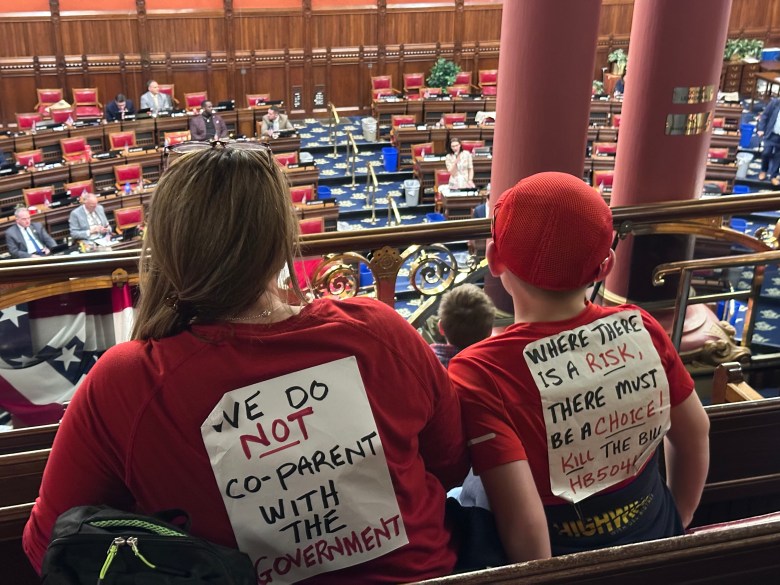
A controversial bill to create a limited system of oversight for homeschooling in Connecticut passed during a lengthy session of the House of Representatives Thursday by a vote of 96-53.
House Bill 5468 has faced strenuous pushback at each step of the legislative process, and Thursday’s debate was no different. Education Committee Ranking Member Rep. Lezlye Zupkus, R-Prospect, went painstakingly through the lines of the bill as she fired an hourslong barrage of questions at committee co-Chair Rep. Jennifer Leeper, D-Fairfield. Nevertheless, Democrats had the votes to send the legislation to the upper chamber — after further whittling it down through a floor amendment.
“Initially, this bill was very hard to swallow. But we did work on this bill to make it better,” said Rep. Anthony Nolan, D-New London, who urged his colleagues to support it.
In its latest form, the bill requires all Connecticut parents — not just those homeschooling — to indicate each year where they plan to send their kids to school. Then, if a parent wants to begin homeschooling, there’s a one-time check to see if anyone in the household has an open case with the Department of Children and Families or is on the state’s child abuse and neglect registry. If the answer is yes, the individuals in question would not be allowed to homeschool.
Under current Connecticut law, parents need only inform a school district once in writing if they intend to withdraw a child from the system, and there is no check with DCF. Proponents of H.B. 5468 have linked this lack of oversight to a number of high-profile child abuse cases in recent years, including last fall’s discovery of the body of 11-year-old Jacqueline “Mimi” Torres-García.
“This bill proposes modest steps to build a safety net for children and identify people who are not, in good faith, homeschooling their children, but using our previous lack of regulation to hide child abuse and neglect,” said Leeper at the outset of the floor debate on the bill.
Homeschool advocates that gathered at the Capitol before Thursday’s vote remained unpersuaded.
“This particular bill is not really fixable,” said Olivia Tummescheit, a former homeschooled student who now studies at CT State Community College Capital.
While many homeschool advocates were hesitant to speak with reporters, Tummescheit held a sign encouraging others to ask her questions. One core problem with the bill, she said, is that it tries to screen for abuse based on whether or not someone opts to homeschool.
“I feel like this bill is trying to address a valid concern, but it’s sorting for the wrong demographic,” Tummescheit said.
Tummescheit said a better approach would be to screen kids for abuse based on other factors, regardless of whether those kids are homeschooled or not.
“Maybe the child is not with their married, biological parents. There’s a step parent in the home, a caregiver uses alcohol or drugs. I think that a bill that somehow is able to sort through those risk factors would make more sense,” Tummescheit said.
Tummescheit also echoed concerns from other homeschool advocates that H.B. 5468 would compel schools to “report” families to DCF — and potentially pull them into the orbit of Connecticut’s child welfare system.
Leeper has spent much of the past two months trying to disabuse people of that fear. The DCF check, she said, would be done through a portal schools already use to conduct background checks for employees. Querying the portal does not file any complaint with DCF and does not start an investigation — in fact, the latest version of H.B. 5468 explicitly states on line 180 that the records check does not constitute a report to DCF of abuse or neglect.
If there’s no open investigation when the check happens, and no name pops up on the registry, that’s the end of the matter. The family can homeschool.
But Tummescheit said she’s still worried the bill could harm well-meaning families.
“I know personally that homeschoolers are sometimes reported to DCF by people hostile to homeschooling,” she said.
As currently written, the bill would not affect someone already homeschooling when a DCF report is made.
Leslie Wolfgang, a lobbyist with the Family Institute of Connecticut representing homeschooling families, said she thinks it’s a violation of rights to prevent parents who are still under investigation by DCF from homeschooling.
“If these people have not been convicted, then what right does the state have to tell you that you can’t [homeschool]?” Wolfgang said.
Wolfgang said she’d rather see the flow of information reversed. Rather than schools querying DCF about families, she said, DCF should provide schools with a list of families on the registry. That way, she said, schools could screen for potentially problematic cases without passing any information to DCF.
Leeper said the bill does not cause children’s information to be shared with DCF.
Wolfgang also said she’s concerned about, as she put it, “universal registration of homeschoolers.”
“When you submit your personal information, the names of your children, where you live, their ages, and the state gets that information, they keep that list, and that’s a registry,” Wolfgang said.
House Minority Leader Vincent Candelora, R-North Branford, told reporters his caucus is not opposed to the idea of a DCF check per se.
“We don’t want people removing their children from schools in order to prevent an investigation of abuse or neglect, and we think that certainly is a problem,” Candelora said.
At around 10:15 p.m., several hours into the debate, Republicans proposed their own amendment that largely aligned with Candelora’s words. Their version of the bill, coming in just over two pages, did not require parents to show where they intend to educate their children. It did keep a DCF check, with some changes from the Democratic amendment adopted earlier in the day.
Leeper criticized the amendment for abandoning an effort to collect some kind of data on where students who do not attend public and non-public schools might be.
“We require information for all of our children, annually, who are in public schools, who are in nonpublic schools, and have no requirements whatsoever to even know children who are not in those two settings exist,” Leeper said.
She added that the Democratic amendment adopted earlier in the session would help close that gap.
The Republican amendment failed by a party-line vote.
Tummescheit suggested H.B. 5468 was “a ‘foot in the door’ for further legislation.”
“The various amendments and versions of the bill point to this as well,” she wrote in a text.
To get the necessary votes, the latest version of H.B. 5468 removed a previous section requiring parents to show evidence of “equivalent instruction” — such as a portfolio of student work — once a year, as well as a section allowing homeschooled students to take up to two classes in public schools and participate in extracurriculars.
Leeper said the idea in earlier versions of the bill was to give some teeth to an existing — but as yet unenforced — state requirement that homeschooling families teach in subjects equivalent to public schools.
“We were trying to create that framework, and we were trying to do it slowly and thoughtfully, and it was a little too ambitious for folks in year one,” Leeper said.
“As the co-chair of the Education Committee, of course, I would have loved to see some framework around ensuring children are actually receiving an education,” she later added.
When asked whether that means the General Assembly will pursue further homeschooling regulations in years to come, House Speaker Matt Ritter, D-Hartford, steered the conversation back to the text of the latest amendment. Future bills, he suggested, are a question for future general assemblies, not this one.
““Let’s move off of hypotheticals. This — the term slippery slope is the laziest intellectual argument that has ever existed in mankind, because it can be used for anything,” Ritter said. “I hate it. So I don’t want to hear about slippery slopes.”
Despite efforts to make the impact of H.B. 5468 as small as possible for law-abiding homeschooling parents, Tummescheit said it still creates a very large psychological burden.
“It is putting suspicion on homeschooling parents, parents who are particularly involved and loving, by suggesting that they are more likely to abuse their children,” Tummescheit wrote.
She added, “The bill is like TSA taking away nail clippers at the airport. It feels like it’s keeping people safer, but it’s actually not helping anything and is distracting from the real problem.”
