A controversial bill to impose Connecticut’s first regulations on homeschooling gained final passage in the Senate after lengthy debate Monday evening. Senators voted, largely along party lines, passing the legislation 22-14 just before midnight.
House Bill 5468 has faced pushback from Republicans at every stage of the legislative process, backed by a large and vocal body of homeschooling families who see the new regulations as an attack on their rights and freedoms. It narrowly cleared the Education Committee and underwent significant revisions on the House floor to win over hesitant Democrats.
The version approved by both chambers imposes two new rules for Connecticut. The first is that all families — not just homeschoolers — must submit a form each year identifying how their children will be educated, be that through public, nonpublic or homeschooling. The second is that anyone removing a child from school to provide education at home may not be under investigation by the state Department of Children and Families or on the state child abuse and neglect registry. Those already homeschooling are grandfathered in.
These rules are designed to close what proponents say are blind spots in the systems Connecticut relies on to protect children from abuse.
At the outset of Senate debate, Education Committee co-Chair Sen. Douglas McCrory, D-Hartford, observed that schoolteachers are required to pass a similar DCF check. He said it only makes sense to apply that same standard when the child’s teacher is their parent.
“It was very important to know that the adults who are responsible for educating these children do not have a history of harming children,” McCrory said.
Many homeschool advocates, however, bristle at the idea of any kind of government involvement and contend the DCF check amounts to an accusation that the homeschool community is rife with abuse. Many feel the state is overreaching its authority, an argument that has found sympathetic ears among Republicans.
“What is at stake in H.B. 5468 is not simply homeschooling, but the meaning of liberty itself,” said Education Committee Ranking Member Sen. Eric Berthel, R-Watertown.
Proponents have stated repeatedly that they believe most homeschooling families do a great job and that the legislation merely brings Connecticut in line with what other states do. Connecticut currently has some of the least restrictive rules around homeschooling in the country.
After the House vote in late April, the bill’s survival hinged on whether the Senate would take it up before the legislature’s rapidly-approaching May 6 deadline.
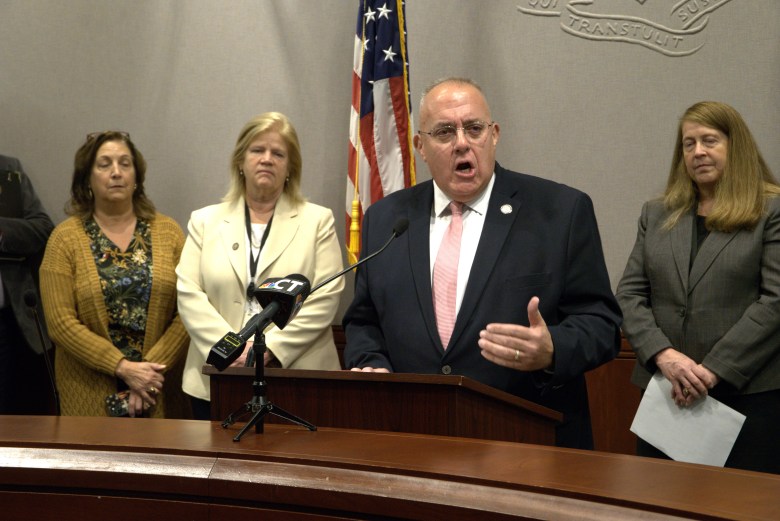
Ironically, it was Senate Republicans who sent a strong public signal the bill would advance when they called a press conference last Thursday to denounce it. Joining them were religious leaders from the Education Association of Christian Homeschoolers in Connecticut and the Family Institute of Connecticut, as well as the national homeschooling legal advocacy group HSLDA.
Berthel said at the event that he believed the bill would be called in the coming days. Speaking to an audience of several homeschooling parents and children, he characterized the legislation as an attempt to “destroy your way of life.”
“It needs to stop. And the way that it stops, ladies and gentlemen, is on Nov. 3. Vote them out. Do not send them back to this building,” Berthel said.
It’s not clear where the broader public stands on the bill — or, indeed, how many people are aware of it — as most testimony and comment has come from members of the homeschooling community.
[RELATED: CT doesn’t regulate homeschooling. Many parents want to keep it that way]
“My experience with this legislation, outside this building and outside this community, is people are shocked to learn this is not already the law in Connecticut,” said Education Committee co-Chair Rep. Jennifer Leeper, D-Fairfield.
Republicans planned to introduce more than three dozen amendments when the bill was finally called in the Senate, though they acknowledged they had little hope of changing the final vote.
Nine Republican amendments were called and debated. All nine failed.
Many Republican senators argued the state would be better served by reforming DCF, which has come under intense criticism — including recently, in a public letter from Acting Child Advocate Christina Ghio that called attention to yet another death of a child who had interacted with the department.
Berthel read the letter on the floor of the Senate Monday.
In that case, the child died in an apparent suicide less than an hour after asking a DCF worker to be placed into foster care during a home visit. Though Ghio’s letter did not say the children in the home were being homeschooled, it specified that they were not enrolled in school. The case was the latest in a series of deaths that have lawmakers concerned about the quality of work at DCF and the lack of homeschooling regulation.
(Separately, the Senate gave final passage to a bill on Monday intended to create new oversight for DCF and otherwise support the agency’s workers and the families they serve.)
Berthel suggested that the new homeschool regulations in H.B. 5468 would violate the U.S. Constitution, echoing a similar argument made by HSLDA attorney Ralph Rodriguez during last week’s press conference. Berthel quoted the U.S. Supreme Court case Pierce v. Society of Sisters, in which the court stated “the child is not the mere creature of the state.”
“That line marks a boundary,” Berthel said. “Parents do not exercise their role at the pleasure of a regulatory scheme like the one before us tonight.”
Berthel also questioned the wisdom of using the child abuse and neglect registry as the standard for determining whether parents can homeschool. The standard of evidence, he said, is low, and the decision is not judicial, but administrative. In other words, there’s no court process — the agency makes an internal decision to put someone on the list. (That person can appeal, first to the agency, and then to a court.)
The bill does stipulate that if a parent’s attempt to withdraw a child for homeschooling is denied, the local school district must provide information on how to challenge the findings of the DCF check.
As the debate came to a close, just before midnight Monday, Senate President Pro Tem Martin M. Looney, D-New Haven, suggested that the Republican concerns had thoroughly mischaracterized the legislation.
“It seems that opponents of this bill are engaging in an ideological debate over issues and concerns that are not reflected in this bill at all,” Looney said.
“This is a very minimal degree of regulation,” he said of the two rules the bill would introduce. “Our state lags behind most other states in protection of children and making sure that children who are removed from the public school setting are protected.”
He compared the scope of the regulations to those around driving under the influence.
“Because we have laws against drunk driving and laws against reckless driving does not mean that we are looking to infringe upon the rights of reasonable and responsible drivers,” Looney said.
The bill heads next to Gov. Ned Lamont for his signature.