


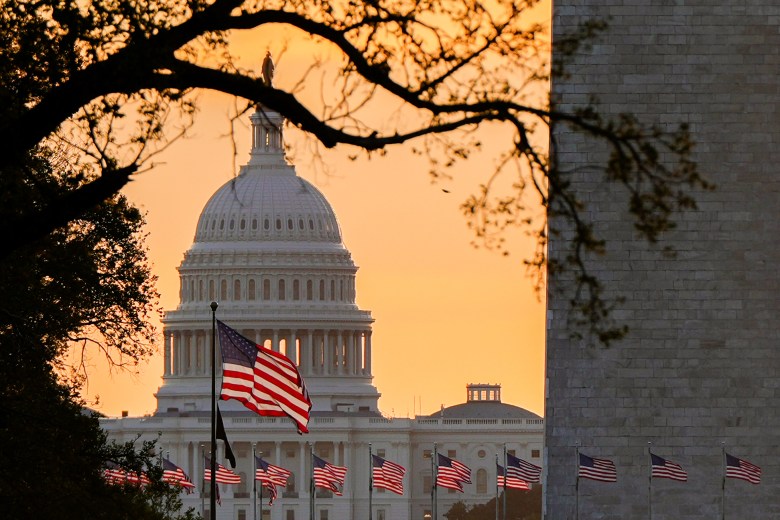
After a dramatic few weeks of scrapped votes and tough negotiations, the U.S. House voted Wednesday to extend a controversial surveillance law that most Connecticut lawmakers opposed.
When it last came up for a vote in 2024, all five members of Connecticut’s House delegation and one of the state’s two U.S. senators supported a renewal of Section 702 of the Foreign Intelligence Surveillance Act, commonly referred to as FISA.
That changed two years later, largely because President Donald Trump is now in power. Of the five Democratic House members, only U.S. Rep. Jim Himes supported it.
After Republicans worked through a contentious hours-long procedural vote earlier in the day, the House ushered through a three-year extension of a tool that allows the U.S. to monitor foreigners outside of the country without obtaining a warrant, largely used to help counterterrorism efforts. The Foreign Intelligence Accountability Act included some modest reforms to the 702 program and also attached an unrelated bill that prohibits the creation of a central bank digital currency.
FISA’s 702 program has consistently been a challenge for Congress since it was first enacted in 2008. And it’s one of the few issues that seemingly unites the left and right flanks of both parties over concerns about privacy rights and the Fourth Amendment that have been even more heightened for Democrats during the Trump administration.
The weeks-long saga of trying to extend the program reignited calls for reforms. Supporters, meanwhile, say it’s a key tool in combatting terrorist attacks and cyberattacks, arguing that allowing the authority to lapse after Thursday would have major national security risks.
The other four members of Connecticut’s House delegation — U.S. Reps. John Larson, Joe Courtney, Rosa DeLauro and Jahana Hayes — all voted against FISA’s 702 program.
Hayes said she’d oppose it because of the absence of a provision that would require warrants for viewing Americans’ information that was incidentally collected under Section 702. That was a shift from 2024, when she and the other four members of Connecticut’s House delegation all voted against such a requirement. That provision failed in a tied 212-212 vote two years ago when Section 702 was last reauthorized.
Himes was one of 42 House Democrats to support the bill; the vast majority were opposed. As the ranking member of the House Intelligence Committee, he’s been a vocal proponent of Section 702, which he says provides much of the information used in presidential intelligence briefings. He acknowledged that renewal would be a much tougher sell for his party because of the lack of trust with the Trump administration.
He predicted earlier in the day that if the procedural rules vote passed, FISA 702 would clear the House with “dozens of votes.”
Himes was tapped by Democratic leaders as one of the point people to help the party navigate the issue. He worked with U.S. Rep. Jamie Raskin, the ranking member of the House Judiciary Committee, for weeks trying to craft a compromise package of 702 reforms. Raskin wants to go further on changes to the surveillance tool than Himes.
But while the two Democrats have been talking on their own, Himes and Raskin were left out of negotiations as Republican leadership muscled through intra-party tensions and sought to pass a procedural vote on their own without help from Democrats.
“I’m on the record saying that there is no circumstance under which we can risk this authority expiring. If 702 goes away, there will be terrorist attacks that could have been prevented, Chinese and Russian spies will celebrate that day, and of course we’ll go dark on the cartels,” Himes told reporters Monday.
“My preference would have been that Jamie [Raskin] and I could have finished the negotiations to get a really solid package of safeguards, but what the Republicans have offered up is not that, but it’s better than the status quo,” he added.
Himes bemoaned the process pushed by Republicans, but he has been a persistent advocate in ensuring the program doesn’t lapse beyond Thursday’s midnight deadline. That has also opened him up to criticism at home.
As FISA talks started to pick up last month, he faced protests in his southwestern district at an event in Westport. And local groups wrote a letter asking Himes and the delegation to push for reforms related to data collection. They want to close what they call the “data broker loophole,” referring to the collection of commercial information by third-party data brokers that private entities and the government can purchase.
About half of those same grassroots groups in Connecticut penned another letter specifically to Himes, calling on him to step down from his role as the top Democrat on the House Intelligence Committee for “failing to conduct serious oversight of this administration’s Fourth Amendment violations.”
Himes has been resistant to the warrant requirements sought by reformers because of wanting to protect defensive queries, which warn an American citizen or resident about a potential threat to them. He has also vehemently pushed back against the existence of a data broker loophole directly related to FISA 702, arguing there are “misconceptions” about the intelligence program.
Earlier this month at a House Rules Committee hearing, he proposed an amendment that would require the FBI to obtain a court order before accessing “the results of queries involving U.S. persons, political organizations, or non-profit organizations,” with a number of exceptions so the FBI could address “significant, time-sensitive national security threats.” The amendment failed and wasn’t added to the legislation.
Critics of Section 702 wanted Himes and Congress to go much farther on reforms.
Even with the bill’s passage, major hurdles remain as it moves to the Senate a day before the program expires. On top of that, Congress is due to head out for a week-long recess.
Senate Majority Leader John Thune, R-S.D., told reporters earlier on Wednesday that the current House version could be “dead on arrival” in the upper chamber because of the digital currency provision.
The Senate considered taking up its own version — a clean extension of three years — that would send it over to the House. But that gives the two chambers little time to resolve differences before the Thursday deadline.
U.S. Sen. Chris Murphy, D-Conn., was the only member of Conencticut’s delegation to oppose Section 702’s renewal in 2024. He said he’ll once again vote against it.
“I’m not going to support it without reforms,” Murphy said. “I understand the need to get it done, but my position has been pretty clear.”
After backing it last time, U.S. Sen. Richard Blumenthal, D-Conn., said he can’t support a clean extension and similarly wants to see reforms like a warrant requirement.
“I don’t trust this administration with unrestrained powers,” Blumenthal said. “I’m certainly much more wary of giving this administration those kinds of powers given its use of existing powers in such a broad and unrestrained way that it intrudes on people’s privacy.”
What is looking like the most likely option is that the Senate takes up another short-term extension to give negotiations more time.
That could potentially open the door for Himes and Raskin — if Republicans engage in negotiations outside of their own party.
If Democrats got involved, they could try to pass it on suspension. That would avoid the need for another tight procedural rules vote like on Wednesday. But instead of needing the usual simple majority to pass a bill, lawmakers would need to clear a two-thirds threshold. That would require many more Democrats to get on board.
Interest from Republicans hasn’t materialized yet, according to Himes. But that could change if the negotiations continue to drag on for weeks.
“Jamie and I, we would be delighted to share our ideas with the Republicans. But the phone hasn’t rung,” Himes said in an interview before Wednesday’s final vote. “The door’s been open all along for a deal that I think gets you into suspension vote territory. But they have never been interested in taking the deal.”
The Connecticut Mirror/Connecticut Public Radio federal policy reporter position is made possible, in part, by funding from the Robert and Margaret Patricelli Family Foundation.
