


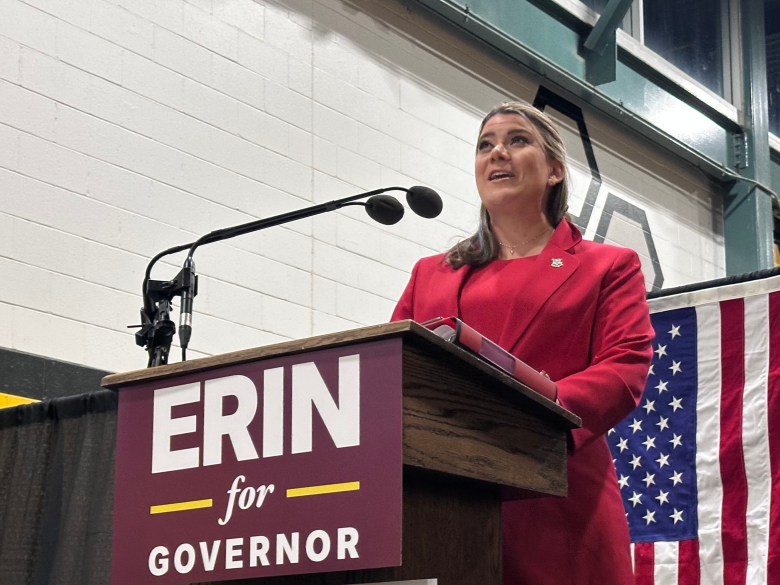
Erin Stewart sought a “deferred partial retirement pension” as her final term as mayor of New Britain wound down last fall and she readied a campaign for the Republican gubernatorial nomination. It is a benefit that doesn’t exist in the city’s charter.
The charter states that any elected official who has served for 20 years, either continuously or cumulatively, shall be entitled to “an annual pension for life of one half of the compensation attached to the office.” It has no provision for a prorated pension for an official who serves less than 20 years.
“Based on my 14 years of service, I calculate my eligibility for a deferred partial pension benefit of approximately 35% of my annual salary, payable upon reaching the eligible age of 55,” Stewart wrote to her human resources director, Linda Guard, on Oct. 31.
It was a Friday, 11 days before the end of her term as mayor. There is no record of anyone questioning the lack of a legal basis for Stewart’s request in the charter. She got a quick reply to her letter, which she had signed as “Erin E. Stewart, Outgoing Mayor, City of New Britain.”
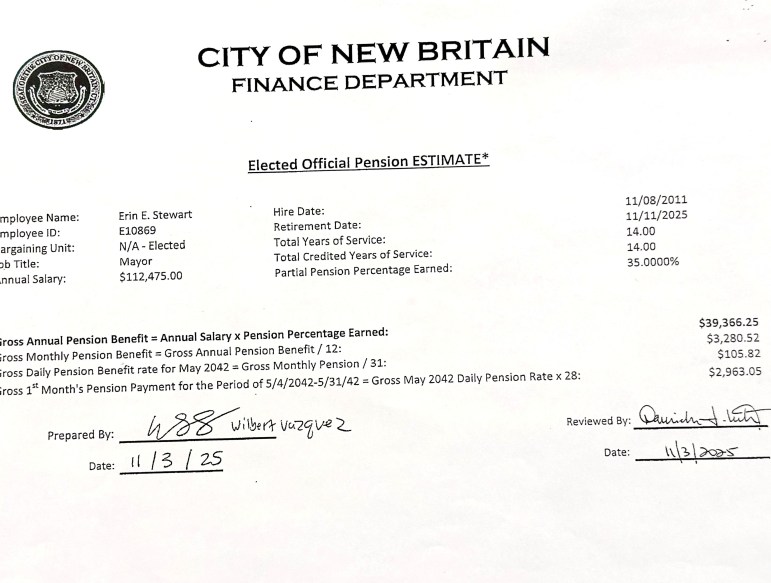
The city’s benefits administrator, Wilbert Vazquez, replied three days later, on Monday. He credited Stewart with 14 years of service — two on the school board, 12 as mayor — and calculated a partial pension equal to 35% of her $112,475 salary as mayor.
Beginning on May 4, 2042, Stewart would be eligible for a gross annual pension benefit of $39,366, according to a document signed by Vazquez and labeled “Elected Official Pension ESTIMATE*.”
In an interview Wednesday, Stewart offered no rationale for seeking a benefit that does not exist in the charter, other than, “Why wouldn’t I?”
“Why wouldn’t I make the ask? I didn’t ask for the full thing. I didn’t ask for the full 20-year benefit,” Stewart said.
But what led her to believe that this even was possible, given that the charter does not make any mention of prorated or partial pensions?
“Again, I think that it would be foolish for me, after 14 years of service, to not make the inquiry and see that if I was entitled to the benefit,” Stewart said.
Stewart said she did not see the request for a pension benefit that was not in the charter as problematic to her campaign.
“No, I don’t think this is bad optics at all,” Stewart said. “I think I would be foolish not to ask. I think that after so many years of service to not make the ask, I would be doing myself a disservice.”
There is an untested precedent for a partial pension, one that Stewart herself helped establish: On June 24, 2024, Stewart signed a memorandum of understanding with Cheryl Blogoslawski that promised her a deferred partial pension after serving 16 years as the elected tax collector — a post eliminated by a charter revision in 2023.
Stewart said she signed the MOU on the advice of counsel, a hedge against Blogoslawski suing for damages after the elimination of the elected position of tax collector. It promised Blogoslawski a pension equal to 40% of the $79,666 she made as tax collector.
“This was a whole different animal here,” Stewart said. “Cheryl’s job was eliminated by the charter, and she had a legal argument to make the case for the entire pension, because her job was was eliminated, and that would have been payable immediately.”
The charter has no minimum age for an elected official to collect a pension. In fact, Stewart was uncertain about the origin of the belief she would eligible to collect a pension at 55. Stewart is 38.
Blogoslawski stayed with the city after her final term as the elected tax collector expired and continued to oversee tax collections in the new civil-service position of revenue collector. She agreed not to collect the pension while still employed by the city.
The documents detailing Stewart’s request and the MOU with Blogoslawski were obtained Wednesday in response to a public records request. Blogoslawski did not respond to a voicemail requesting comment.
Stewart’s successor, Mayor Bobby Sanchez, a Democrat, suspended Blogoslawski in February amid allegations of improprieties, including the careless handling of cash and the backdating of tax payments to avoid interest penalties.
Sanchez fired her in April and released an interim report by a law firm he hired to investigate Blogoslawski’s management.
Once fired, Blogoslawski filed a request to begin collecting her pension, igniting an effort by the Sanchez administration to determine whether the MOU signed by Stewart is binding. The inclination is not to pay, according to Alisha Rayner, the city’s director of operations and communications.
“Section 15-9 of the Charter is clear: only upon completion of 20 years of service would an elected official be eligible for a pension benefit,” Rayner said, responding by email to questions posed by Connecticut Mirror. “Ms. Blogoslawski did not meet that threshold. The City will take any steps necessary to protect taxpayer funds and preserve the public trust.”
Rayner said there is no record of a retired elected official getting a partial pension, such as the one promised to Blogoslawski and requested by Stewart. “If that occurred, it would be in violation of the Charter,” she said.
The Blogoslawski MOU and Stewart’s request have been referred to the investigators examining the tax office.
“I have been clear from day one: there cannot be one set of rules for the well-connected and another for everyone else,” Sanchez said in a statement. “The City Charter exists to protect taxpayers and ensure fairness, and any attempt to act outside that process raises serious concerns that deserve full and independent review. That is why these matters have been referred to the independent investigators.”
The firing of Blogoslawski was announced and the investigative report released at midday on April 15 as Stewart was introducing Rep. Tim Ackert, R-Coventry, as her choice of running mate. Stewart called it a dirty political trick by a Democratic mayor trying to weaken the GOP’s strongest candidate.
[Investigative report overshadows unveiling of Stewart-Ackert ticket]
The same week, Stewart claimed in a television interview she had rejected bribe attempts never reported to authorities.
She quickly walked back the claim, telling the Connecticut Mirror she never intended to suggest she was the target of serious efforts to offer her bribes to resolve overdue taxes but rather the recipient of pleas from unsophisticated constituents to accept partial payments, including cash.
[Erin Stewart, GOP candidate for governor, walks back bribery claim]
Stewart is competing for the GOP nominaton with Sen. Ryan Fazio of Greenwich and Betsy McCaughey, a Newsmax cable host and former lieutenant governor of New York. The nominating convention is May 16; the primary is Aug. 11.
The report by the Crumbie Law Group stated Bogoslawski had regularly backdated tax payments to spare herself and others from interest penalties and that she claimed acting with the knowledge of Stewart’s office.
Stewart denied knowing anything about the backdating, but she was aware of disciplinary measures taken against Blogoslawski by officials in her administration over the lax handling of cash and her management of staff. Blogoslawski’s personnel file showed a series of efforts to counsel her throughout 2024 and into 2025 by a former finance director, Jonathan Perugini.
Stewart was copied on Perugini’s memos to Bogoslawski.
“I am having serious concerns on whether or not you can lead and manage this office,” Perugini wrote in February 2025. “The City has gone through numerous reiterations and office re-organizations but the problems have continued to persist. I need you to pull the bull by the horns, manage the office and reestablish order in the Revenue Collection Office.”
She remained in her position until after Sanchez took office.
