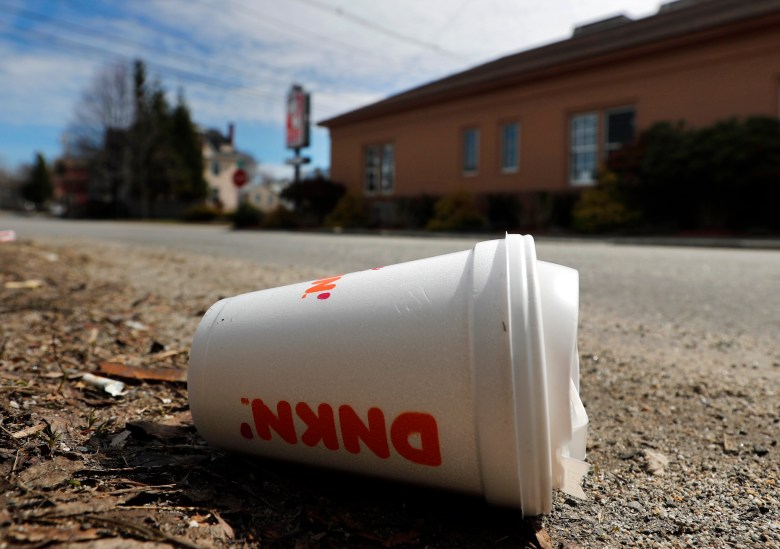
An effort to ban the use of polystyrene takeout containers across Connecticut has, once again, ended up in the legislative trash bin.
Earlier this week, House Democrats announced that they would not move forward with legislation, House Bill 5524, that would have implemented a ban on food service products containing polystyrene — better known by the brand name Styrofoam — by July 1, 2028.
Instead, lawmakers pulled several less-controversial sections from that bill and rolled them into an unrelated measure making minor changes to Connecticut’s environmental laws. That bill was expected to be taken up and voted on by the House Thursday.
State Rep. Aundre Bumgardner, D-Groton, said the decision was made to drop the polystyrene ban after it faced heavy opposition from manufacturers, which he said made it more likely that Republicans would spend a large amount of time debating the bill.
“In a short session, time is of the essence and you only have a limited amount of time to debate big changes to state law,” Bumgardner said. “I would say this is a signifigant change, albeit a positive one.”
The reworked bill, H.B. 5153, still includes other provisions aimed at reducing the use of single-use plastics, including a section modeled after New Jersey’s “Skip the Stuff” law requiring restaurants to only provide disposable utensils and condiment packets upon request from a customer.
It also would require establishments such as supermarkets and conference centers that currently separate their food waste to be composted to prioritize donating any leftover, edible food.
“It’s a step in the right direction,” said Julianna Larue, an organizer with the Sierra Club. “I think food donation is the most important piece of the bill, and I think skip-the-stuff is moving us towards, hopefully, a ban in the future on polystyrene.”
Efforts to ban polystyrene takeout containers in Connecticut date back years and have often faced heavy pushback from the state’s restaurant industry.
But Bumgardner and other advocates said that opposition lessened in recent years as more and more businesses adopt environmentally-friendly alternatives to polystyrene, such as paper and plant-based containers.
Bumgardner noted that his hometown of Groton — home to some of the state’s most acclaimed restaurants — banned polystyrene and single-use plastics in 2020.
Manufacturers of polystyrene and their industry trade groups, however, have argued that bans are counterintuive and can push consumers toward products that come with their own environmental harms, such as increased energy use and greenhouse gas emissions in the manufacturing process.
And while polystyrene is not commonly recycled in Connecticut, manufacturers say the technologies are available to reuse foam container material for other products.
“All foodservice packaging materials have environmental footprints, and substituting one material for another does not necessarily reduce environmental impacts,” Margaret Gorman, a lobbyist with the American Chemistry Council, wrote in testimony to lawmakers earlier this year.
Scott Dolch, the president of the Connecticut Restaurant Association, also submitted testimony to lawmakers earlier in opposition to a proposed ban. Ahead of Thursday’s vote, however, he said he’d had productive conversations with Bumgardner and other lawmakers about the industry’s lingering concerns, which he said include costs and “equal treatment” with other sources of polystyrene, such as disposable coolers and prepackaged food containers.
“I think we are close on some of these issues,” Dolch said Wednesday. “If we can find a compromise that a lot of our restaurants are already doing, I’ll stand up with you, and let’s eliminate some of this waste.”