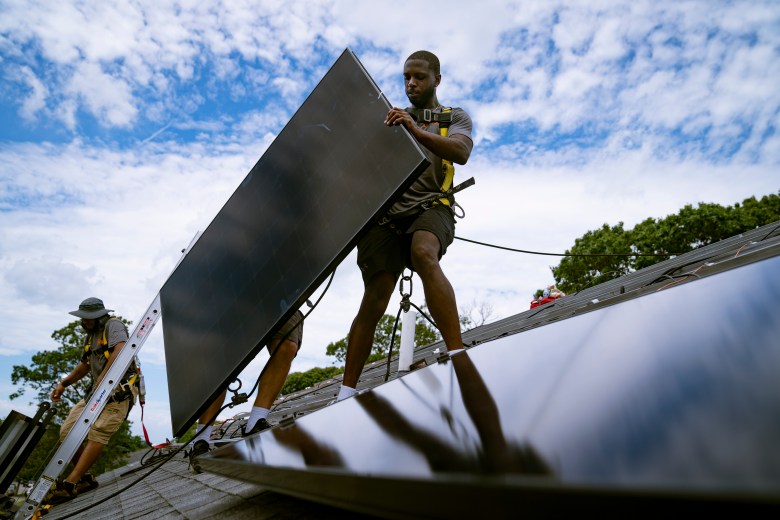
House lawmakers passed an extension of Connecticut’s solar incentive programs on Friday over the objections of Republicans who argued that the proliferation of rooftop solar has become a costly burden on the rest of the state’s electric customers.
The legislation, House Bill 5340, reauthorizes the state’s existing residential, commercial and community solar programs through 2035. Without an extension, those programs will expire at the end of next year.
The bill includes other provisions clearing the way for the adoption of plug-in solar panels, expediting permitting and imposing a one-year moratorium on the permitting of large solar arrays in the town of East Windsor, which is home to the largest array in Connecticut.
The bill went through numerous revisions over the last week as its sponsors negotiated with representatives of the solar industry and environmental advocates over ways to contain costs for the programs while still maintaining a viable market for solar in the state.
In the end, H.B. 5340 imposes a budget target of $85 million a year for all three programs, which the bill’s authors said represented a nearly 10% saving over the programs’ historic costs. Advocates said they would accept those constraints to ensure the programs’ continuation.
“If they don’t pass a solar bill this session to extend the programs, it would be an epic failure on the part of a legislature,” said Lori Brown, the executive director of the Connecticut League of Conservation Voters.
But Republicans — who have made rising energy costs and opposition to the public benefits charge a centerpiece of their election pitch — promised to make the process painful for Democrats by eating up time debating the bill in both chambers.
Their ranks include state Sen. Ryan Fazio, R-Greenwich, who serves as a ranking member of the Energy and Technology Committee and is seeking the GOP nomination for governor. During a press conference on Thursday, Fazio disputed Democrats’ promises of savings, saying the bill would lock customers into paying for the energy produced by the new rooftop installations that are developed by utilizing the state’s solar incentives.
The contracts to purchase that excess solar power can run up to 20 years and are recovered through the public benefits charge.
“This is an unconscionable policy. It’s extraordinarily expensive,” Fazio said. “It will result in billions of dollars in new costs on the backs of consumers into the future. It’s doubling down on all the failed policies of the past that made Connecticut the second-highest cost electricity state in the entire country.”
Democrats initially planned to run the bill in the House on Thursday evening, however it was pushed off by a day due to series of lengthy debates on other bills. House Majority Leader Jason Rojas, D-East Hartford, identified H.B. 5340 as one of a handful of Democratic priorities that lawmakers planned to push through before this year’s session adjourns at midnight on Wednesday.
The House began its debate on the bill around 5:30 p.m. on Friday and quickly hit a roadblock as Republicans, led by state Rep. Tracy Marra, R-Darien, objected to the lack of a ratepayer impact statement, as is required by state law. That sent staffers scrambling to produce the necessary statement, which said that the “intent” of bill is to reduce rates. Exactly how much savings are to be had, however, depends on the how the electric utilities Eversource and United Illuminating choose to implement the programs, according to the analysis.
Marra said those calculations were implausible given the historic costs of the state’s solar programs. But after several additional hours of questioning, the House voted 99 to 43 in favor of the bill. Its next stop is in the Senate, where Fazio said he planned to lead the debate.
“I don’t know that we’ll be able to block it,” Fazio said. “But we’ll give it the old college try.”
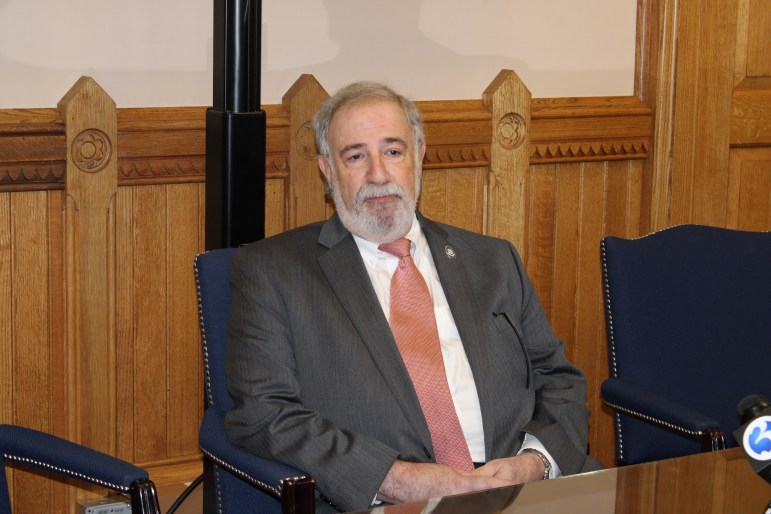
State Rep. Jonathan Steinberg, D-Westport, the bill’s primary author and chairman of the Energy and Technology Committee, accused Republicans of distorting the narrative around the state’s solar programs by focusing on their cumulative costs over decades, rather than the annual costs that the legislation seeks to constrain.
The combined cost of the state’s solar incentives, he added, amounts to less than a penny per kilowatt hour of electricity on a customers’ bill.
“It’s sort of like refinancing your mortgage and being focused on how much you’re going to pay in principal and interest, rather than how much you pay a month, which is the thing you care about,” Steinberg said.
Solar developers also argue that lawmakers and state officials have placed too great an emphasis on the tangible costs of the state’s solar programs without adequately researching the indirect benefits of solar that come about from reduced strain on the electric grid and lower supply costs. They support language in the bill directing the Public Utilities Regulatory Authority to make an effort to calculate those costs and incorporate them into the into future incentives.
The bill also exempts solar installations that are paired with battery storage from the new budget targets, which advocates say will help reduce periods of peak energy demand.
“If we’re making decisions just based on costs, we’re making lousy decisions,” said Mike Trahan, the executive director of the Connecticut Solar and Storage Association. “We need to consider both sides of the coin.”
Other pieces of the bill were less controversial, including a section that would allow residents to utilize plug-in solar panels of up to 1,200 watts without the approval of their local utility.
While the panels have become broadly popular in countries such as Germany, they have faced regulatory hurdles in the U.S. In the last year, Utah, Virginia and Maine have each passed laws aimed at easing their adoption.
Even without the need for utility approval, however, Steinberg and other advocates cautioned that it could be months or even years before plug-in panels become widely — and legally — available. The bill requires that any plug-in solar panels get approval from a product safety organization such as Underwriters Laboratories, as well as the state’s building and fire codes.
“The more things we add into this, for safety, actually make the cost higher and make it less of a populist option,” Steinberg said. “So we’re trying to strike that balance. I think the key takeaway is nothing really is going to happen until UL has a standard that we can all adhere to.”
The bill would also authorize a study of “agri-volatic” solar projects located on active farmland, as well as a proposal championed by Gov. Ned Lamont to create an statewide online platform to streamline residential solar permitting.
“That’s been under-the-radar a little bit, but it can go a long way to reducing the costs of solar,” Christopher Phelps, the state director of Environment Connecticut, said of the permitting language.
The bill also imposes a one-year moratorium on the approval of new grid-scale solar arrays in parts of the Connecticut River Valley where residents and officials have grown alarmed over the proliferation of solar arrays on farmland and open space.
The provision was originally tailored to include only the town of East Windsor, which is home to the 120-megawatt Gravel Pit Solar project, the largest solar array in the state. In March, the Connecticut Siting Council approved a 30-megawatt expansion of Gravel Pit Solar, over the objections of local officials.
One of the final tweaks to the bill on Friday expanded the provision to apply to neighboring Enfield, in order to draw support from state Rep. Carol Hall, R-Enfield.
The moratorium would not apply retroactively to the expansion project, but it would effectively block Gravel Pit’s owners, DESRI Holdings, from pursuing a second project, Saltbox Solar.
East Windsor First Selectman Jason Bowsza said Thursday that he’d be pushing lawmakers to make significant reforms to the process of siting large solar facilities but that he was thankful to have a pause for his town.
“I’m not going to let the perfect be the enemy of the good,” Bowsza said. “I’m grateful that we are hopefully going to see some relief this year, and as we look into the 2027 legislative session, prior to that moratorium being lifted, I’m hoping that there can be some truly meaningful policy changes that will make the whole process more equitable across the state.”
A spokesperson for DESRI declined to comment on the legislation.