


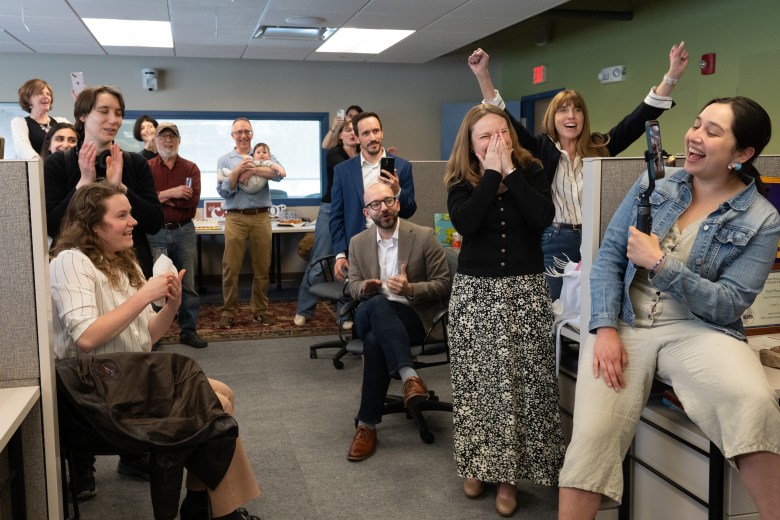
The Connecticut Mirror and ProPublica won the 2026 Pulitzer Prize in local reporting Monday for “On the Hook,” an exposé of the lax standards and predatory practices that allowed the towing industry to victimize people who live paycheck to paycheck.
The work by two CT Mirror reporters, Dave Altimari and Ginny Monk, led to an overhaul of laws that had allowed towing companies to sell cars as soon as 15 days after they were towed, a tighter window than in every state but two.
The Pulitzer is the first won by CT Mirror, a nonprofit news site launched in 2010 with a focus on covering public policy, politics and state government. It was among the early nonprofit digital news sites, a media segment that has grown rapidly in recent years to more than 500.
“This Pulitzer Prize is an extraordinary honor for our newsroom and a deeply meaningful recognition of the values that guide our work,” said Elizabeth Hamilton, the executive editor of CT Mirror for nine of its 16 years. “At its best, investigative journalism shines light into places where harm has long gone unseen and gives voice to people too often ignored.”
“On the Hook” was produced in partnership with ProPublica through its Local Reporting Network. The Pulitzer is the ninth for ProPublica, a news site founded in 2008 to produce its own investigative stories and work in partnership with other organizations. The Chicago Tribune was also awarded a Pulitzer Prize for local reporting this year.
“Our reporting revealed the human cost of an industry operating with little government scrutiny and too little accountability, and it resulted in much-needed changes to the law that will benefit residents of this state for years to come,” Hamilton said. “We are deeply grateful to our partners at ProPublica and proud of the journalists whose persistence, rigor and compassion made this work possible.”
The story originated from a tip to Altimari, a long-time investigative reporter in Connecticut, from a source in the Department of Motor Vehicles and Monk’s coverage of housing and poverty issues, her beat since arriving in Connecticut in 2021. She had been hearing from renters about towing companies taking cars from their apartment complexes, sometimes over minor infractions like an expired parking sticker.
The Connecticut Mirror and ProPublica reviewed thousands of the forms that towing companies submitted requesting the Department of Motor Vehicles’ authorization to sell cars that rapidly accumulated storage fees that owners could not afford. The DMV initially asked CT Mirror to pay $47,000 for the records, dropping the cost after a CT Mirror attorney intervened.
The initial story was published Jan. 5, 2025, more than two years after the reporters began seeking records and conducting interviews. Haru Coyne and Sophie Chou, reporters at ProPublica, provided key data analysis. A follow-up by Altimari and Monk on April 7, 2025 reported DMV’s acknowledgement it never had enforced a century-old law meant to protect the owners of towed cars.
The law allowed tow companies to sell seized cars and required them to hold onto the proceeds for a year so the vehicle owner could claim the money, minus fees owed for the tow and storage. After the first story’s publication, the state treasurer’s office audited its deposits and determined that no tow truck company or the DMV had ever turned over money from sales in the history of the law.
In May 2025, the legislature overhauled the law. Another bill making further changes passed the Senate last week, passed the House on Monday and was expected to be signed into law by Gov. Ned Lamont.
Altimari and Monk stressed the impact of the investigative work and gratitude to the Connecticut residents featured in their stories.
“The state’s towing laws disproportionately impacted people who could least afford to lose their cars by allowing some predatory towers to get permission to sell their vehicles quickly,” Altimari said. “Our series led to a complete overhaul of the law that will better protect the state’s most vulnerable residents.”
“This project was the result of a lot of hard work from an incredible team, and it absolutely would not have happened without the people who were brave enough to step up and share their stories. I’m deeply grateful to them for their trust and for the opportunity to bring their experiences to light and help others understand the human impact of an underexamined system,” Monk said.
The list of journalists from both organizations that contributed to the project is long. Michael Grabell, Elizabeth Hamilton, Shahrzad Rasekh, José Luis Martínez, Asia Fields, Shoshana Gordon, Peter DiCampo, Rachel Molenda, Sarah Blustain, Charles Ornstein, Ken B. Morales, Agnel Philip, Ryan Little, Hannah Fresques, Olivia Walton, Ariana Tobin, Stephen Busemeyer, Andrew Brown, Anuj Shrestha, Julia Rothman, Grace Palmieri, Kristine Malicse, Gabby DeBenedictis, Diego Sorbara, Emily Goldstein, Colleen Barry, Jack Putterman, Roman Broszkowski and Ryanne Mena all contributed to the series.
The Chicago Tribune also was awarded a Pulitzer Prize for local reporting Monday for its coverage of the Operation Midway Blitz, the immigration enforcement crackdown in Chicago last fall.
The CT Mirror is the second nonprofit news organization to win the Pulitzer Prize for local reporting in as many years. The Baltimore Banner was honored last year for its coverage of a stunning rate of overdose deaths never seen in any major American city.
The impetus for the founding of CT Mirror was the rapid shrinking of state Capitol coverage by legacy media, a national phenomenon. The organization began with a full-time staff of four, a publisher, editor and two reporters. It quickly added reporters to cover the state’s chronic fiscal crisis and health care.
CT Mirror now employs a full-time news staff of 20, backed by development and business staff of six, and is based in a newsroom in Hartford in a building owned by a collaborator, Connecticut Public, the owner of WNPR and CPTV. CT Mirror and Connecticut Public share a Washington reporter.
On Monday afternoon, it was a place of celebration.
