


This story has been updated.
A divided Senate gave final passage Wednesday to legislation that lifts the last barriers to no-excuse absentee voting in Connecticut and will make casting ballots by mail a universal option in this year’s primaries and general election.
Passage of the bill came on a 25-11 vote on the last day of the General Assembly’s annual session, a day of pomp, circumstance and exhaustion. The Senate worked overnight until 8 a.m. then returned Wednesday afternoon.
Once signed by Gov. Ned Lamont, the measure, House Bill 5001, will repeal a law that denies absentee ballots to any voter who cannot attest to being unable to vote in person due to sickness, disability, absence, military service, religious conflicts or being an elections worker.
Until the passage of a constitutional amendment in November 2024 by a margin of 58% to 42%, those same six conditions were part of a state constitution that was unusually prescriptive on rules for absentee voting.
“This has been a long time coming,” said Sen. Mae Flexer, D-Windham, co-chair of the Government Administration and Elections Committee.
With a primary mission of implementing changes anticipated after the constitutional amendment, the bill also was vehicle for making technical changes in how absentee ballots are issued and tracked, authorizing a commission to promote voting and addressing states’ conflicts with the president over the federal role in elections.
President Donald Trump has repeatedly urged congressional Republicans to “nationalize” elections, a sentiment counter to the U.S. Constitution, which gives states the authority to run elections for federal offices.
“We’re concerned about the rhetoric at the national level with respect to our elections,” Flexer said. “This is an example of the legislature being incredibly responsive.”
The response is partisan. The bill was opposed by every member of the Republican minorities in the House and Senate.
Senate Minority Leader Stephen Harding, R-Brookfield, said he supported, in concept, no-excuse absentee ballots, but he said the expansion of their use should have been accompanied by greater protections against fraud.
Harding disagreed with Trump’s assessment that fraud is rampant and the 2020 presidential election was stolen. He called fraud relatively rare — but real.
“There is a lack of safeguards,” he said.
Connecticut isn’t immune to allegations of absentee ballot fraud. In Bridgeport, a number of people are facing a variety of charges related to the city’s 2023 Democratic mayoral primary.
Other than closing remarks by Harding, the fight against passage was carried by a sole Republican, Sen. Rob Sampson of Wolcott. He offered eight amendments, including a requirement for photo identification to vote, a ban on anyone making unsolicited distributions of absentee ballot applications, and a mandatory minimum sentence of one year in prison for certain acts of voter fraud.
Sampson bemoaned that each one failed on a 25-11 party line vote. He also complained, after a night he spent speaking for hours on other bills, that there was so little time to explore all 73 sections of a bill that did far more than establish no-excuse absentee voting.
“I think it’s a travesty, the way this process is working,” Sampson said.
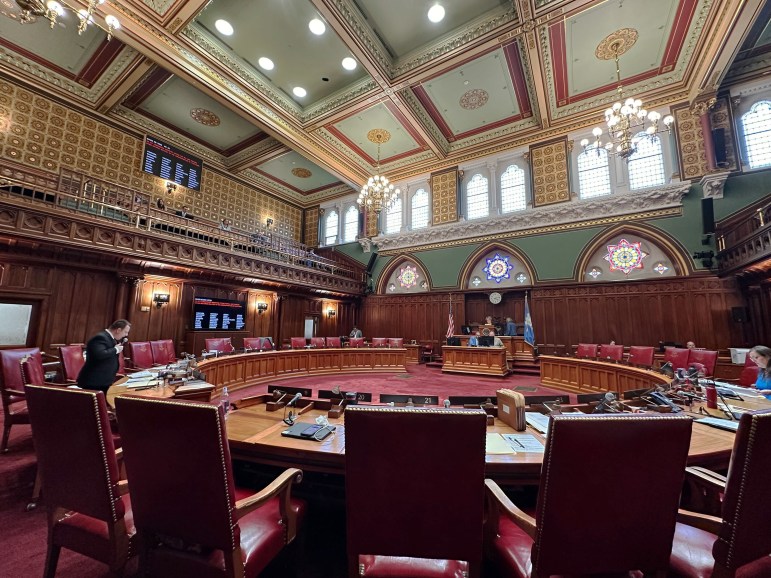
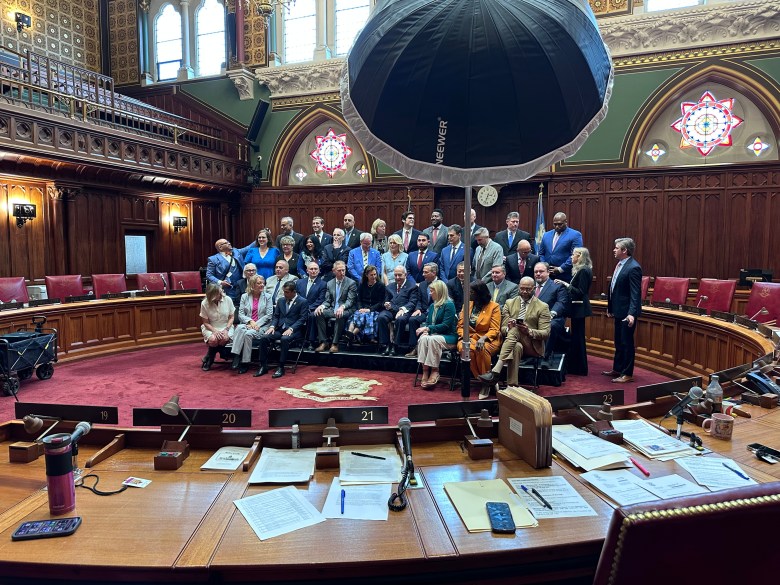
He was the only senator who did not participate in a bipartisan end-of-session activity with Lt. Gov. Susan Bysiewicz, who presides over Senate debates, and the other 35 senators: posing in the Senate for a formal group portrait, a memento for five senators who are not seeking reelection.
“You’d think that our state government, our state legislature, would be operated in a way that was with a little more decorum than the way it has been,” Sampson said. “I couldn’t be more frustrated by the past couple of days and the way this place is operated.”
He praised Flexer for her work on one element of the bill: A provision that establishes risk-limiting audits that manually examine a statistical sample of paper ballots and guarantee a specified risk limit, which the bill caps at 5%.
But he faulted her for feeling “the need to interject federal politics and Trump.”
“I hear it constantly,” Sampson said. “What’s going on across this country, there is a narrative that’s being generated to pull the wool over the eyes of the people across this country, and particularly in the state of Connecticut by the majority party, that somehow national politics has something to do with what’s happening in this room. And it doesn’t.”
The bill also increases the penalty for harassing election workers from a misdemeanor to a felony on a second offense, including publicizing a worker’s name or address with intent to intimidate. It also makes tampering with an absentee ballot drop box a felony.
A measure sought for several years by Miles Rapoport, the former secretary of the state, to explore ways to produce a 100% voter turnout also is in the bill.
With E.J. Dionne Jr., Rapoport has written a book, “100% Democracy: The Case for Universal Voting.”
House Bill 5001 imposes no such mandate. It establishes a nine-member task force to study efforts to achieve 100% voter participation in the state by January 1, 2030.
Correction: A previous version of this story referred to Sen. Mae Flexer as co-chair of the Government Administration and Elections Commission. She is co-chair of the Government Administration and Elections Committee, one of the General Assembly’s legislative committees.
