


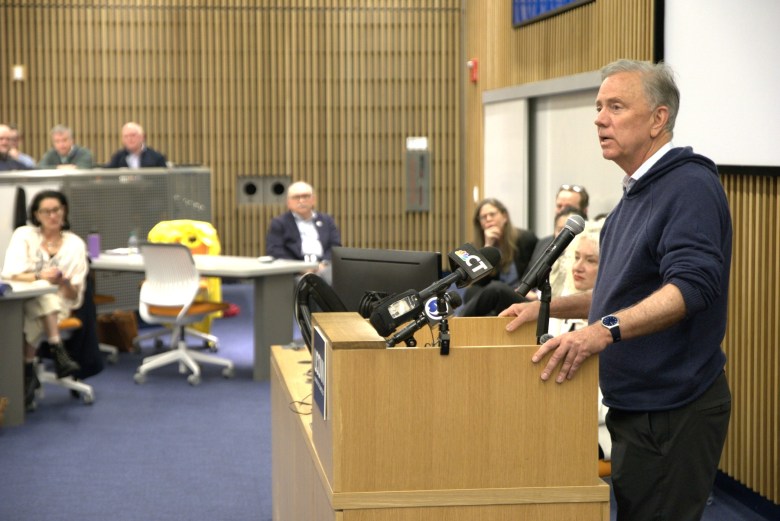
Gov. Ned Lamont and other elected officials joined faculty and administrators at the University of Connecticut Thursday to announce $35 million in state aid to offset lost federal research funds.
The money would come out of Connecticut’s Federal Cuts Response Fund, which legislators created for Lamont last year to prop up programs facing cuts by the Trump administration. The governor is sending $21 million to UConn and $14 million to UConn Health, which together report losing almost $100 million in research grants since the start of Trump’s second term.
“I am just terrified [of] what’s going on in our country right now, the idea that we’re cutting back on research and development,” Lamont said.
Many of those federal grants have not been formally canceled but remain undisbursed, according to UConn’s Interim Vice President for Research, Innovation and Entrepreneurship Lindsay DiStefano. Several projects remain halted, with researchers unsure if and when the work will resume.
The long list of programs affected includes work with towns on predicting and mitigating natural disasters and power outages; developing new antiviral drugs; reducing opioid misuse; preventing cancer through stress reduction; and improving mental health services in schools and communities.
The losses also affected UConn’s participation in SNAP-Ed, a program helping individuals and school systems understand how to use their SNAP benefits to promote health, and the university’s Early Childhood Intervention Personnel Center, which provides disability services to individuals from birth through age 21.
Division of Hematology/Oncology Chief Maggie Callahan said the funds are desperately needed to advance medicine and save lives.
“[Medicine today is] not enough for the 45-year-old mother who’s told she has colorectal cancer, and she wonders if she’ll be there for her family,” Callahan said. “Or for the 67-year-old grandfather with Alzheimer’s disease, who hopes he’s going to be able to make memories with his grandchildren. We have to do better.”
Nathan Alder, a professor of molecular and cell biology researching cures for age-related diseases, said the university provides important experience and mentorship for students and postdoctoral trainees.
“Every dollar of state investment in the university translates into nearly two dollars of economic output,” Alder said.
During his remarks, Lamont also broached the topic of immigration, another area where the state has recently come into conflict with the federal government.
“I just want to make sure those of you who weren’t born in this country know that despite some of the rhetoric you hear coming from Washington, we’re so thankful that you’re here in Connecticut,” Lamont said. “You’re making an enormous difference in terms of the future.”
The governor said almost $300 million remains in the emergency response fund.
“I gotta keep some in reserve because I’m really worried about what happens this fall if some of those projected Medicaid cuts happen,” Lamont said.
