



Legislators on Connecticut’s Education Committee started the 2026 session with big plans.
At the top of the list: increasing, for the first time since 2013, the cost-per-pupil written into the state’s main school funding formula. This number had been set at $11,525 for over a decade, with no adjustment for inflation. With such an adjustment, this so-called “foundation amount” would be about $16,000 per student today — a difference of hundreds of millions of dollars across all the state’s school districts.
Along with that, Democratic lawmakers hoped to enact a statewide bell-to-bell cellphone ban, boost stipends for student teachers and — following multiple high-profile deaths of children whose parents had removed them from school — create a regulatory framework for homeschooling.
None of it came without obstacles.
The budget proposal for the next fiscal year Gov. Ned Lamont released in February didn’t increase core school funding — the Education Cost Sharing grant or ECS — at all, setting up a fiscal tug-of-war with legislators from both parties. Meanwhile, school boards bristled at the cellphone ban, which many felt would undermine local control. And homeschool advocates came to the Capitol in droves to push back on what they perceived as an attack on their fundamental rights.
Republicans managed to get a couple of their education priorities in, easing back some unfunded state mandates for schools and directing more attention toward literacy — though not as much as some hoped.
Here’s how it all played out.

Education got a much-needed boost
By some estimates, the ongoing failure to raise the ECS formula in line with inflation has cost districts upwards of $800 million since 2013. Without that money, districts have had two options: ask their town governments for more money, which usually means a property tax increase for local residents, or cut staff and programming — or both.
Those pressures came to a head this year, with some districts warning of major property tax hikes and catastrophic cuts if the state did not make serious moves to inject more money into public schools.
Before the session started, Education Committee co-Chair Rep. Jennifer Leeper, D-Fairfield, said increasing ECS was a top priority this year.
“[Schools] could have more reading specialists and interventionists. They could have smaller class sizes because they can hire more teachers,” Leeper said at the time.
Then came the governor’s budget proposal in early February. The proposal called for a Blue Ribbon Commission to study school funding, with the idea of eventually recommending reforms. However, it had no new increase for ECS.
Meriden Superintendent Mark Benigni called it “a trainwreck for education.”
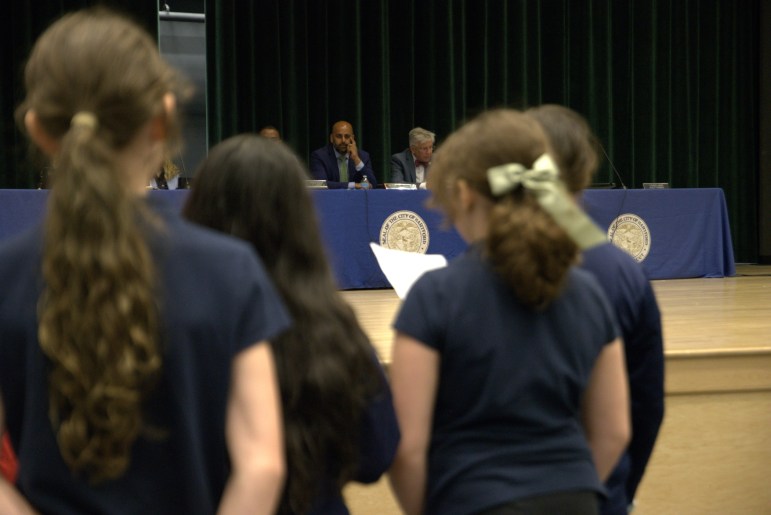
A broad coalition of municipal officials, faith leaders, school administrators, teachers and students urged lawmakers not to wait. Democrats in the General Assembly were sympathetic, and by late March, they had a rough number they thought the governor might accept: $150 million for schools, possibly more. Republicans, meanwhile, sought to outflank the Democrats with a $335 million proposal of their own.
The problem for both parties was how to get around Connecticut’s stringent budget caps. Lamont has been generally wary of overspending in the way some previous administrations have, and he’s made it a priority throughout his tenure to reduce the state’s enormous pension debt. Nevertheless, in his budget proposal, he suggested spending $500 million from a special fund to give every resident a $200 tax rebate just before Election Day. Advocates questioned why he wasn’t putting the money straight into ECS instead.
The dust finally settled when lawmakers passed the state budget on May 2. In it: a boost of about $180 million for public schools, well north of what Democrats thought was possible in March but still far short of the estimated gap from over a decade of missed inflationary adjustments.
“It feels pretty historic, and a huge win for students and residents across the state,” Leeper said. “It won’t solve every problem, of course, but it will have a positive impact on children in schools, educators and our local municipalities and taxpayers.”
Education Committee Ranking Member Sen. Eric Berthel, R-Watertown, said the ECS formula as a whole remains “somewhat muddied.” But, he said, “I don’t want to lose sight of what we actually accomplished this year, because it’s important, and I believe it’s a step in the right direction.”
Education advocates gave legislators a pat on the back for coming up with the money but indicated the General Assembly would still have significant school funding problems to tackle next year.
“The work has just begun,” said New Britain Superintendent Anthony Gasper in a statement from the Connecticut Association of Urban Superintendents.
How the funding increase actually works
In the end, lawmakers managed to give each school district at least a 4% increase in state funding for the upcoming fiscal year — without raising the ECS foundation amount itself. It remains at $11,525 per pupil.
“They did this in one of the most confusing and complicated ways that you could do,” said Michael Morton of the School and State Finance Project. “Heart was in the right place. It works for people. Could have been done a little easier.”
Lawmakers used two methods to determine a dollar amount for each school district. The first: calculate how much each town would receive if the ECS foundation amount rose to $13,087, then give them that money — without actually writing an ECS increase into statute. Total cost to the state: $152 million.
For some municipalities — especially large cities like Hartford — this amounted to a 4% increase or more. But for many others, it didn’t actually amount to much at all. The reason: Many towns are technically considered “overfunded.”
This doesn’t actually mean a town has too much money. Rather, it means the school district’s enrollment has declined, which should, in theory, shrink its ECS grant. In reality, costs continue to rise for those districts, too, which is why the state has been holding them harmless year after year — in effect, giving them more money than the formula says they should get.
The bottom line: Many towns wouldn’t actually get much money if the ECS foundation amount rose to $13,087. For towns in that position, lawmakers ditched the faux-ECS boost and just upped their state education funding by 2%. Then, they tacked on an additional 2% in a grant they decided to call DRACULA, which stands for District Relief and Compensatory Use Learning Aid. Total increase: 4%. Cost to the state: just under $21 million.
A small handful of towns got a combination of a faux-ECS boost and a DRACULA grant to reach the 4% threshold.
One important point: If towns had already raised property taxes to increase local school funding, they can use the state money to undo that tax increase rather than pay it directly to schools. That’s why many lawmakers have referred to the education aid as a form of property tax relief.
This was confusing even to the members of the General Assembly, who had to revise the budget twice on the final day of session to clarify what they meant to do.

The big questions weren’t answered
As complicated as all this is, it did accomplish a handful of goals. It directed over $170 million more to towns for their municipal school districts. It cleared space in the budget for raising the ECS foundation amount by about $2,500 per student. And it ensured every town would get a 4% increase, even if its enrollment has declined significantly.
But it also left unanswered questions about what schools can expect in the years to come. For one, the ECS formula still hasn’t changed and still isn’t formally tied to inflation.
Education Committee Ranking Member Rep. Lezlye Zupkus, R-Prospect, said she would have liked to see the foundation amount formally raised. “The ECS formula has to be fixed,” she said.
The budget bill nudged that effort along by instructing the state to hand out the extra $152.2 million again in fiscal year 2028, but according to the School and State Finance Project, lawmakers will have to make some statutory changes to ensure it gets distributed. And the other $21 million, which includes the DRACULA grant, isn’t guaranteed at all.
“We got temporary success,” said Education Committee co-Chair Sen. Doug McCrory, D-Hartford. “It [the budget] doesn’t address structural changes going forward.”
McCrory noted the legislature will have to deal with a litany of other funding issues next year. Much of that will likely fall under the purview of Lamont’s Blue Ribbon Commission, which officially launched April 16.
For example: Lamont has signaled he wants the state to have a bigger role in covering special education, where costs have risen drastically. It would be a big lift.
“I’m not sure it’s manageable,” Lamont acknowledged, “but I know it’s a lot easier managing at the state level than having 169 towns all scrambling to see what happens. … I think we can be a real assistance there and share those costs.”
McCrory said he’s concerned by how many students are now being placed in special education. He said the number has risen significantly in the last 15 years.
“With that, there is an over-identification of young men of color, Black and brown boys in special education in the state of Connecticut. And that concerns me a great deal,” McCrory said.
The commission may even consider questions as fundamental as whether Connecticut should use an enrollment-based funding formula at all. Critics have pointed out that schools have many fixed costs that don’t really decrease if a fraction of students leave. But changing this would mean effectively rebuilding ECS from the ground up.
While challenges remain, Leeper said the legislature’s success in getting a school funding boost over the finish line this year was a good sign for the state’s political health.
“I feel really grateful that we all have the privilege to operate in a culture that really is quite collaborative, and very different than what we see on the news coming from Washington,” Leeper said.

The bell-to-bell cellphone ban stalled
That collaborative atmosphere had its limits, however.
Despite bipartisan support in the House, a bill imposing a bell-to-bell cellphone ban in public schools died before reaching the floor of the Senate, apparently because it lacked the votes. Senate Majority Leader Bob Duff, D-Norwalk, said in a statement that senators were concerned the bill would strip local control from school boards, which until now have been setting cellphone policy based on guidance from the State Department of Education.
McCrory largely affirmed Duff’s statement.
“How should I answer this question for you? It got late in the process. I believe there was a population of people who just didn’t want to do it. … There was pushback from both sides of the aisle,” McCrory said. “I just think we got to it too late.”
It was a disappointment for Leeper on the final day of the session, who, along with Lamont, had been a staunch advocate for the legislation.
But she struck a conciliatory note the day after the legislative session ended.
“Not every priority makes it across the finish line. We had a lot of really historic wins, and, you know, time was not on our side,” Leeper said. “I look forward to continuing to engage with my colleagues and all the stakeholders and continue to build sort of grassroots support for this.”
Leeper made it clear she still believes phone-free schools are the best policy. The same is true for Lamont, who was bullish about the bill’s chances next year.
“Sometimes it takes a little while. Something about the calendar up there in the Senate, they ran out of time,” Lamont said.
He added that the State Department of Education will still work to support efforts to implement bell-to-bell bans.
“We’re going to put out very clear guidance to teachers and superintendents. We think it really is to the great benefit of students to get those phones out of the school,” Lamont said.
He cut in when reporters began discussing possible bipartisan opposition among senators.
“It’ll pass next year,” he said sharply.
Connecticut set rules for homeschooling
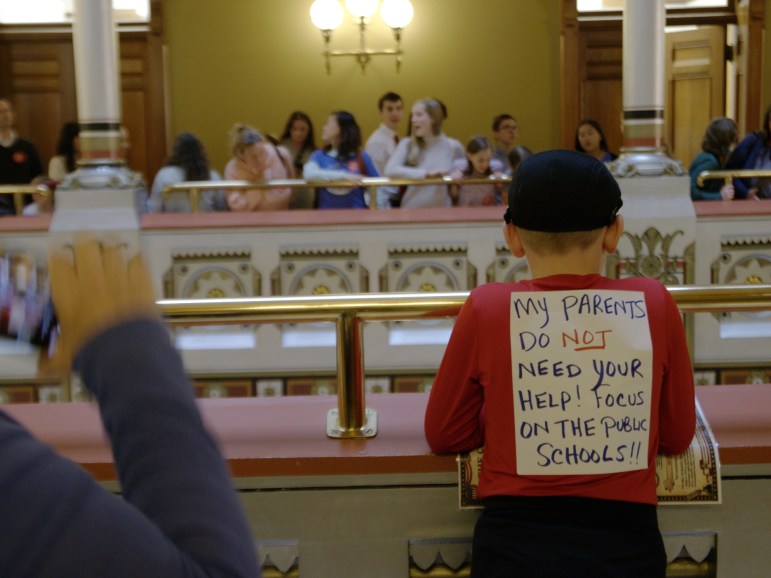
Perhaps the most bruising education-related fight this session was over whether Connecticut should create new regulations around who can homeschool and what information parents should share with the state. The discussion followed a series of deaths of children who had been removed from public school.
Ultimately, the bill included three rules:
- All parents must now indicate how they intend to educate their children at the start of each year;
- Parents newly beginning to homeschool must appear in person to sign a withdrawal form;
- And those parents must pass a one-time background check with a Department of Children and Families.
Proponents of the new regulations said they were necessary to keep track of where kids go when they are withdrawn. Critics, including a well-organized body of homeschool advocates, said the rules were an attack on their community and their rights.
Republicans signaled a fight was brewing as soon as the concept was raised in committee. Homeschoolers submitted thousands of pieces of written testimony — though Facebook screenshots indicate some people may have submitted several times — and spoke for hours at a public hearing in opposition to the bill, prompting Democratic lawmakers to whittle it down before a House vote. The changes didn’t satisfy advocates, who continued to oppose the bill through its final passage in the Senate.
Lamont has yet to sign the bill into law.
Although the bill has been pared down significantly from its original text, Leeper still characterized it as a “meaningful win.”
“The legislature has been periodically attempting to do that for decades, and this was the first time we were really able to,” she said.
Although homeschool advocates weren’t able to stop the bill from passing, they appear to have succeeded in dissuading lawmakers from pursuing the issue further, at least for now.
“I think it might be a couple years before any additional proposals around homeschooling come back to the legislature,” Leeper said.
McCrory was more blunt. “No. No. My honest answer: no,” McCrory said. “This is not going to be touched anytime soon.”
Berthel, who opposed the bill in committee and on the Senate floor, said the process of crafting the bill was flawed from the outset. Although efforts were made to establish a working group for the issue over the summer, Berthel described them as nominal at best. He and other Republicans raised similar concerns in committee.
“I think where the failure happened was this whole thing started out as a jam-it-down-your-throat mandate on our homeschoolers,” Berthel said.
Had lawmakers brought in a wider range of stakeholders, he said, everything might have gone differently.
But Leeper has said Republicans and homeschoolers were initially included in conversations about the bill. Those efforts broke down due to a lack of good faith, she said.
“Unfortunately, those conversations were then turned into district events saying we were trying to end homeschooling and the rest. And so those conversations also ceased, unfortunately,” Leeper said during a committee meeting Mar. 18.
Literacy got relatively little attention
One of Berthel’s priorities at the start of the session was strengthening support for Connecticut schools in the wake of the recent Right to Read law‘s passage. Senate Bill 220, a literacy bill he collaborated on with Leeper, passed both chambers; But a flurry of last-minute changes in the waning hours of the session ended up weakening it.
“I’m a little disappointed, to be quite honest,” Berthel said.
The bill had already been watered down significantly in committee. Initially, it instructed schools to implement individualized reading plans for any student in grades 4-9 who tests below proficiency on the state reading assessment. This was meant to build on Right to Read, which focused exclusively on K-3.
Some educators pushed back, warning the requirement could force schools to incur substantial costs they were in no position to take on, especially given the concerns around school funding more broadly.
A handful of changes ensued. “Individualized reading plans” became “multi-tiered systems of support,” or MTSS, which can include small-group work. In addition, rather than the mandate that schools implement such a system, the bill called on the State Department of Education to create guidance on MTSS for schools.
It looked like smooth sailing from there until about 10 p.m. on the final day of session. The bill had already passed the Senate unanimously; in the House, Leeper stood for the usual question-and-answer period when a bill is introduced, only to stop minutes later. A motion was made and passed to suspend debate.
Some time later, the bill came up again — and one of Leeper’s fellow Democrats, Rep. Maryam Khan of Windsor, to begin asking questions. Khan expressed concerns about Section 1 of the bill, which, according to Leeper, would have codified existing State Department of Education policy around literacy assessments in grades K-3. Debate halted again amid Khan’s questioning.
With the time fast approaching midnight, Rep. Greg Howard, R-Stonington, introduced a friendly amendment to strip Section 1 entirely. It passed, and the bill went promptly back to the Senate, where it landed without discussion on the chamber’s consent calendar.
Leeper declined to comment on why the changes in the House were made.
Apart from S.B. 220, the session saw the creation of a statewide literacy coaching network for kindergarten through third grade. The money for the program was included in the state budget. School administrators have said literacy coaches can play an important role not only for students, but for teachers who need training to effectively implement curricula aligned with the science of reading.

School lunch and other priorities
Apart from the activity around ECS, the state budget allocated $12 million to inaugurate a universal free school breakfast program for Connecticut public schools.
Lamont has championed the idea since last year. Advocates say some students who qualify for free meals avoid eating entirely because of stigma, while students who don’t qualify may still come from families that struggle to pay. Giving everyone a free meal removes those issues.
Legislators made an effort this year to include school lunches in the program, as well, but it did not survive the session. Neither did a bill creating a working group to study anti-Muslim and anti-Arab racism in schools.
The bill would have complemented a provision in an emergency-certified bill that passed earlier in the session, which established a working group to study antisemitism. Critics, including some Jewish groups, raised some concerns about how the group would be composed. They also argued having one group to study both anti-Palestinian racism and antisemitism together would be more effective.
A proposal to offer stipends for student teachers — another priority Leeper set out at the start of the session — also failed. The goal, she said, was to make entering the profession more financially feasible. As to the results this year, she expressed mixed feelings.
“I hope to bring that policy back next year. I think there’s more we could do,” Leeper said.
Nevertheless, she noted the state is expanding a teacher apprenticeship program it has with the Department of Labor and improving access to Connecticut’s Aspiring Educators program, which provides scholarships to student teachers from underrepresented demographic groups.
Ranking Member Zupkus had her own win this year: a bill to relieve schools of certain unfunded mandates and strengthen the state’s Education Mandate Review Advisory Council. The council will report annually on which state mandates are still causing financial strain for schools.
“I am relieved, no pun intended,” Zupkus said. “Our schools, all that happens is, more mandates and mandates and mandates. … They just can’t take it anymore.”
Now that the session is over, most of the Education Committee leadership said a small break might be in order — though with an election in November, it won’t be long before they’re back to work.
“I am looking forward to taking a trip with my husband,” Leeper said, “and then it will be right back to work.”
