



This story has been updated.
The General Assembly adopted a $28.1 billion state budget Saturday that orders major new investments in municipal aid and affordable childcare and restructures Connecticut’s tax on hospitals to leverage more federal aid and assist the industry.
Legislators did not include Gov. Ned Lamont’s proposal for a $200-per-person tax rebate this October nor any of the major tax-cutting proposals offered by either party. But the final plan does create a new income tax credit for caregivers and a sales tax break for school supplies.
Lawmakers also increased rates for doctors and other providers who treat low-income patients, added funds for nonprofit social service agencies and established a universal free breakfast program in Connecticut schools.
The new budget technically falls under the spending cap that keeps budget growth in line with household income by a razor-thin $600,000 next fiscal year, which represents a fraction of 1%. But to get there, Lamont and legislators had to add about $85 million to the amount of allowable spending normally permitted under the cap. They also had to shift hundreds of millions of dollars in annual payments to hospitals outside of the formal budget and spending cap systems.
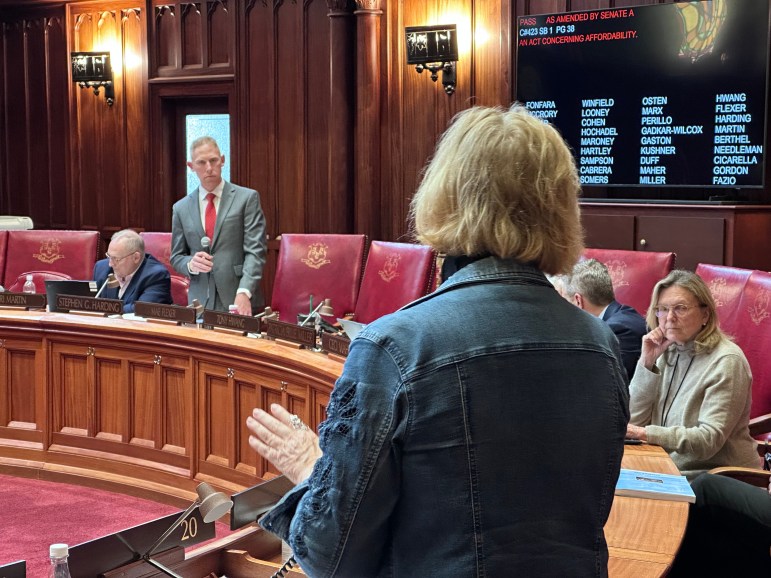
The Democratic-controlled House of Representatives gave final approval by a 127 to 21 vote around 9:45 p.m., with 27 of 48 Republicans joining the majority in backing the plan. The Senate endorsed the package 30-6 vote following a nearly four-hour debate that wrapped just before 5:35 p.m. Five Republicans sided with the Senate’s Democratic majority in support of the budget.
Big new investments in town aid and affordable childcare
Senate President Pro Tem Martin M. Looney, D-New Haven, held up the new state budget as a counterpoint to the deep healthcare cuts and big tax breaks for wealthy households that Congress and President Donald Trump ordered last July.
“This is our Connecticut Democratic version — and a much more humane and positive and enlightened version it is,” Looney said. “It is our own ‘One Big Beautiful Bill.’ … This is a budget for the people of Connecticut that really is worth celebrating.”
“We have a budget that is going to give Connecticut affordability,” Rep. Toni E. Walker, D-New Haven, co-chairwoman of the Appropriations Committee, said during a press conference just prior to the House debate. “Our programs will get plenty of support, and we will go forward for the people of Connecticut.”
The linchpin of the new plan involves $280 million in additional aid for cities and towns and a $300 million to $350 million investment in affordable childcare.
That includes $100 million in one-time aid for non-education programs and $180 million for schools that communities could expect year after year.
Lamont, who negotiated the budget with legislative leaders and is expected to sign it, said this week it would stipulate that municipalities that already have set their local budgets can re-open those documents and use the extra state aid to lower taxes if they choose.
“This budget delivers a strong, responsible path forward, one that makes Connecticut more affordable while keeping our state on solid fiscal footing,” Lamont said Saturday. “This is a budget that provides immediate relief for families and positions our state for long-term growth.”
Sen. Cathy Osten, D-Sprague, the other co-chairwoman of the Appropriations Committee, added, “This is probably the best budget we have seen for municipalities in decades.”
Legislative leaders say many local school districts are in fiscal crisis, reeling not only from vanishing federal pandemic relief but also rising energy and healthcare expenses.
Surging costs for early childhood education mean many low- and middle-income families can’t have two spouses employed. The new budget also deposits $300 million to $350 million in a new trust to dramatically expand affordable childcare program slots.
Legislators and Lamont launched the program last June, also with a $300 million deposit.
To fund this childcare investment and the $280 million in extra town aid, though, legislators will tap a special savings program that Connecticut has used since 2017 to reduce pension debt and build reserves.
State fiscal analysts projected Thursday that this program, which captures a portion of state income and business taxes, will hold about $2.1 billion by the fiscal year’s end on June 30.
The state has paid down about $10 billion in pension debt using this program since 2020 but still owes more than $33 billion, which is one of the largest burdens, per capita, in the nation.
But while Republicans conceded the increased town aid makes the new budget attractive to some, they decried the failure to live within the spending cap and other fiscal controls, or to substantially reduce state taxes.
“I think today is a further step of eviscerating what is left to those ‘guardrails,’” House Minority Leader Vincent J. Candelora, R-North Branford, said at a press conference prior to Saturday’s debate. “Overall, there are people that are pleased with the additional money to our local towns and cities for school aid and hopefully to offset property taxes, but it does come with a price — that is this budget is putting us into deficit in the out years.”
Taxpayers “deserve it,” said Senate Republican Leader Stephen Harding of Brookfield. “It’s unacceptable that we have the third-highest electric rates in the country, the third-highest property taxes, third-highest income taxes.”
Few direct tax cuts despite lots of proposals
And while investments in municipal aid and affordable childcare could translate into savings for many households, Lamont and legislators spent most of the past three months proposing direct state tax relief.
The governor’s plan for a late-October, $500 million one-time rebate, however, was dismissed quickly.
But legislative leaders also abandoned proposals for new income tax credits for renters and poor and middle-class households with children, despite strong support from rank-and-file lawmakers.
Despite aggressive budget caps that have forced annual surpluses of roughly $1.9 billion — equal to about 8% of the General Fund — Lamont and some legislative leaders were fearful that big ongoing tax cuts would make it hard to maintain big investments in recent years in town aid and affordable childcare.
The governor and leaders also fear new pressure on state finances coming from Washington.
Connecticut, starting in the next budget cycle, must decide whether to use state dollars to offset hundreds of millions of dollars in vanishing federal funds for health care, nutrition and other programs.
Senate Republicans tried to amend the plan to provide a $750 million state income tax cut. Connecticut has seven different marginal rates to tax income, and the GOP plan would reduce the three lowest rates.
The caucus would offset about $55 million of the annual cost to the state by making undocumented children and adults ineligible for state-funded health coverage and other Medicaid programs.
But the rest of the funds would come from a state savings program used to pay down pension debt. Senate Republicans said Democrats have gradually weakened these programs anyway to support more spending, so it’s better to divert the funds for taxpayer relief, Harding said.
“My fear today is that we are now declaring the death of” state budget controls, he said.
Majority Democrats in the Senate rejected the Republican amendment in a 25-11 party line vote.
Connecticut lawmakers did order a few small state tax cuts, but also repealed what amounted to a tax break for corporations.
A new sales tax exemption on school supplies will save consumers about $7 million per year.
And residents providing at-home care for relatives would be able to claim an income tax credit to offset certain expenses. This would save filers collectively about $2 million per year.
“There are about 773,000 caregivers in Connecticut, and they are spending an average of about $7,200 out of pocket annually to help keep their loved ones independent,” said Nora Duncan, director of the Connecticut chapter of AARP. “They pay for wheelchair ramps, assistive technology, transportation, paying for prescription drugs and more. Ultimately, their efforts help keep people off taxpayer-funded higher levels of care. A caregiver tax credit is good for families and taxpayers.”
House Republicans pushed last month for more than $400 million in ongoing state tax and fee cuts, primarily by boosting income tax credits and exemptions.
Rep. Gayle Mastrofrancesco, R-Wolcott, said given the lack of direct tax cuts in the new budget, “it doesn’t address affordability at all, in my opinion. There’s nothing in this budget that’s going to help [households] on a daily basis. … Our residents are still overtaxed.”
Lawmakers are asking Connecticut’s corporations to pay more after collections this year dropped $420 million below expectations and $166 million below receipts from the last budget cycle.
Connecticut links its state corporate tax system to the federal code, as do several other states. And since Congress last year extended federal corporate tax breaks that had been set to expire, Connecticut’s receipts from big business have slumped badly.
The new state budget orders changes to decouple from the federal code, and analysts project that will restore $104 million to Connecticut’s coffers by the 2027-28 fiscal year.
But the Connecticut Business and Industry Association said Saturday that the state has missed a chance to attract more companies.
“As other states in our region have also scaled back this improvement to the tax code, Connecticut had the opportunity to position itself as the best state in the region for relocating and expanding manufacturing facilities and jobs,” said Chris Davis, CBIA’s vice president of public policy.
A five-year plan to secure more federal funds for hospitals
The package includes a new five-year taxing arrangement with hospitals that lawmakers hope will leverage more federal dollars for the industry.
Hospitals currently pay $820 million annually to Connecticut, which returns those funds, plus $124 million more, to the industry.
This back-and-forth arrangement, which most states employ and Washington allows, technically counts as state health care spending and qualifies Connecticut for additional federal Medicaid payments.
The state comes out about $505 million ahead annually by keeping the majority of extra aid from Washington.
But hospitals, which say they collectively lose $1.5 billion annually due to Medicaid payments that fail to meet the full cost of delivering service, say they need more help.
The new deal calls for hospitals to pay $154 million more next fiscal year and get $394 million extra back from the state.
Jennifer Jackson, CEO of the Connecticut Hospital Association, called the new taxing arrangement “a breakthrough for healthcare in Connecticut, a major milestone for healthcare access, affordability, and preserving the high-quality care for which Connecticut is recognized in every community.”
Jackson added industry and state leaders jointly crafted a system that “will strengthen patient care, support hospital stability and protect access to essential services and jobs.”
The state’s annual gain of $505 million would remain constant for the next five years.
Connecticut lawmakers were focused on providing more aid to hospitals this year given growing reports of fiscal distress in the industry. Prospect Medical Holdings, which relinquished ownership this past winter of hospitals in Waterbury, Manchester and Vernon, still owes the state more than $127 million in unpaid taxes.
Rep. Maria Horn, D-Horn, co-chair of the Finance, Revenue and Bonding Committee, called the tax “a strong and equitable way to provide [hospitals] the most revenue we are able to.”
Legally exceeding and working around the spending cap
Lawmakers and Lamont have struggled to live within the spending cap throughout the governor’s tenure, which began in 2019. Nearly $3 billion in emergency federal pandemic relief grants sent directly to state government, which could be spent outside the formal budget system, eased some cap pressures between 2021 and 2025.
But that money is mostly spent.
To accommodate their plan to increase town aid, legislators and Lamont agreed to increase the maximum level of spending allowed under the cap by $85 million. Such an exception can be made under current law provided the governor declares a fiscal emergency in writing and 60% of the Senate and House vote in favor of the budget. Votes in both chambers met the two-thirds’ requirement.
Still, officials also needed a few fiscal gimmicks to work around the cap, as they have in recent years.
The new spending plan also shifts more than $960 million in payments to hospitals outside of the formal budget and spending cap systems.
Had those funds not be shifted outside of the formal budget, appropriations would be up 8%, said Sen. Ryan Fazio of Greenwich, ranking GOP senator on the finance, committee and a gubernatorial candidate.
“At a certain point, enough is enough,” he said. “It’s wrong, it’s bad economic policy and it’s ensuring decades to come of economic stagnation.”
And Lamont and Democratic legislators budgeted nearly $1 billion to cover retiree health care costs, about $90 million less than what Comptroller Sean Scanlon projects will be needed to meet the contractual obligation.
The state has a reserve fund holding more than $130 million to cover unanticipated expenses in this area. But officials had to tap that recently after Scanlon noted retiree health care had been underfunded in the current budget by roughly $39 million.
And if the comptroller’s projections come to pass again in the next budget cycle, the reserve could be nearly depleted.
Connecticut must pay the retirement benefits based on its contract with the union. But by appropriating less than the required level, legislators and Lamont can, effectively, keep the formal budget lower relative to the spending cap.
The State Employees Bargaining Agent Coalition, which represents nearly all major bargaining units in state government, recently issued a statement urging the governor and legislators to pursue a more direct solution: reform a spending cap system that labor says already saves too much money to the detriment of core services.
“Our arbitrary fiscal roadblocks are Connecticut’s largest obstacle to investing in the future of all working families,” the coalition wrote in a recent statement.
Rep. Tammy Nuccio of Tolland, ranking House Republican on the Appropriations Committee, voted for the budget, citing the additional aid for towns as a key factor.
But Nuccio urged her colleagues to honestly acknowledge surging healthcare costs for retired state workers and in other programs.
“This is going to continue to a problem that haunts us, in every budget going forward,” she said. “At some point, we have to accept the fact that the healthcare costs are growing exponentially.”
But House Majority Leader Jason Rojas, D-East Hartford, said that worrying about state government’s fiscal future is important, but it’s not the only challenge lawmakers faced this year.
“It’s right to do that,” he said. “But in this moment, we have an opportunity to invest in our children and our families and our communities and our workforce and healthcare and our state, and that’s an awesome opportunity that we all have here together as Republicans and Democrats to do something right.”

Investing in health care and social services
The new budget continues taking modest steps to increase rates for physicians and other providers who treat Medicaid patients.
Legislators added $15 million to the budget one year ago and will add another $60 million starting July 1. But that is far shy of the $300 million, or more, legislative leaders have said is needed to fix a system that wasn’t adjusted comprehensively between 2008 and 2025.
Further complicating matters, legislators directed the state Department of Social Services to find $25 million in budget savings next fiscal year in the Medicaid program but didn’t specifiy how that should be achieved. That means the department may scale back that $60 million increase for provider rates to help achieve that savings mandate.
Health care advocates complain Medicaid patients often cannot find doctors willing to treat them because the compensation is so poor. A 2019 analysis by KFF, the health care think-tank formerly known as Kaiser Family Foundation, found that Connecticut’s Medicaid rates for most specialists ranked 42nd among all states.
Similarly, the community-based nonprofits that deliver most state-sponsored social services to people with disabilities and patients struggling with mental illness and addiction say they lose hundreds of millions annually under state payment schedules that haven’t kept pace with inflation for decades.
The budget would boost funding for nonprofits by $138 million next fiscal year, though $32 million of that increase would be given only to providers serving clients with intellectual or developmental disabilities.
The funding “will continue to address long term underfunding for vital programs that serve tens of thousands of Connecticut residents,” said Gian-Carl Casa, president and CEO of the CT Community Nonprofit Alliance, who said most social service programs remain 30% behind inflation.
“Connecticut continues to bring in more in tax receipts than is needed to balance the state budget,” Casa added. “In these critical times, we continue to advocate for stronger, sustained support to safety net programs.”
Public colleges and universities likely will tap reserves
Lawmakers and the administration have been pressuring higher education units to curb costs now that the federal pandemic grants Connecticut used to supplement their operating budgets between 2021 and 2025 have largely expired.
The Connecticut State Colleges and Universities system particularly has come under fire for holding close to roughly $700 million in reserves, which represents more than half of its annual operating budget.
The new state plan would boost assistance for CSCU, which includes regional state universities, community colleges and online Charter Oak State College, to nearly $508 million — a $28 million jump that would force the system to tap reserves to maintain current services.
The University of Connecticut has maintained a much smaller fiscal safety net than has CSCU but also will likely have to tap its savings starting July 1.
Aid for UConn’s main campus in Storrs and its regional branches would drop from $268 million this fiscal year to $257 million in 2026-27. Similarly, the committee would drop funding for UConn Health in Farmington from $143.5 million to just over $141 million.
Free school breakfast, funds for Shore Line East and other budget components
The new budget also marks a successful conclusion to Lamont’s two-year effort to provide free breakfast at all Connecticut public schools for all students, allocating more than $14 million for that initiative.
Many supporters of the initiative want both breakfast and lunch to be available free to all students.
James Williams, a lobbyist for the American Heart Association, said that while it still supports a broader benefit, “Connecticut is taking an important step towards ending food insecurity and improving student performance” with the free breakfast initiative.
“Thousands of families across the state are struggling to put meals on the table,” Williams added. “Federal funding cuts to food assistance programs, which will take effect later this year, will only make that situation worse.
The budget also commits $4 million to the Shore Line East rail service next fiscal year. Lamont has said Connecticut no longer can maintain the subsidies it does for the rail service because of limited use. Ridership along the Shore Line East route has struggled to rebound from service cuts imposed during the COVID-19 pandemic. Transportation Committee Chair Christine Cohen, D-Guilford, said that she ultimately would like to see service along Shore Line East restored to pre-pandemic levels, though she noted that would cost an estimated $28 million.
“We have a long way to go to get us there,” Cohen said. “We’re slowly getting back to service levels and optimizing service to get commuters back to the line.”
Other components of the new budget would:
- Direct the Lamont administration to study the feasibility of creating a “Connecticut Option” — a government-backed health insurance plan to assist consumers who’ve lost federal assistance to purchase private coverage. A report is due back to lawmakers in January.
- Order $800,000 in additional aid to both Ledyard and Montville to reflect increased demand for public services because of their proximity to tribal gaming casinos.
- Order $3 million in special aid for Waterbury, $800,000 for Manchester and $700,000 for Vernon. All three communities host hospitals that had been owned, prior to this year, by Prospect Medical Holdings, which also is delinquent on certain municipal tax payments.
Connecticut Mirror reporter John Moritz contributed to this story.
