



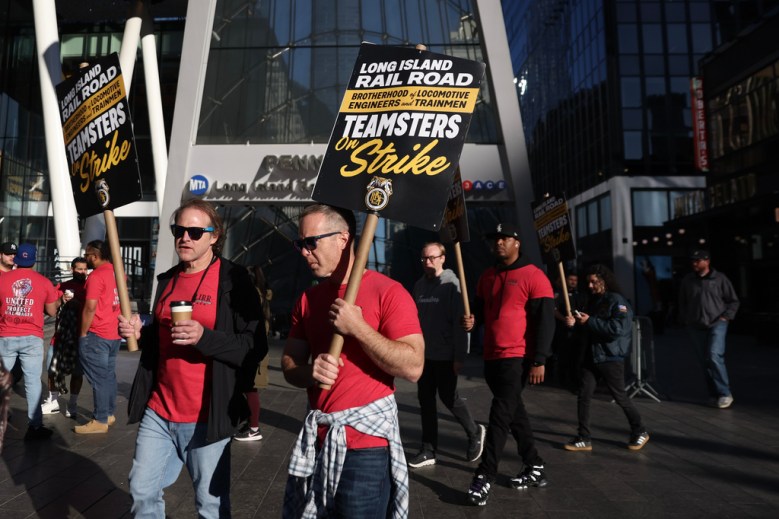
The Long Island Rail Road strike is not just a Long Island problem. Instead, think of it as a dress rehearsal for potential regional transportation chaos.
About 3,500 LIRR workers walked out this past weekend, shutting down service for nearly 300,000 daily riders. The fight is over wages and health costs.

Don’t even get me started on the bargaining over union “work rules,” like engineers receiving premium or double-pay rates for operating different locomotive types during the same shift or for moving trains between yards and the main line. Or engineers or conductors receiving additional pay because a train departed from a different track than originally assigned. Really?
Today LIRR locomotive engineers commonly earn roughly $100,000–$160,000+ annually before heavy overtime. Senior LIRR conductors can earn roughly $75,000–$120,000+, with some overtime-heavy employees exceeding $200,000 total compensation. Metro-North conductors average roughly $84,000, though veteran workers with overtime can earn much more.
During the pandemic, railroad workers were “essential heroes.” But during contract negotiations, they are characterized as “overpaid union labor.” Funny how that works.
Even to affluent suburban taxpayers, those salaries and work rules can sound outrageous — until you remember these are the people responsible for moving thousands of passengers through century-old infrastructure at 80 miles an hour.
Railroads also face a quieter crisis: not enough people willing to do the job (hence all the OT). The hours are brutal. The training takes years. And (despite the high pay) younger workers increasingly look at railroad schedules and say: “No thanks.”
So could Metro-North be next for a strike?
Yes, it could happen. But probably not soon, though labor pressure is building across the MTA. Will Metro-North unions seek parity with LIRR workers? Of course they will. That’s how pattern bargaining works. Nobody wants to be the railroad union that takes less.
And guess who ends up paying for higher wages: rail commuters.
The last Metro-North strike was in 1983. It went on for six weeks. About 90,000 daily commuters had to find other ways to work, often at twice the cost and twice the travel time.
If a Metro-North Railroad strike ever occurred, Connecticut commuters would face major disruption with few good alternatives. Connecticut has spent decades building an economy dependent on Manhattan while never creating a realistic backup plan for losing the railroad.
Many riders would shift to driving, likely turning I-95, the Merritt Parkway and Stamford parking areas into “carmegeddon” within hours. Limited substitute bus service (crawling on the same jammed highways) could be provided, but buses cannot replace the capacity of commuter rail. A single 10-car train on Metro-North can carry three times as many passengers as a 747.
There’s always Amtrak if you don’t mind paying $70 – $150 one way from New Haven compared to Metro-North’s $26 peak fare.
Ferry services, carpools, remote work and staggered schedules would likely be encouraged. But planners acknowledge any emergency backup system would handle only a fraction of normal rail riders. The best alternative… work from home or crash on your brother-in-law’s couch in Queens for the duration.
Meanwhile, the MTA says it is broke … or close enough to keep saying so. Fare evasion is part of that story. The numbers are ugly: about $1 billion lost each year.
So commuters are stuck in the middle.
Workers want fair pay. Riders want trains. The MTA wants more money. For politicians, transit failures are temporary headlines. For commuters, they’re our daily life.