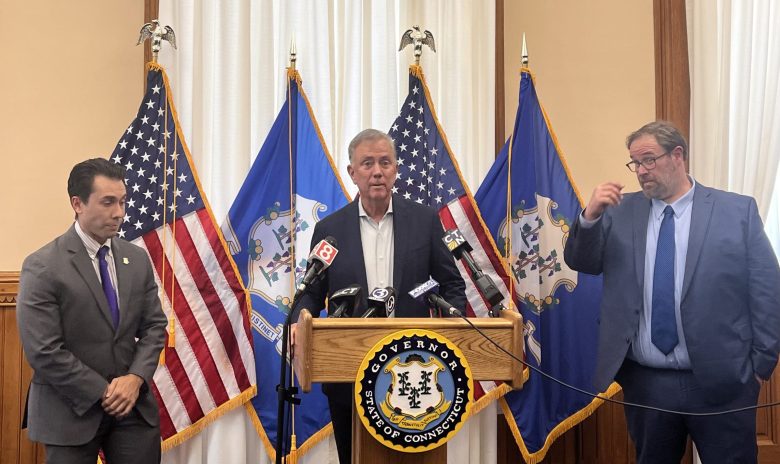
Gov. Ned Lamont unleashed a scathing critique of Eversource officials for seeking an 11% electric rate hike in Connecticut, accusing the company of leaning on its customers to fund generous executive pay and higher profits for its shareholders.
But the governor’s message — delivered Thursday as a personal missive to families struggling with high utility bills — also addressed the fact that perhaps more than at any point in during his eight years in office, Lamont has little ability to influence the outcome of the company’s case.
Earlier this month, lawmakers gave final approval to a slate of four new commissioners at the Public Utilities Regulatory Authority that were hand-picked by Lamont to serve five-year terms.
Those new members completed a total overhaul of the state’s ratemaking authority in a little more than a year. Previously, PURA had been dominated by Lamont’s former ally and chair, Marissa Gillett, along with other two other members serving at the pleasure of the governor under expired terms.
“The decision on this rate increase belongs to PURA, Connecticut’s independent utility regulator,” Lamont said Thursday. “That independence is real, and it’s important. It is their job, not mine, to say yes or no. However, I expect the PURA board to look at every one of these numbers and ask: does this serve Connecticut families, or does it serve Eversource shareholders?”
The message also comes as Lamont, who is seeking reelection for a third term in November, faces pressure from both sides of the aisle to provide relief from high energy prices. Connecticut currently ranks fourth-highest out of all states in average cost of electricity, behind Hawaii, California and Maine.
Lamont, a multimillionaire from Greenwich, took the unusual step of calling out in specific terms the largess of a private business towards its shareholders and top executives.
He noted that Eversource, which operates utilities in three states, reported $1.69 billion in profit last year. Lamont also took aim at the company’s CEO, Joseph Nolan, saying he took home $13.5 million in salary and benefits last year, an increase of nearly 19%.
“To summarize what’s happening here, one of the most profitable utility companies in America, whose CEO earns 94 times the average worker and walks away with $60 million if the company is sold, is asking Connecticut families to dig deeper to help out their bottom line,” Lamont said in the letter.
Jamie Ratliff, a spokeswoman at Eversource, said earlier in the week that the company’s request for a rate increase would not include any additional money to pay the salaries of the company’s president, chief executive or chief financial officer. In response to the Lamont’s message on Thursday, Ratliff said he and other politicians were attempting to “sensationalize” claims about company salaries, which she said have little impact on customer rates.
“We recognize that this is an election year, however, our customers deserve better,” Ratliff said in a statement. “Constant attempts to politicize energy policy and trade on charged rhetoric around electric rates do not serve the interests of customers, nor does it do anything to solve the pressing energy issues facing our state and region … Even if our CEO and other executives worked for free, customer bills would be the same and energy affordability would still be a prevalent conversation in New England as energy supply constraints continue to drive the largest and most volatile part of customer electric bills.”
Lamont’s opponent in the Democratic primary, state Rep. Josh Elliott, D-Hamden, also said that the campaign seemed to be elicting a change in the governor’s tone toward big business.
“I have never seen a message like this over the last eight years. I haven’t seen a message like this over the last 20 years of him being in public life,” Elliott said. “He is now trying to make himself look like an economic populist.”
Elliott quickly added: “Do I love everything he wrote? Absolutely. This is something that I would have said, and actually, these are things that I’ve been saying.”
Lamont did tout some actions his administration has already taken to lower the cost of electricity, including soliciting new contracts for nuclear power and using state bonds to pay off portions of the much-maligned public benefits charge, which recently began crediting customers money back on their monthly bills.
GOP gubernatorial nominee, state Sen. Ryan Fazio, R-Greenwich, said Thursday that Lamont and other Democrats had pursued policies and clean energy investments that made electricity less affordable.
“If you’ve been in charge for eight years and costs have been high and gone up, then you know you can’t be disassociated from that record,” Fazio said.
Both Fazio and Elliott said they supported Lamont’s most recent picks to fill out the PURA board. (Fazio’s votes in favor of all four nominees were entered into the record, while the House approved each nominee by voice vote.)
Elliott, however, expressed skepticism that the board would be as aggressive in pushing back against any rate increase as Gillett was. Gillett, the former chair, resigned in October following a series of legal battles with Eversource and United Illuminating.
While Gillett was appointed by — and for many years supported by — Lamont, his office eventually concluded that her position at the agency was untenable in the face of mounting public scrutiny over her leadership.
“The person holding the line was Marissa Gillett, and so I would be surprised if anything were to happen other than Eversource getting its increase,” Elliott said.
The four new PURA members appointed by Lamont in October include Chairman Thomas Wiehl, a former attorney in the Office of Consumer Counsel, as well as former Republican state Rep. Holly Cheeseman, energy policy professor Janice Beecher of New Britain, and investor Everett Smith. They joined Vice Chair David Arconti, a former state lawmaker and lobbyist for United Illuminating, who was himself appointed by Lamont in 2024.
Arconti replaced another former lawmaker, John W. Betkoski III, who had been PURA’s longest-serving member when Lamont took office in 2019. Lamont also declined to reappoint another holdover from the previous administration, Commissioner Michael Caron, when he named his slate of new appointees last year.
Fazio criticized Lamont’s prior approach of leaving vacancies at PURA unfilled while allowing Betkoski and Caron to continue serving for years under expired terms.
In an interview on Thursday, Caron acknowledged the pressure that public opposition to rate increases can place on neutral regulators. However, he said that pressure did not influence his decisions — and he did not think it would have an effect on members of the current PURA board.
“You want them to make a decision, not because of political pressure. Now, is it in the back of some of their minds that maybe they want to be reappointed, and was it in mine? Certainly,” Caron said. “But for me, if I could show that you may not have agreed with my decision, but you felt you had a fair shot in my hearing room, then that was filtered backward, would get back to the governor.”
Speaking to reporters later on Thursday, Lamont reiterated his faith in his appointments at PURA, while promising to steer clear of attempting to influence their decisions.
“I don’t talk to them, they do their own thing,” Lamont said. “They’re an independent group, but it’s a broad-based group of private sector, consumer, regulatory experience. Five people, I think they know exactly what they’re doing and they’re going to do the right thing.”
Reporter Mark Pazniokas contributed to this article.