Recently I wrote in these pages about U.S. Sen. Richard Blumenthal’s vote on April 15 — one of only seven Democrats who crossed party lines to block a resolution that would have halted the sale of military bulldozers to Israel. Forty of his Democratic Senate colleagues voted the other way. I called it a moral failure and a vote that chose political shelter over conscience.
Now I find myself returning to the same question, but this time looking closer to home.
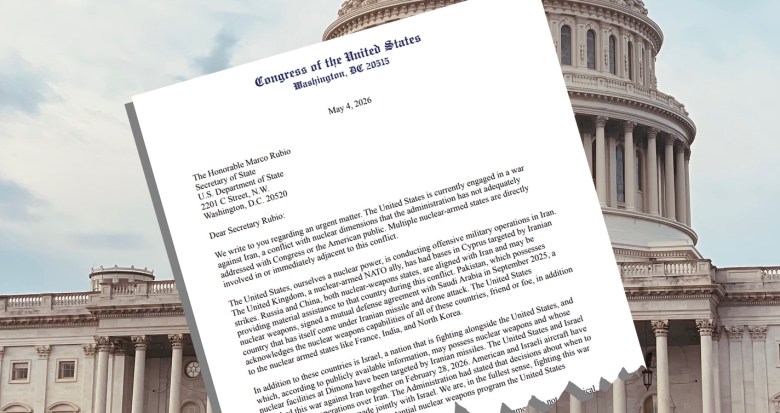
On May 4, 30 Democratic members of the House sent a letter to Secretary of State Marco Rubio asking something straightforward: that the United States end its decades-long policy of official silence about Israel’s nuclear weapons program. Led by Rep. Joaquin Castro of Texas, the 30 were not calling for sanctions. Not an arms embargo. Just transparency. Just the acknowledgment of what the entire world already knows.
Connecticut sent five Democrats to the House. Not one of them signed.
Before asking why, it helps to understand what is actually at stake in that silence — because this is not merely a matter of diplomatic courtesy. It is, at its core, a financial exercise being run on the American people.
Under the Arms Export Control Act and related U.S. nonproliferation law, the United States is legally prohibited from providing military assistance to countries that possess nuclear weapons but refuse to submit to international safeguards — countries that have not signed the Nuclear Non-Proliferation Treaty. Israel has not signed the NPT. Israel is widely understood to possess between 90 and 400 nuclear warheads. And yet the United States sends Israel approximately $3.8 billion in military aid every single year.
How is this legal? It is legal because we have collectively agreed never to say out loud what we all know to be true. The moment an American official formally acknowledges Israel’s nuclear arsenal, the law kicks in. The aid pipeline becomes legally indefensible. So, we don’t say it. Israel doesn’t say it. And the money keeps flowing.
This is the arrangement that 30 House members had the courage to challenge, and that Connecticut’s five representatives chose not to join. Call it what it is: a conspiracy of silence that exists to protect a funding stream, dressed up as foreign policy.
Meanwhile, here in Connecticut — and across this country — we are told there is not enough money. Not enough for Medicaid. Not enough for SNAP, the food assistance program that keeps working families from going hungry. Not enough for crumbling infrastructure, for affordable housing, for the tens of thousands of Americans sleeping on the streets tonight. We are asked to accept cuts to these programs as fiscal necessity, while $3.8 billion exits the country annually under legal cover that depends entirely on a lie everyone is required to pretend is the truth.
I am not naive about the pressures on Connecticut’s delegation. The downstream consequences of breaking this silence are real, the lobby’s reach is long, and none of these members represent districts that reward foreign policy courage. But that is precisely the point. The courage costs something. That is what makes it courage.
Thirty members of Congress looked at this arrangement and decided to name it. Five from Connecticut looked at the same moment and decided otherwise. I want to hear them explain why — not in a fundraising email, not in a carefully worded statement, but plainly, to their constituents, who are also the taxpayers underwriting this silence.
What would it take? That is the question I asked last month about Sen. Blumenthal and the bulldozers. I am asking it again. I suspect I already know the answer, and I suspect so do they.
Joseph Luciano is a Bridgeport resident and longtime Connecticut Democrat.