



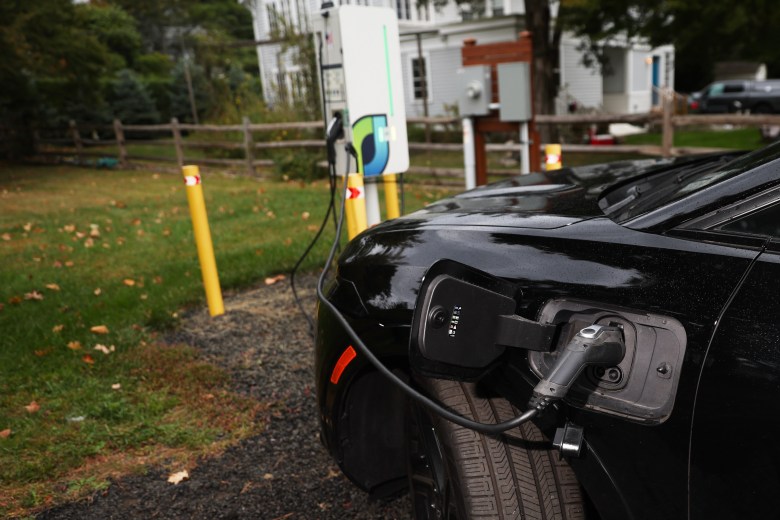
This suggested opinion piece is in response to Jim Cameron’s column regarding a proposed EV tax.
The state of the air is not good. The “State of the Air” is the name of a report issued annually by the American Lung Association. And the most recent edition tells us that seven of Connecticut’s eight counties get a grade of “F” for Ozone pollution (Windham gets a C). Five of eight counties get a “D” for particulate matter pollution, and 707,181 children are at risk.

Cameron notes that Connecticut wants to reduce emissions. As well it should. The transportation sector accounts for about 40% of greenhouse gas emissions and 70% of nitrogen oxide emissions, a major contributor to smog, according to the Connecticut Department of Energy and Environmental Protection.
While emissions rate only a passing mention in the column, we should not overlook the very real impact they have. The New York University Marron Institute/American Thoracic Society “Health of the Air” report attributes 163 excess annual deaths and 9,634 excess major morbidity events (e.g. heart attack, chronic bronchitis, ER visits, etc.) in Connecticut due to poor air quality.
There is a lot of controversy around vaccines and autism. Vaccines don’t cause it. But you know what might be related? Air pollution.
A study published in The Lancet has documented measurable decreases in pollutants in places like Southern California where EV adoption is high. It further projects that with full EV adoption, nitrogen dioxide concentrations (a precursor to smog) would be reduced by 61%.
The Special Transportation Fund and EV taxes
The reasons the fund faces operating deficits are improvements in the fuel efficiency of internal combustion engine vehicles and choices made (or not made) by the legislature.
The federal Corporate Average Fuel Economy (CAFE) standards, augmented by the California Air Resources Board (CARB) standards, have led to an improvement in fuel efficiency of almost 40% over the past 25 years.
While transit construction costs were rising and internal combustion vehicles were consuming less fuel, gasoline taxes were not indexed to inflation or barely raised at all. There are two parts to the state gasoline tax. The first is an excise tax of 25 cents, which was last increased in 2000. The second gas tax is the gross receipts tax, which stands at 8.1% of the wholesale price and was last adjusted in 2013.
At current adoption levels, taxing EVs will in no way make up for operational shortfalls. In fact, raising the gasoline tax by 1 cent would generate 144%**(see note below) more funds than the proposed EV tax.
There’s a war out there
The economic impact of the Iran war demonstrates our vulnerability to major disruptions in the fossil fuel supply chain. These happen regularly, if not exactly predictably, e.g. Russia invading Ukraine and the political instability around the Arab Spring. The best responses, as many countries are finding, are renewables and EVs.
People are feeling pain at the pump. Even though the Trump Administration has gutted the fuel-efficiency standards, the trend toward greater fuel-efficiency (and lower tax revenue) is likely to continue at least while high gas prices are with us. Kelley Blue Book reports sales of hybrids are up 9% for the first half of the year and by mid-2026 have reached an 18% market share.
Vehicle weight
Let’s dispense with the vehicle weight argument, which is a red herring. The vehicles that disproportionately damage our roads are fully loaded semi-trucks, which cause 1,000 times the damage that an EV would cause.
Also, even though an EV may be 10 or 15% heavier than its combustion sibling, that doesn’t really account for the distribution of vehicles on the road. The most popular EVs are the Tesla Model Y (3920 – 4,416 pounds) and the Tesla Model 3 (3,552 – 4,072 pounds). Compare that to the most popular internal combustion engine vehicles, –the Ford F-150 (4,021 – 5,950 pounds), Chevrolet Silverado (4,410 – 6,850 pounds), Toyota RAV 4 (3,370 – 4,300 pounds), Honda CR-V (3,300 – 3,926 pounds) — and it is not clear that EVs are responsible for adding extra weight to our roads.
Fossil fuel subsidies
A much bigger subsidy than anything going toward EVs is our continued (and recently expanded) subsidies of fossil fuels. Yale Environment 360 reports that “the amount of public money the U.S. will now spend on domestic fossil fuels stands at least $34.8 billion a year.” These are direct subsidies and do not account for the indirect impacts of extracting, transporting, refining and burning the stuff.
Imposing an EV tax will slow EV adoption at a time when we should be doubling down on promoting EVs for environmental, public health and national security reasons.
Simple or simplistic
When someone buys a gasoline vehicle, they can influence their gasoline expenditures based on their option to choose a fuel-efficient vehicle and their utilization. This proposed tax is a simplistic one-size fits all design. And you have the privilege of paying for three years of it upfront.
EVs should contribute to the maintenance of our transportation system, but in a way that acknowledges the damage that burning fossil fuel causes. The subject deserves a more carefully considered approach. For example:
- At what level of EV adoption should we begin to phase in some kind of tax?
- There are other options besides registration fees being tried in other states. What have we learned from the results?
- The current gasoline tax level is not sacrosanct. It should be raised (though this is an admittedly difficult moment).
- According to Cox automotive, the purchase premium for a new EV sits at $5,500. That means EV owners pay an extra $349 to buy an EV at the standard sales tax or $426 if the vehicle is subject to the luxury tax. EV drivers using public charging in the state pay sales tax on the juice (gasoline has no sales tax).
- A holistic design should take these factors, and the multiple levers available into account.
===========================================
**Here’s how I came up with the 144% number:
There are 47,441 battery electric vehicles. At $250 each, this would yield $3,953,417.
There are 25,416 PHEVs. At $62.50 each, this yields $529,500. Total $4,482,917
There are 2,305,954 registered vehicles in Connecticut.
Deducting for EVs, that leaves 2,233,097.
If they are driven an average of 12,000 miles annually, that comes to 26,797,164,000 miles. Divided by 24.5 MPG used in the column, that is 1,093,761,796 gallons. An additional 1 cent per gallon yields $10,937,618.
Barry Kresch is President of the Electric Vehicle Club of CT.