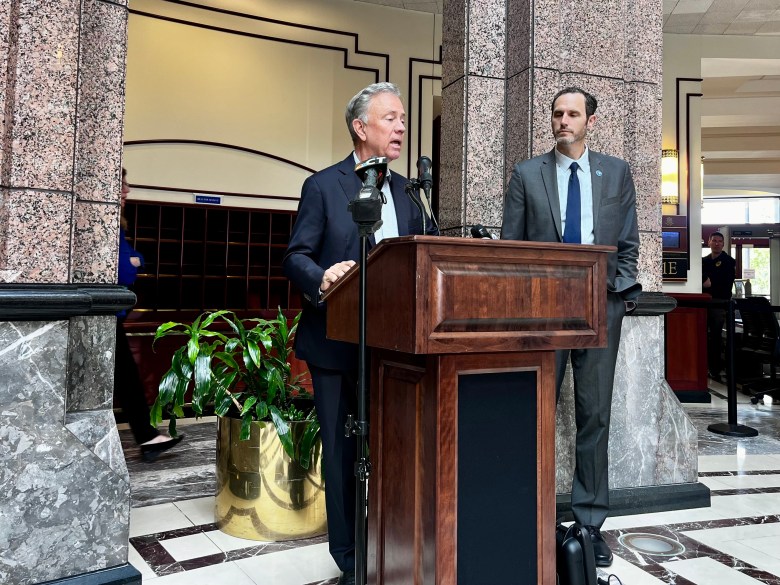
The first four developments paid for through the Connecticut Municipal Development Authority, including housing, a museum and downtown retail space, got approval on Friday for about $19 million in bond funding.
Connecticut’s State Bond Commission approved about $652 million in funding for statewide projects, school construction, upkeep of state facilities and purchasing of electric vehicles.
The Connecticut Municipal Development Authority, formerly called the Municipal Redevelopment Authority, was established in 2019 as an unfunded entity and officially got money and started work in 2024. The authority partners with municipalities to help them reconfigure their zoning to allow more housing and transit-oriented development, particularly in downtown areas.
More than 40 towns are member agencies. Once towns are member agencies, developers can apply to the authority for funding.
The agency has been a favored initiative of Gov. Ned Lamont and is one of his administration’s answers to a looming housing crisis partially borne of restrictive local zoning that makes it hard to build apartments.
“The demand is there for housing. We need more housing to make sure that people can continue to move to the state, stay in the state, young people can stay in the state,” said Lamont, who chairs the commission, during Friday’s meeting.
The money the bond commission distributes has already been approved by the state legislature. The government typically issues bonds for capital improvement projects and other high-cost items, meaning that private investors can purchase the bonds and essentially lend the government money for a set length of time.
Much of the CMDA’s funding comes through the bonding process.
The first four projects to get funding approval are in Enfield, Norwich and New London.
The commission approved $9.4 million to build more than 150 apartments in Enfield, near a station planned to be a part of the Hartford Line. That project will have 20% of its units set aside as workforce housing, or housing that’s affordable to working residents.
In Norwich, the commission approved $3 million for redeveloping an office building in the downtown area. It will be a mixed-use development with 58 apartments and commercial space.
There are two projects in New London — one for $5 million to transform the former New London Day newspaper campus into apartments, a ground floor museum and retail space. The other is a $2 million bond to create apartments alongside ground-floor commercial space and a public market within walking distance of the train station.
“This is kind of the greatest place that we could have hoped to have been at, which is within two years, starting to move funding into housing development, and it’s explicitly housing development that hits those co-benefits of downtown revitalization, economic development, transit ridership and transit-oriented development,” said David Kooris, executive director of the authority.
Lamont said he’s excited to see further investments in housing and particularly transit-oriented development.
The single largest item on the agenda was $486 million in borrowing to improve the state’s aging transportation infrastructure. That included $6 million in continued investments in technology combatting wrong-way driving.
“The wrong-way driving technology, I find fascinating. We’ve got that at locations, a couple hundred locations, and we’ve turned around probably 800 or 900 cars that were going the wrong direction,” Lamont said.
Lamont, who is running for a third term as governor, focused his comments at the meeting on his administration’s approach to borrowing, echoing elements of his reelection campaign: Borrowing is down as a percentage of the budget, and the proceeds reflect his administration’s priorities on transportation infrastructure and housing.
The governor credited a shift in economic development incentives — away from aid for large, well-established companies — as a factor in Connecticut’s recent burst of economic growth, which outpaced regional and national averages in 2025.
“Today, more and more of that money is going to small businesses, new business startups. That’s helping our economy grow. So we’re now one of the faster-growing economies in the country, which I think is incredible,” Lamont said.
Connecticut’s economy grew by 2.4% in 2025, ranking it 12th of the 50 states and the second-best in New England, after Massachusetts. National economic growth was 2.1%; New England’s was 2.2%.
Sen. Ryan Fazio, R-Greenwich, the GOP nominee for governor and a member of the commission, reminded reporters after the meeting that Connecticut lagged national growth when measured over eight years.