



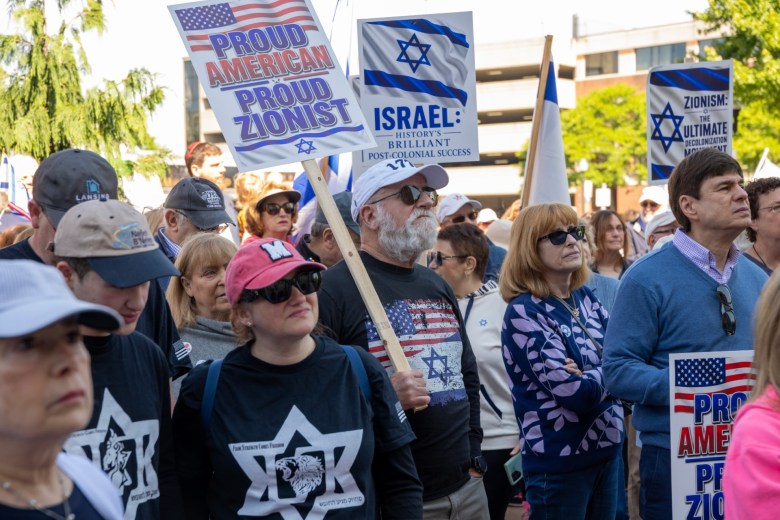
On a beautiful Sunday morning, I joined hundreds of others on the lawn in front of West Hartford Town Hall for a march in support of Israel, organized by CT for Israel.
Families arrived pushing strollers. Teenagers stood beside Holocaust survivors. Rabbis, students, grandparents, and community leaders greeted one another. Some carried signs reading, “Proud American, Proud Zionist.” Others wore shirts displaying the flags of the United States and Israel side by side.
As many Connecticut residents headed for golf courses, gardens, and hiking trails, we gathered publicly to say that Israel’s existence, security, and future matter.
It was supposed to be my second march in a week. A few days earlier, I had planned to march in my town of Avon’s Memorial Day parade as part of our commemoration of America’s 250th birthday. Rain forced the ceremony indoors, but I was still able to address the town at the Senior Center and bring to life the stories of seven young men from what is now Avon who gave their lives so that a new country, based on the radical claim that “all men are created equal,” could come into being.
That idea did not appear from nowhere. Its deepest roots are in the Hebrew Bible, which teaches that every human being is created in the image of God. No person is born with greater human worth than another.
So why did I march for Israel?
It is a fair question, especially at a time when Israel faces growing criticism from international organizations, college campuses, activists, and media outlets. Around the world, support for Israel has become increasingly controversial. Yet for me, marching for Israel and honoring America’s founding ideals are connected. Both ask whether imperfect nations can still be defended because the ideals they carry are worth preserving, improving, and passing on.
The answer begins with what Zionism means to me.
For me, Zionism is not a political slogan. It is the belief that the Jewish people, like every other people, have the right to self-determination in their historic homeland. It is the belief that after centuries of persecution, expulsions, discrimination, and ultimately the Holocaust, the existence of a Jewish state provides a refuge and a measure of security for a people who learned, often painfully, what can happen when they are dependent entirely on the goodwill of others.
That does not mean I believe Israel is perfect. I do not.
Like every democracy, Israel makes mistakes. Israelis themselves argue passionately about their government, its policies, and its future. I do not agree with every decision made by every Israeli government. Supporting Israel does not mean believing Israel is always right.
But my connection to Israel is rooted not only in history. It is rooted in values.
The Hebrew Bible teaches that every human being is created in the image of God. It commands us to pursue justice, care for the stranger, protect the vulnerable, and seek peace. Those teachings have shaped not only Judaism but much of the moral vocabulary of Western civilization. They are not values for Jews alone. They are values for all humanity.
When I think about Israel, I think about the remarkable survival of a people that carried those teachings through thousands of years of exile, persecution, and renewal. I see a modern nation connected to an ancient tradition that has contributed profoundly to humanity’s understanding of dignity, justice, and moral responsibility.
Many people criticize Israel today. Some criticisms are legitimate. Democracies should be criticized when they fall short of their ideals. Indeed, criticism is essential to democratic life.
What troubles me is when criticism moves beyond policy and becomes a challenge to Israel’s very existence.
I hear slogans and see movements that do not simply advocate for Palestinian rights but question whether there should be a Jewish state at all. I hear chants of “from the river to the sea” and “Globalize the intifada.” I see maps that erase Israel. I hear voices that speak not about coexistence but about replacement.
To me, that changes the conversation.
I can acknowledge flaws in Israeli policies while still believing that the elimination of the world’s only Jewish state would be a moral and humanitarian catastrophe. I can support Palestinian dignity and aspirations while rejecting demands that would effectively end Jewish self-determination.
None of this requires ignoring Palestinian suffering. The loss of innocent life in Gaza is heartbreaking. Every civilian death, whether Israeli or Palestinian, is a tragedy. Palestinians, like Israelis, deserve security, dignity, opportunity, and the ability to raise their children in peace.
I hope for a future in which Israelis and Palestinians both enjoy self-determination, prosperity, and safety. My concern is not that Palestinians should have fewer rights. My concern is that the answer to Palestinian suffering cannot be the elimination of the Jewish state. The challenge before the region is not choosing one people’s future over another’s but finding a way for both peoples to live side by side in peace and mutual recognition.
I also believe that discussions of Israel often fail to recognize the harsh realities of the region in which it lives. The Middle East is not a place where ancient antagonisms, sectarian rivalries, authoritarian rule, proxy wars, and ideological extremism are abstractions. They have taken an appalling human toll.
The Iran-Iraq War, from 1980 to 1988, killed perhaps 500,000 people, with total casualties estimated between 1 million and 2 million. Syria’s civil war, beginning in 2011, killed at least 306,887 civilians between March 2011 and March 2021 alone, according to the U.N. Human Rights Office, with broader estimates running higher. Yemen’s war, beginning in 2014–2015, was projected by the U.N. Development Programme to have caused 377,000 deaths by the end of 2021, including both direct deaths from fighting and indirect deaths from hunger, disease, and the collapse of basic services.
None of that excuses Israeli mistakes or Palestinian suffering. But it does help explain why Israelis and their supporters hear threats differently. Israel exists in a region where wars do not remain theoretical, where militias and states have repeatedly used civilians as targets or shields, and where promises of destruction have too often been followed by actual bloodshed. Israelis send their sons and daughters into military service not because they celebrate conflict but because they fear the consequences of vulnerability.
The sign I carried that morning declared, “Proud American, Proud Zionist.”
To me, those identities are not in conflict.
As an American, I cherish democracy, freedom, pluralism, and the rule of law. I know that America has not always lived up to those ideals. For nearly 250 years, we have argued, struggled, sacrificed, amended our Constitution, expanded rights, and challenged ourselves to make real the promise that all people are created equal. That unfinished work does not make the ideal false. It makes the ideal urgent.
I see Israel in a similar light: an imperfect democracy struggling, as all democracies do, to balance liberty and security while remaining faithful to its founding hopes. The right response to imperfection is not destruction. It is criticism, reform, courage, and continued commitment to human dignity.
Reasonable people can disagree about Israeli policy. Reasonable people can disagree about military operations, diplomacy, settlements, and the path to peace. Those debates should continue.
But that is not why I marched. I marched because I believe Israel’s existence matters.
I marched because I believe the Jewish people deserve the same right to national existence that we take for granted for every other people.
I marched because I believe the values rooted in the Hebrew Bible —human dignity, justice, compassion, responsibility, equality, and hope —remain worth defending.
I marched because I want a future in which both Israelis and Palestinians can live in security and dignity, with neither people asked to surrender its identity, history, or right to self-determination.
And I marched because when I see growing efforts to isolate, delegitimize, or even eliminate the world’s only Jewish state, I believe silence is not an option.
That is why, on a beautiful spring morning in West Hartford, a little more than a month before America’s 250th birthday, I chose to stand up and be counted.
Norman Sondheimer lives in Avon.