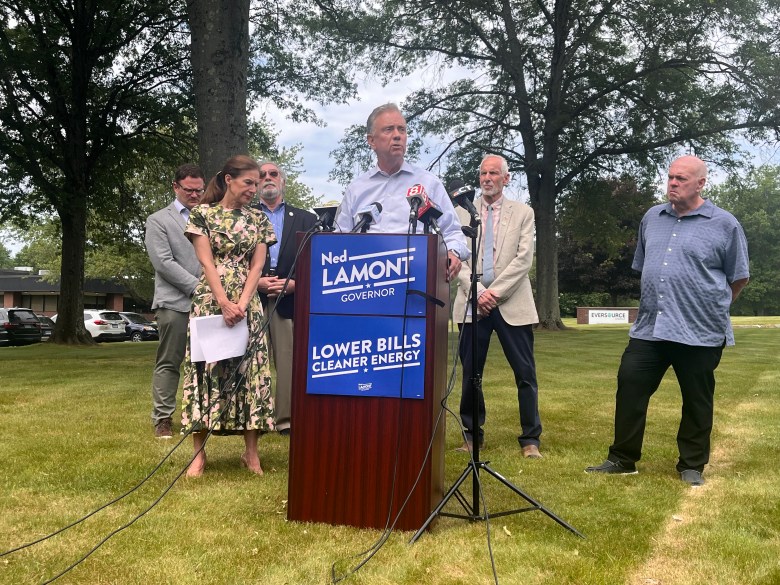
Faced with a request for a double-digit rate increase from the state’s largest electric utility — in an election year — Gov. Ned Lamont on Wednesday proposed a suite of reforms he said would target excess utility profits and require companies to periodically seek permission to continue operating as exclusive monopolies.
The backdrop for the announcement was a deliberate choice by the Lamont campaign: the front lawn of an Eversource work center in Cheshire.
With line trucks rattling behind him, Lamont accused Eversource of having grown too comfortable with its ability to raise revenue from its customers in Connecticut, adding that state regulators need new tools to hold all utility companies accountable during requests for rate increases.
The package of reforms introduced by the governor led with a proposal to require the state’s two investor-owned utilities, Eversource and United Illuminating, to have their franchise licenses reviewed and renewed on a regular basis by the state’s Public Utilities Regulatory Authority.
“Being able to have monopoly use of the poles here is not just a natural right, I think it’s a privilege,” Lamont said. “And I think you ought to earn that privlege every 15 years.”
In addition, the governor said he would seek penalties against utilities that fail to deploy new technologies to help customers control costs — such as more advanced “smart” meters — and give the state’s Office of Consumer Counsel subpoena power to investigate suspected wrongdoing by utility companies.
Lamont also said he wants to introduce competition into the utility market by allowing new companies greater flexibility to develop microgrids attached to fuel cells and solar installations. On the regulatory front, he said he would seek to require PURA to consider “affordability” as part of its criteria for setting rates and that utilities should have to perform a “cost-effectiveness analysis” before undertaking large infrastructure upgrades.
In a statement Wednesday, Eversource spokeswoman Jamie Ratliff said the company welcomed the governor’s “unexpected visit,” and offered to have him back for a tour and meeting with its employees.
“Over recent years, we’ve worked directly with the Lamont administration and other policymakers on multiple proposals that put customers first by lowering and stabilizing costs for residents and business owners across the state,” Ratliff said. “Some of these have been approved, others have been rejected. We are reviewing the concepts announced today to see if they align with the customer-centric focus that is always our top priority.”
A spokesperson for United Illuminating did not immediately respond to a request for comment on the governor’s proposals.
An outline of the governor’s plan released by his campaign later Wednesday provided a few more details about his proposals, which Lamont said he planned to introduce through legislation next year, assuming he’s reelected for a third term.
But the governor’s critics quickly attacked a lack of specificity they saw in the plan, as well as the timing of the announcement amid a reelection campaign in which the price of electricity has emerged as a key issue.
“None of these are new ideas and if they are so important, why hasn’t the governor passed some of them in the last eight years?” said Republican gubernatorial nominee state Sen. Ryan Fazio, R-Greenwich. “A third term, I don’t think, is the charm.”
Lamont is also facing a surpisingly strong primary challenge on his left from state Rep. Josh Elliott, D-Hamden. As part of his campaign, Elliott has proposed using eminent domain or a loosening of franchise rights to allow municipally-owned power utilities to expand within Eversource’s service territory.
“If the governor were serious about affordability, public power would be the centerpiece of his plan instead of absent from it entirely,” Elliott said in a statement Wednesday.
Currently, electric utilities operate under a collection of franchise agreements with individual towns dating back decades and, in some cases, over a century. PURA has the ability to revoke a utility’s franchise if it fails to provide adequate service, but a spokesperson said Wednesday that the agency is unaware of any instance in which that power was used against a large utility company “in recent memory.”
Lamont compared the electric utility model with his past experience owning a cable company, which have historically had to have their exclusive franchises renewed by regulators. The outline of the governor’s plan did not go into detail about what would happen to an electric utility that failed to have its franchise renewed, but Lamont suggested it would allow another utility company to take over.
“You don’t get a free ride, at the end of a period of time, you’ve got to earn your right that monopoly,” Lamont said. “Or maybe you’ve got to sell your wires to somebody else who perhaps can do a better job.”
Another Democratic governor facing reelection this year, Pennsylvania’s Josh Shapiro, recently wrote a letter castigating utilities in his state for requesting nearly $1 billion in rate increases, adding that the “the 20th century utility model is broken.”
That letter received a “lukewarm” response from the utility officials as well as a statement from the Pennsylvania Public Utility Commission asserting its independence, according to the public radio station WHYY.
Tom Swan, the executive director of the Connecticut Citizens Action Group, joined Lamont at Wednesday’s press conference and offered praise for the governor’s new proposals as a response to what he called a “dishonorable assault by utility companies” over the last five years.
“These are very good, thoughtful responses for dealing with the cost crisis,” Swan said. “We may not agree with every line we’ve written here, but it’s a damn good start that we look forward to working with and going forward on.”
Lamont also defended his own record on energy issues, including the negotiation of a power-purchase agreement with Millstone Nuclear Power Station in 2019 and signing three major pieces of legislation in recent years aimed at increasing oversight of utilities and reducing the cost of electricity.
One of those measures, last year’s Senate Bill 4, was recently credited with a steep reduction in the state’s public benefits charge that will result in savings of between $30 and $34 a month for the typical customer. Much of those savings are at risk of being erased, however, under the utilities’ proposed rate increases.
In May, Eversource announced that it would seek an 11% increase to its base distribution rates beginning next year. The request still needs to be reviewed and approved by the five commissioners at PURA, all of whom are Lamont appointees.