



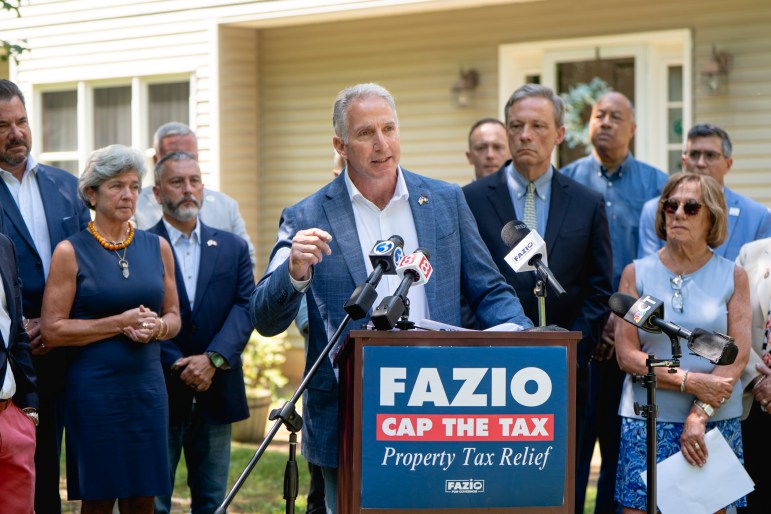
Republican gubernatorial candidate Ryan Fazio offered a blueprint Wednesday to reduce Connecticut’s over-reliance on municipal property tax, including boosting state education grants, reducing exemptions for private universities and hospitals and capping future mill rate hikes.
“Connecticut families need leadership and relief,” said Fazio, who unveiled his plan during a late-morning campaign stop in Hamden. “For more than eight years, politicians have talked about affordability while property taxes continue to rise and families continue to struggle. My plan will provide real relief, confront the root causes of increasing property taxes and cap property tax growth for the future.”
While state government uses a myriad of taxes — income, sales, business and utilities’ earnings, estate, liquor and cigarette consumption and others — to fund its operations, Connecticut leaves its cities and towns just one major revenue engine: the property tax.
But that levy generates more than any other single tax at either level of government. According to the Department of Revenue Services’ last major tax analysis, the property tax generated $12.5 billion in 2022, about $400 million more than the income tax.
Connecticut’s largest cities also struggle with the state’s highest property tax rates, which chokes business growth and, in turn, shifts more burden onto residential owners. Critics also oppose the property tax because it is regressive, meaning its rate does not vary relative to the taxpayers’ income or wealth.
Sending more dollars to local schools
Fazio, a state senator from Greenwich, didn’t offer specific fiscal projections for his plan but says he believes the strategy ultimately would boost aid to communities — and relief to local taxpayers — by hundreds of millions of dollars annually.
He centered his strategy on a plan to tie Connecticut’s chief operating grant for local schools to the rate of inflation.
The state will send almost $2.5 billion to schools next fiscal year through the Education Cost Sharing [ECS] program, which represents almost 9% of Connecticut’s entire budget.
Legislators and governors have been charged with allowing ECS to lag inflation for decades, although Gov. Ned Lamont and the General Assembly have made significant strides to reverse that trend since 2019.
The Consumer Price Index, a national measure of inflation, rose 2.7% during the 2025 calendar year. A 2.7% hike in ECS would trigger an extra $66 million for local school districts.
And while average state surpluses over the past decade have surpassed that number many times over, Connecticut’s budget is subject to a spending cap that ties its own growth to household income and inflation. The adopted budget effectively has no room for added spending under the cap.
Lamont’s campaign spokesman, Rob Blanchard, noted Fazio and other minority Republicans in the state Senate were the only caucus to offer no plan to balance state finances and remain cap-compliant in the next fiscal year.
“Gov. Lamont and Democratic lawmakers have an actual record of delivering property tax relief to Connecticut families, relief Fazio voted against,” Blanchard said. Lamont and the Democratic-controlled General Assembly built $280 million in additional aid for schools and other local government needs into the latest state budget. Lamont also signed the largest income tax cut in state history into law in 2023, delivering about $300 in annual relief to many middle-income households.
“Fazio’s approach breaks the fiscal ‘guardrails,’” Blanchard added. “It’s as outrageous as it is unachievable.”
But the GOP candidate countered it is achievable, provided Democratic legislators change their big-spending habit.
Democrats have approved raises of about 4.5% for state employees yearly since 2022, something Republicans say exceeds pay hikes most private-sector workers receive. The GOP also has charged Democrats with being too generous with Medicaid benefits for undocumented children and for allowing the state’s regional university and community college system to amass huge reserves, even while imposing tuition hikes.
Curbing tax breaks for hospitals and universities
Fazio also estimated he could channel tens of millions of dollars annually, possibly as much as $100 million, into local coffers by curbing or ending longstanding tax breaks for nonprofit universities and hospitals.
Connecticut for decades has said these institutions don’t have to pay full property taxes on most of their holdings.
But Fazio wrote in his plan that some institutions, such as Yale University and its $44.1 billion endowment, “effectively operate as corporations.”
He added that many large universities and hospitals have purchased numerous parcels within their home communities, taking too much property off the taxable rolls.
“When you have a city like New Haven with a sky-high property tax,” he said, “It’s just not fair to those residents,” who must compensate for these exemptions for nonprofits by paying more themselves.
This proposal likely would receive significant pushback if ever brought to the General Assembly.
“Connecticut hospitals make substantial contributions to the state and their communities, paying hundreds of millions annually in taxes with approximately $500 million retained by the state,” the Connecticut Hospital Association wrote in a statement Wednesday. “At the same time, hospitals provide care to Medicare and Medicaid beneficiaries at an annual loss of $3 billion and to uninsured and underinsured individuals providing hundreds of millions in uncompensated care.”
Testifying against a similar proposal in 2025, the Connecticut Conference of Independent Colleges wrote that most states provide these exemptions because nonprofit colleges play a critical role in educating future workers while having a $16.5 billion annual impact on the state’s economy.
The conference also noted that about 70% of its members’ students stay in Connecticut after graduation.
Capping local tax increases and stopping unfunded mandates
Fazio said Connecticut has one of the highest property tax burdens in the nation, according to the Tax Foundation, and has to take major steps to reverse this.
“Your property tax bill shouldn’t feel like a second mortgage,” he said. “Spiraling tax bills are unacceptable, and the problem has only gotten worse under eight years of Gov. Lamont.”
The GOP gubernatorial contender also proposed capping municipalities’ ability to boost local taxes by 2% or the inflation rate — whichever is greater — and challenging the legislature not to issue any new mandates on cities and towns unless it’s prepared to pay for those directives out of the state budget.
The executive director of the Connecticut Conference of Municipalities, Joe DeLong, praised Fazio for supporting mandate relief and linking education aid growth to inflation.
But while local officials would be open to discussing a cap on taxes, DeLong said, it’s crucial that no cap block improvements needed to attract new businesses and expand the local economy.
Communities “have to be able to adjust spending to meet growth in the community,” DeLong said. If municipalities can’t attract new development, “they’re shifting the [tax] burden onto everybody else.”
Fazio’s plan would allow communities to boost taxes greater than the cap limit but only if approved by local voters at referendum by at least a 60% margin.
