



Irony is not generally considered patriotic. But reflecting on the many absurd juxtapositions we saw over the July 4th weekend just may be the most sensible response to this particular national anniversary. The examples were everywhere, and impossible to miss:
The image of one lone black woman on a D.C. train, unmasked and stoic, surrounded by neo-Nazis too ashamed to show their faces.
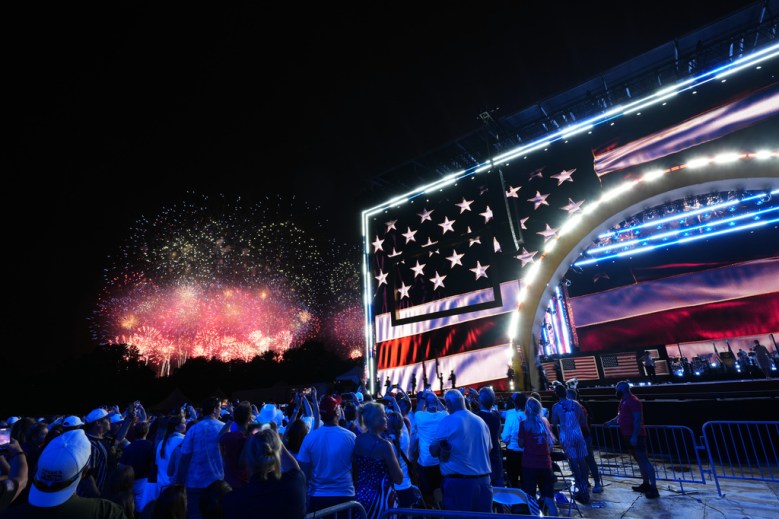
A fireworks display so incompetently planned that it resembled nothing so much as the smoky sky over Tehran after Israeli airstrikes on Iranian oil refineries. Fairgoers fled in droves, a new kind of “huddled masses yearning to breathe free.” Meanwhile, as pops of indistinguishable color punctuated the toxic cloud that drove people inside, New Yorkers rode the elevated portions of subway lines and looked in awe at the fireworks bursting colorfully and clearly over the East River.
The group of resentful Trump followers forced to take refuge from the rain in the Museum of African American History and Culture, walking slowly past life-sized statues of Olympians Tommie Smith and John Carlos (of the iconic “Black Power” salute), astronomer Benjamin Banneker and educator/activist Mary Mcleod Bethune.
Under The Sun Productions, the contractor overseeing the National Independence Day Parade cancelled because of the heat, relied on weather updates on the National Park Service, whose budget and staff Trump has decimated.
Attendees at Trump’s Fair fought with guards who tried to evacuate them for their own safety, while hundreds of Bostonians gathered peacefully under the Storrow Drive Underpass and sang “My Country ’Tis of Thee” until the rain subsided.
And leading up the July 4th revelry, sporadic joyful bursts of pride in the fact that six of the 26 players on the USA Men’s Soccer team were born outside the United States, to the chagrin of a president who believes immigrants “poison the blood of our country.”
Kicking off a week of self-congratulatory speeches masquerading as solemnity, Trump spoke in front of Mount Rushmore, a place sacred to the Lakota Sioux people, who call it Tȟuŋkášila Šákpe (Six Grandfathers). Stolen from them in 1870 when gold was discovered there, it was the perfect place for Trump to claim America will never let “a band of thieves, radicals, and lunatics…come in and loot and pillage our nation.” This was just a few days after acknowledging he made more than $2 billion now that he’s back in the White House.

No matter. In truth, America’s July 4th commemorations have been ironic from the start. During the “Jubilee of Independence,” two of the remaining Founding Fathers, John Adams and Thomas Jefferson, died on July 4, 1826 — 50 years to the day after signing the Declaration off Independence.
When the nation turned 100, in 1876, Philadelphia’s Independence Hall celebrations were interrupted by members of the National Woman Suffrage Association, who presented their own Declaration of the Rights of Women.
The Sesquicentennial Exposition of 1926, marking 150 years, didn’t fare much better. A lavish World’s Fair, which, interestingly, also featured a heavyweight boxing match, this July 4th extravaganza lost millions of dollars and was deemed by the press at the time “America’s Greatest Flop.”
Indeed, Independence Day has always been set against a backdrop of turmoil. Still, I remember the excitement that infused the Bicentennial of 1976.
Fifty years ago, an estimated 90 percent of Americans attended a parade, fireworks, or an historic re-enactment, according to the American Revolution Bicentennial Administration (a federal agency created to oversee the effort and disbanded in 1977). The day’s New York Times reported seven million people flocked to Manhattan to watch the Tall Ships enter New York Harbor. And, according to Newsweek, 500,000 came to Washington, D.C. for the official Bicentennial Parade.
In acts communal and private, grand and small, citizens celebrated all that is good about America, even as we struggled to recover from the Vietnam War, Watergate, a 7.7 percent unemployment rate, and what then-president Gerald Ford termed “stagflation.”
The Bicentennial year, 1976, helped advance the modern environmental movement and Earth Day. It was a time when popular culture — even advertisements — echoed a new understanding of the importance of protecting the earth. I was a teenager in 1971 when Chiffon Margarine ran a tongue-in-cheek ad about the hubris of a stick of engineered trans fat masquerading as butter. “It’s not nice to fool Mother Nature” became a catch-phrase of the day.
It seems this past July 4, Mother Nature had her revenge. Trump’s parade and fair were literal and figurative washouts. Many in our nation gave it their best shot — town governments across the country “reaffirmed” their commitment to the U.S. Constitution. Refusing to let the alt-Right “own” the American flag, many waved it in protest of the current regime, a brave but desultory attempt to keep our heads above turbulent waters.
Meanwhile, I choose not to revel in fireworks, but to watch instead the most spectacular light-show I’ve ever seen. For more than an hour on this July 4th, the sky flashed and blazed hot and white, like the rage of a mother watching someone harm her child. The rain lashed and the wind toppled trees. There was no thunder, just the brilliant, silent white light illuminating our folly, and the irony of it all.
And then, on July 5th, the sun came back out for a while. The air hung heavy with the threat of more rain, as if to ask us: are you paying attention yet? What have you learned?
*This commentary was corrected to reflect Under The Sun Productions’ role in the Independence Day celebration in Washington, D.C.
Christine Palm, who served three terms in the State Legislature, is founding director of The Active Voice, a leadership program for young environmentalists.