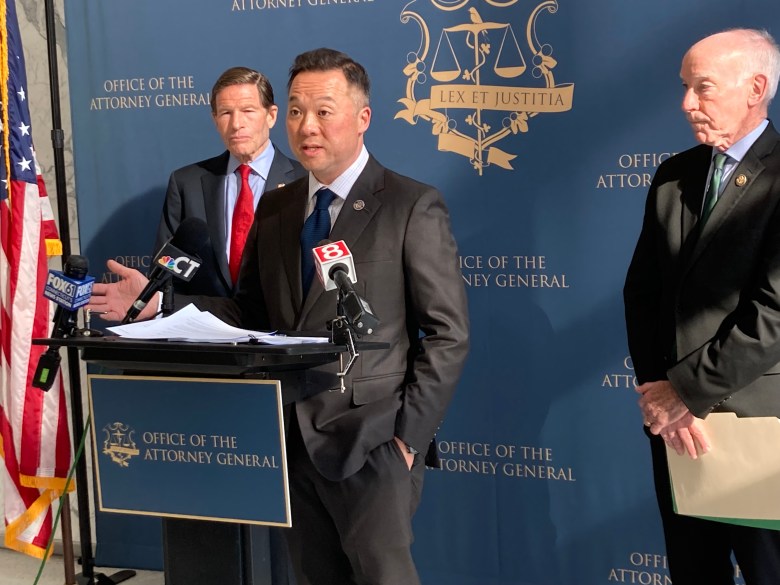
Connecticut joined 19 other states and the District of Columbia on Tuesday in filing a second lawsuit against the Trump administration over changes to a federal housing program that states say could leave tens of thousands of people homeless.
The lawsuit challenges a June 1 funding notice from the Department of Housing and Urban Development (HUD) that directs $1.3 billion toward projects prioritizing transitional or temporary housing while people seek permanent homes. The states said the changes could put at least 97,000 residents nationwide, who rely on permanent housing programs, at risk of losing their homes.
“Trump tried to impose drastic, cruel conditions on homelessness funding that would have thrown thousands of people out of their homes and onto the streets. We sued, we won, but now Trump is back at it again. His cruelty truly has no bounds,” Connecticut Attorney General William Tong said in a statement. “We are heading back to court, and we will keep fighting for as long as it takes to protect safe and stable housing,”
The states argued that HUD’s actions violate the Administrative Procedure Act, and they asked the court to permanently block them from implementing new rules.
When the Connecticut Mirror asked HUD for a comment on the new lawsuit, HUD referred to its comment following last month’s court ruling.
“HUD fully stands by our objective to reform America’s failed homelessness system, which has relied almost exclusively on permanently warehousing the homeless at exorbitant taxpayer cost while ignoring root causes. The ‘Housing First’ approach has funded this self-serving homeless industrial complex, enabling dangerous encampments, addiction, and government dependency,” a HUD spokesperson wrote at the time, in an emailed statement.
Last month, the states won a separate federal court case against HUD over changes to funding for what are called “continuums of care,” or the regional groups that organize efforts to address homelessness. Those changes prioritized funding for programs that require sobriety, push people into stays at psychiatric facilities, ask about immigration status, and recognize only two genders.
A federal judge blocked those changes, preserving more than $3 billion in homelessness funding. However, the ruling did not permanently stop HUD from making similar changes in the future, according to the court order.
For years, HUD had favored a “Housing First” model, which holds that a person’s underlying issues can be more easily addressed once they have secure housing. The Trump administration has taken a different approach, saying in 2025 that the prevailing approach had failed to address “the root causes of homelessness, including illicit drugs and mental illness.”
This shift has drawn opposition from Connecticut lawmakers and housing advocates who said in a press release Tuesday that they would continue challenging the proposed changes.
Housing Committee co-Chair Rep. Antonio Felipe argued that local providers had met community needs with the Housing First model.
“Funding should not be contingent on approach, it should be contingent on results and as our providers continue to meet the moment we must support them,” he said.
Housing Committee co-Chair Sen. Martha Marx said the administration was continuing to pursue changes that “go against all effective policies to support people experiencing housing insecurity.”
House Majority Leader Jason Rojas said the administration was trying to “advance the same harmful conditions under a new name” after losing its previous case.
Chair of the legislature’s End Homelessness Caucus Rep. Kadeem Roberts said the lawsuit seeks accountability. “When systems meant to serve the most vulnerable fail, silence is not an option,” he said.
Continuums of care provided rental aid to nearly 6,000 households in Connecticut, as of 2025. Many of those formerly homeless people are in permanent supportive housing, which means they have disabilities and receive services at their homes.
Connecticut Balance of State, a statewide group of homelessness service agencies, received roughly $75 million in federal continuums of care funding last year. Millions more went to local homelessness agencies across the state.
Meanwhile, Connecticut’s homeless population has been rising. It reached 3,487 in early 2026, up 3% from a year earlier, according to an annual count conducted by the state. Homelessness in Connecticut also rose year-over-year in 2024, by 13%, and in 2025, by 9%.
“At a time when more people are struggling to afford housing, we should protect the tools that work, not make it harder for states and local communities to bring people indoors and keep them there,” said Sarah Fox, chief executive of the Connecticut Coalition to End Homelessness.
Kevin Rivera, a spokesperson for Gov. Ned Lamont, said Connecticut would continue challenging changes to homelessness programs that undermine effective housing strategies.
“In Connecticut, we know stable housing is a critical foundation. As the federal government builds new roadblocks to funding proven strategies for homelessness prevention, Connecticut continues to put real resources behind these programs and joins other states in fighting the administration’s attempts to change the rules on programs it doesn’t like without giving the public a chance to weigh in,” Rivera wrote in an emailed statement. “We will keep fighting, because everyone deserves the stability and dignity that comes with having a place to call home.”