


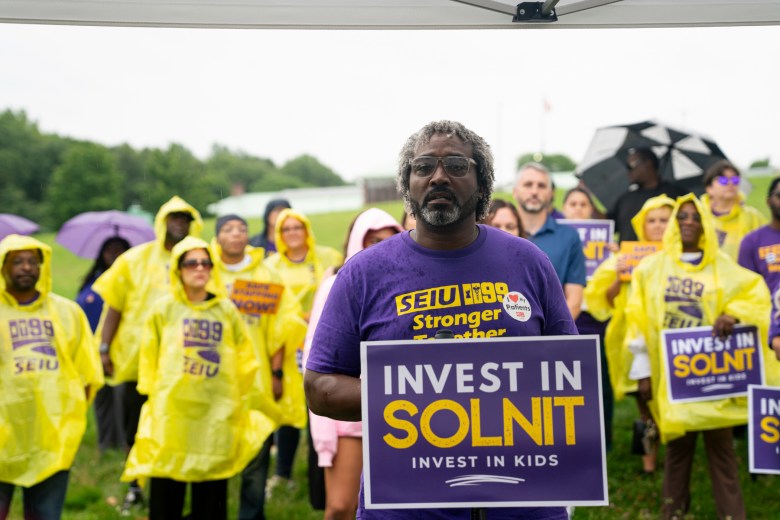
With a rare window opening next year allowing Connecticut to negotiate the terms of state employee retirement benefits, union leaders are making an early and unusual push Thursday with Gov. Ned Lamont and his Republican challenger, state Sen. Ryan Fazio, to frame those talks.
The governor, who won a Democratic primary Tuesday by a 2-1 margin and is favored in early polling to win a third term in November, and Fazio are meeting with representatives of 45,000-plus unionized state employees at a closed-door forum at Charter Oak International Academy in West Hartford.
Previous contracts establishing long-term benefits have been set in increments of 10 or even 20 years, raising the stakes for labor and the state.
Coming after the primary and as the general-election campaign takes center stage, the event has the trappings more of a political and lobbying effort than collective bargaining. The unions are offering limited press coverage at the start of the event before the doors close and talks begin.
The fiscally moderate governor has frustrated labor by steering $11 billion since 2020 into debt reduction and away from spending on current services. And while most employees have enjoyed annual raises averaging 4.5% for most of Lamont’s tenure, he repeatedly challenged them this spring to roll back flexible work-from-home rules established during the COVID pandemic.
Fazio will not be offering labor any leverage to make Lamont more generous or pliable.
The state senator from Greenwich says Lamont has been too loose with state budget policies and should have generated even more savings to ease Connecticut’s debt burdens. The GOP nominee said Wednesday that state employee retirement benefits, which have been scaled back three times in the past 17 years via concessions deals, need to be tightened further.
“Connecticut’s state workforce keeps our roads and bridges safe, cares for children and families in crisis, protects our air, water and food, staffs our colleges and universities, administers critical health and safety programs and provides hundreds of other services that residents rely on every day,” the State Employees Bargaining Agent Coalition wrote in a statement this week advancing Thursday’s forum. “Few elected officials have more direct influence over those services than the governor.”
SEBAC, which represents all major employee groups except the state police troopers, faces a crucial test during the first six months of the next gubernatorial term, which begins in January.
The coalition will try to negotiate a new contract that will preserve or revise the pension and retirement healthcare benefits workers have enjoyed for decades.
Gov. John Rowland, a Republican, and the coalition struck a controversial deal in 1997 that guaranteed these benefits for 20 years, limiting the bargaining power of his successors.
Gov. Dannel P. Malloy, a Democrat, extended that system for another decade, from mid-2017 through June 30, 2027. It was the price labor extracted for ratifying concessions packages in 2011 and 2017 that delivered the multiyear wage freezes and benefit cutbacks Malloy needed to balance budgets during the protracted fiscal crisis following the 2008 recession.
Unions also approved a 2009 agreement with Gov. M. Jodi Rell, the Republican who served between Rowland and Malloy, that increased worker contributions toward retirement healthcare.
In talking with labor on Thursday, the governor and his challenger will be keeping two audiences in mind: the union members, who eventually will vote on a new contract, and the voters who will choose between Lamont and Fazio in November.
Lamont noted that the billions he has saved during his first two terms have bolstered cash-starved pension funds for state employees and for municipal teachers, easing pressures on seeking further concessions.
“It also means they have a pension they can count upon,” Lamont said. “They weren’t sure about that eight years ago.” The average annual state employee pension in 2025 was $44,961, according to the state comptroller’s office’s OpenPension website.
Connecticut amassed tens of billions of dollars in pension debt by not saving for these benefits for more than seven decades prior to 2011. Future generations not only had to make up these missing deposits but also the massive investment earnings that could have been achieved. The state still owes more than $30 billion in this area, a burden expected to pressure state finances well into the 2040s.
Fazio has criticized Lamont for not saving even more to shrink this hefty debt. And given that, and the high state and municipal taxes many households and businesses face, Fazio added, Connecticut should tighten retirement benefits again before extending them next summer.
“I think it would be fair to see there needs to be reforms or changes made to make the long-term state of the state more sustainable,” Fazio said, adding that Connecticut must be fair to its taxpayers and to its employees.
The Republican nominee also said the work agreements that allow many state employees to perform their jobs remotely need reform as well.
Fazio said his administration would look closely into key positions that necessitate work be performed in-office and on-site, such as social workers responsible for monitoring child abuse cases.
“They clearly need some changes,” he added.
Lamont said Wednesday he still believes “We [can] talk about that a little bit going forward” about limiting some remote work rules.
But the governor expressed confidence that the issue is manageable.
“Two-thirds of our people show up in person day day,” he said. “Some people can work very efficiently remotely, so we’re trying to get that balance right.”
The governor added he believes most state employees “do amazing work” and validated some union leaders’ concerns about staffing levels. “In some categories, we need more people. So please, if you want to be a state employee, here’s a pretty good time to apply.”
Fazio expressed disappointment that Thursday’s forum would be closed to the public and to most of the media. The union coalition said one news photographer and one videographer would be allowed in for a few minutes prior to the forum’s staff to capture images and scenes and then would have to leave. The coalition also said its leaders would be willing to discuss the forum with the media after the event.
But Fazio said those restrictions wouldn’t stop him from attending. “I have an attitude,” he added, “that you go everywhere and you listen to everyone and you talk to everyone, whether they’re inclined to vote for you or not.”
