



Ryan Fazio, a Republican from Greenwich, ventured north on a late-summer Sunday to pray and campaign at Black churches in Bloomfield, a dauntingly Democratic suburb of Hartford. He sat in seats occupied two Sundays prior by Gov. Ned Lamont, another son of Greenwich, the one holding the job Fazio desires.
At the Rehobeth Church of God, where most worshipers have familial ties to Jamaica and other islands in the West Indies, gray-haired Bishop Jonathan Ramsey preached in a thunderous voice about prayer and possibilities — but also the futility of denying that whatever comes will be by God’s plan.
“You are not in control,” Ramsey said. “God is in control.”
Rehobeth worships in the passionate tradition of Pentecostals. Congregants surrender to the Holy Spirit, responding to a preacher in murmurs, shouts or hands waving high. Fazio, a Catholic engaged to an Episcopalian, worshipped less demonstrably. His was not among the voices shouting, “Amen.”
Fazio is 36, a state senator, a former commodities trader and Connecticut’s youngest gubernatorial nominee since 33-year-old Congressman John G. Rowland ran and lost in 1990, the year Fazio was born. Rowland succeeded on a second try in 1994 and would win three terms, the record Lamont is trying to match.
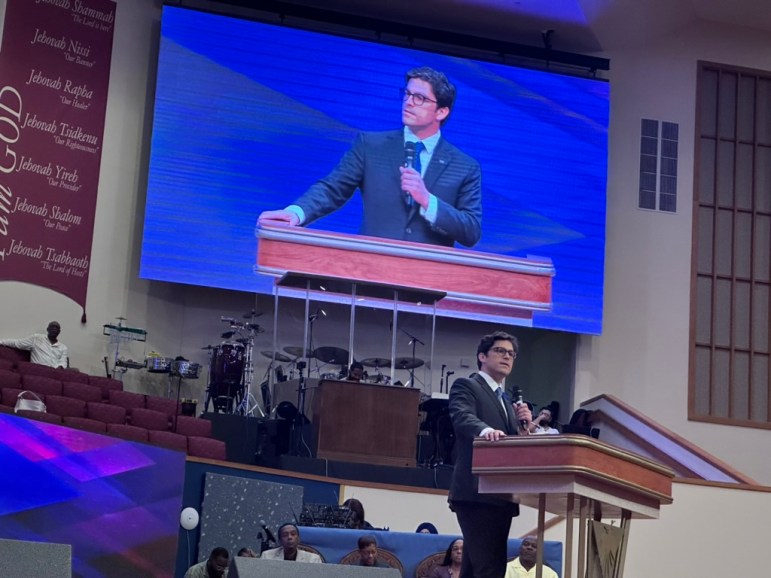
Called to speak from Rehobeth’s half-round altar in an amphitheater-style sanctuary that can seat 900, Fazio sought common ground with references to the apostle Paul’s letter to the Galatians about Christ and the candidate Ryan’s message to the Nutmeggers about property tax reform and cheaper electricity.
“Paul wrote to the Galatians we are all one in Christ Jesus, we are all created in the love of God,” Fazio said. “We should always remember that.”
And also that taxes are too high, electricity too expensive.
“It feels like the property taxes are like a second mortgage, and the electric bills are like rent,” Fazio said. “And I think we could do more to make the state affordable to ensure that we have opportunity, education and hope for everybody. So I’m so appreciative of you allowing me to be here today, and I’m looking forward to worshiping with you this morning as well.”
The road ahead is steep and not clearly mapped for Fazio. Rowland’s victory was 32 years ago, coming in an open race after the adoption of an income tax under a third-party governor, Lowell P. Weicker Jr.
Whether God’s plan or not, it’s been 72 years since anyone has unseated a Connecticut governor.
Fazio is a millennial carrying cautious hopes of a Grand Old Party staggered by four successive cycles of losses in Connecticut and fears of a fifth, all in the decade since President Donald Trump has redefined the party in his image with hostility to free trade, undocumented immigrants and any notion of addressing climate change.
Fazio is a believer in free-market competition shaping public policy. He favors school choice and is a fan of charter schools like the KIPP Academy in the South Bronx, where he tutored middle-school kids for several years after college. He is dubious about single-payer health care. Or that offshore wind ever will be a good deal for electric ratepayers. And he worries about Major League Baseball.
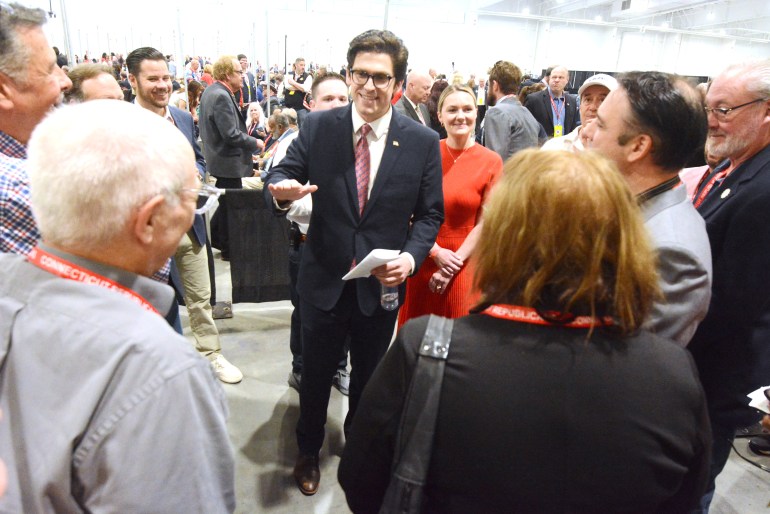
He is tall with thick dark hair — good candidate hair, as more than one colleague has lightly observed. He was a high school athlete but gives off the vibe of a kid who always did his homework. He wears roundish, dark-framed glasses and enjoys writing long policy assessments for conservative journals and punchier ones for the New York Post. He can be playful on social media, but admirers acknowledge he is blessed with more earnestness than charisma.
In other words, not unlike a certain other fellow from Greenwich.
As summer winds down, Fazio is fine-tuning the tenor and tone of a campaign that must simultaneously raise his own profile and destroy Lamont’s brand as a fiscal disciplinarian who has used an extraordinary run of budget surpluses to pay down debt and deliver the first significant cut to the income tax since its passage.
Fazio argues that the 72-year-old Democrat, whose moderate fiscal policies inspired a primary challenge from a liberal seeking freer spending and higher taxes on the wealthy, made a significant and largely overlooked shift to the left on budgetary issues in the past two years.
“That will be part of the campaign and the debate,” Fazio said. “But honestly, if the governor had stuck to his guns on fiscal and economic issues and was running for a third term — if the governor was the same governor he was in 2021 or 2022 — I might not have run for governor.”
It is true that Lamont has legally exceeded the state’s spending cap to bolster spending for Medicaid and municipal grants in the past two years, and he has shifted nearly $1.3 billion off budget, mostly to expand affordable child care and shield human services from federal cuts. Those are things Lamont is happy to talk about.
It also is true that Lamont has done that while keeping a $4.5 billion budget reserve equal to 18% of the general fund, the maximum allowed under law. And he used another $2.9 billion in surplus funds to shrink a massive unfunded pension liability, which is about 16% less than previous years.
Rehobeth was the second of two churches Fazio visited on the same Sunday morning in Bloomfield, one of two suburbs on Hartford’s northern border that are the heart of a Black middle class and its religious life. The other is Windsor. Median household incomes in the two communities are more than double Hartford’s; home ownership rates, roughly triple. Both churches were founded in Hartford.
The first stop was First Cathedral, a rare New England megachurch with a membership of 11,000, a sanctuary that seats 3,000 and a network-quality livestream. It was First Baptist when established in 1968, taking over a vacant synagogue across from Hartford’s sprawling Keeney Park. Led by a minister from Memphis, Leroy Bailey Jr., the Baptists bought 40 acres in Bloomfield in 1998, and the new Cathedral opened there in 1999.
Fazio is aware that Black churches are not fertile fields for the harvesting of Republican votes come autumn, that there are only 11 Sundays before voters go to the polls and that modern campaigns tend to be targeted narrowly, not broadly.
“I’m a believer that to be a good public servant, you have to aim to represent all people, and you have to make a case to all voters, whether they’re more likely to vote for you or not,” Fazio said. “I think it’s been a little bit lost in modern politics, and I think that in Connecticut it could be fruitful to talk to people and go places that other Republican candidates have been less likely to go.”
Dr. Michael David Bailey, the senior pastor at First Cathedral, welcomed Fazio, his running mate, Matt Corey, and a small entourage of local Republicans to his private study. Fazio’s local liaison and guide was Dr. Sweets Wilson, a faith-based therapist of West Indies descent and chair of the Republican town committee of Hartford.
Bailey, the son of the Cathedral’s first minister, is a burly Red Sox fan married to a woman from outside Boston. He teased a Fazio campaign staffer, Andrew Tammaro, for wearing a midnight blue windbreaker with a Yankees logo. The candidate, wearing a charcoal gray suit and sitting on a blood-red leather couch, didn’t volunteer that his baseball loyalties also lay in the Bronx.
Fazio shared little of himself at either church.
His childhood in Greenwich is not part of a campaign narrative, though a constituent named Amy Orser is prominently featured. She is from New Canaan, one of the three communities Fazio has represented in the Senate since winning a special election five years ago. They met by chance on holiday in Nantucket.
Fazio proposed a year ago, and they are to be married 11 days after the election at their shared parish now that Orser has converted to Catholicism, St. Mary Roman Catholic Church in Greenwich.
In his first general election ad, Fazio and Orser stand by the two-bedroom starter home he bought four years ago in the Greenwich neighborhood of Riverside. Orser glances upwards towards her fiancée as he says, “I’m Ryan Fazio. I was born here, went to public school here, and now we’re starting a family here. Because I love Connecticut.”
“It’s my home,” Fazio reiterated to the congregants at First Cathedral. “And I just hope that I can serve it and give back what I felt it gave to me as a young boy growing up here.”
Fazio is the oldest of three brothers born in four years to Michael A. Fazio and Madeline Gadaleta Fazio, who both worked in finance. On an alumni page of the private K-8 school his mother attended in Philadelphia, she described her first born as the 10 pound, 3 ounce baby who “stole my heart.”
Home for the Fazios was a five-bedroom, 5,500-square foot Georgian Colonial with a pool on two acres off Lake Avenue, the iconic road lined by estates and well-tended homes. His parents split when Fazio was a teen, the divorce finalized shortly after he turned 16. The father’s career took him to Chicago and London.
Fazio has an 18-year-old sister from his father’s second marriage. She was an unpaid intern on Fazio’s campaign over the summer. His father and stepmother live in Austin, Texas.
It is a 12-minute drive from Fazio’s childhood neighborhood to the one where Lamont and his wife, Annie, bought their 8,500-square foot house in 1992 and raised two daughters and a son. Between is Applejack Farm, where Weicker was living when elected governor in 1990.
The Fazios belonged to Burning Tree Country Club — the family-friendly one in Greenwich, not the one in Maryland famous for its Washington, D.C., elite members and infamous for excluding women.
Fazio grew to 6-foot-2 and played varsity baseball at Greenwich High School for the Cardinals as a left-handed pitcher and first baseman, wearing number 11. One of the umpires at his games was Fred Camillo, the former state lawmaker and current first selectman of Greenwich.
Fazio called Camillo after the 2018 election. Camillo was reelected to the House, but Republicans suffered unexpectedly broad losses, including a Greenwich-centered Senate seat held by the GOP for the better part of a century. Camillo said Fazio talked to him about ideas and issues, not ambitions.
“It was refreshing, because you knew he was young and smart and interested in public policy, not just in running to be something,” Camillo said.
Fazio graduated in 2012 with a degree in economics from Northwestern University, started a career as a trader and began writing for two conservative outlets, the Manhattan Institute’s City Journal and The Federalist, an online journal founded in 2013 by, among others, John McCain’s son-in-law.
From the perspective of a free-market commodities trader, Fazio had warned in the City Journal that Trump’s first-term flirtations with tariffs could be trouble at the polls for Republicans in the 2018 midterms, though his focus was the impact on corn, wheat, soy beans and sorghum prices in farm states. In The Federalist, Fazio chided Trump for equating a strong stock market with broader economic success and panned a 2018 budget deal for ballooning the debt.
The critiques notwithstanding, Fazio disclosed after beginning his run for governor that he voted for Trump each time he ran.
Not all his essays were political. Two of the dozen he wrote over three years for The Federalist were about baseball. He decried Major League Baseball’s embrace of the pitch clock and its single-elimination wild card game, the latter under the headline, “MLB’s Wild Card Games Celebrate Randomness And Mediocrity.”
His first Federalist piece argued why the United Kingdom should make good on its exit from the European Union. It showed a flash of puckish humor, opening with a jab at the trappings of the political left, not just its beliefs.
“The United Kingdom’s plebiscite to leave the European Union has the ‘cosmopolitan’ Left in hysterics,” Fazio wrote. “It is as if their tribe is experiencing a true existential crisis, like a ban on microbreweries or ‘Hamilton’ failing to win a Tony award.”
It was published July 15, 2016, three weeks after the narrow Brexit vote, four months after Fazio’s 26th birthday and 13 months after a reality TV star descended the golden escalator at Trump Tower and announced a presidential candidacy anchored in hostility to free trade and migrants from Mexico.
“They’re bringing drugs. They’re bringing crime. They’re rapists,” Trump said. “And some, I assume, are good people.”
With none of Trump’s venom, Fazio wrote approvingly that Brexit was about sovereignty and border control: “Most (in)famously, member states must accept nearly unlimited migration of EU citizens. That means all member states implicitly adopt the external immigration policy of the most lenient EU nation, because once a state nationalizes an immigrant, all grant him free rein.”
Like every Connecticut Republican lawmaker, Fazio opposed efforts to regulate ICE agents by placing courts off limits and banning the wearing of masks. An early ad, when he anticipated a difficult primary, stressed his support for deporting criminals. He had no opinion last week on agents arresting parents at a school bus stop in Danbury.
“I think we want orderliness and safety and rule of law,” Fazio said. “I don’t know exactly what happened, so I’ll wait until I hear the facts to truly understand what it did and comment accordingly.”
Another essay attacked the notion of a single-payer, Medicare-for-all approach to healthcare. It was titled, No, You Don’t Have A ‘Right’ To ‘Free’ Health Care, And Neither Does Anyone Else. It described healthcare as “a product that must be created out of thin air by the mind and muscle of doctors, nurses, scientists, businesspeople, and other providers. It is not manna from Heaven.”
He concluded if people have a right to free healthcare, they effectively have a claim on the labor of others.
“It was a little argumentative,” Fazio said. “What I was trying to show is that just because you write something into law or write something on paper or intend for something to be, that doesn’t mean it’s going to be.”
He insists that the essays were not a preparation for a candidacy.
“I’ve always enjoyed the kind of competition and clash of ideas, and what motivates political debates,” Fazio said. “By writing and by thinking about those difficult issues, I kind of learn more about the political process, and, you know, also sometimes change my mind in the process.”
For the record, he now is OK with the pitch clock.
Camillo, disheartened by GOP losses and waning influence in Hartford, declared for first selectman in 2019. Fazio coordinated campaign volunteers. Fazio also was on the ballot for the first time as candidate for the Representative Town Meeting. Camillo and Fazio won.
Fazio was the choice to attempt regaining the Senate seat Greenwich Republicans lost in 2018. He fell just short in 2020 but won a similarly close special election in August 2021 after the Democratic incumbent, who had previously announced she was gay and divorcing her husband, resigned.
Joining the Senate ended his job as a commodities trader, a pursuit requiring minute-by-minute attention to the markets. He became an investment adviser employed by Capital Services, an affiliate of the company his father founded and chairs, MARCorp Financial.
Focusing on the campaign, Fazio now has no employment outside the Senate, where he has amassed a conservative voting record that both he and the Democratic Party are happy to publicize.
He claims credit for $100 million in savings to electric ratepayers, pointing to his push in a bipartisan energy bill for reductions in the public benefits charge, an assortment of state and federal mandates. “Give a little credit to Ryan Fazio,” Lamont told reporters after the bill’s passage. “He is somebody we were able to work with.”
The Democratic Party was more interested in making sure his endorsement by CCDL, a group opposed to gun control, did not go unnoticed.
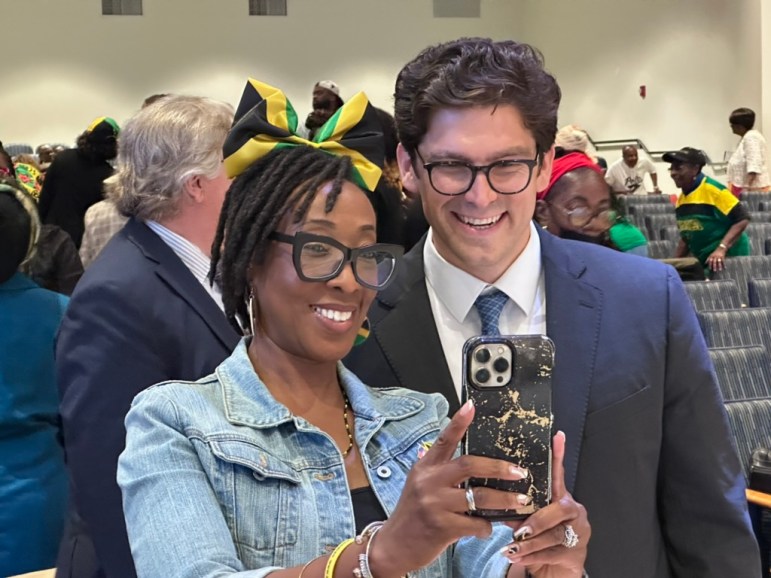
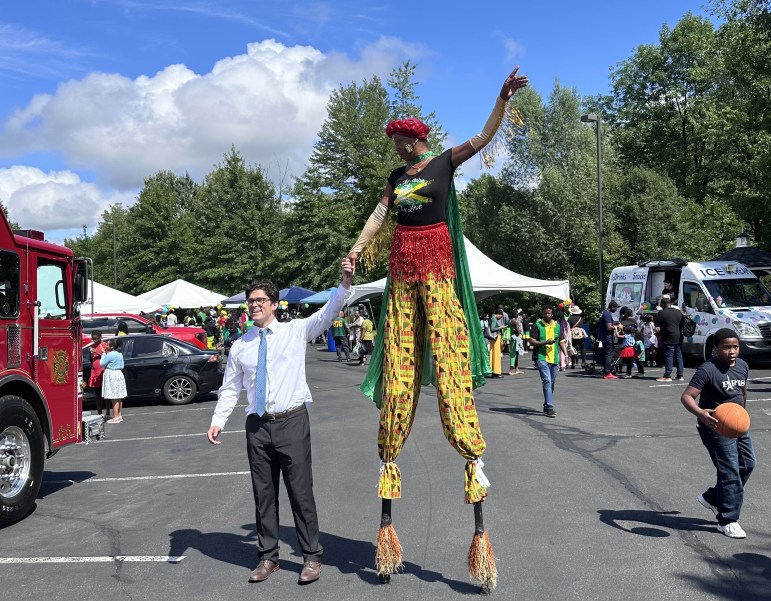
In Bloomfield, Fazio entered Rehobeth in a steady rain and emerged from the services to find the clouds gone and the sun shining, a blessing on the church’s parking-lot party celebrating the nations represented by its parishioners. They include a few outliers — Canada, Poland and Ukraine — among the island nations of the Caribbean.

Fazio mingled with curious children, one who amused him by seeking his autograph near the steel-drum band and across from the Island Breezes vendor selling ox tail, jerk chicken, curry goat and fried red snapper from a truck.
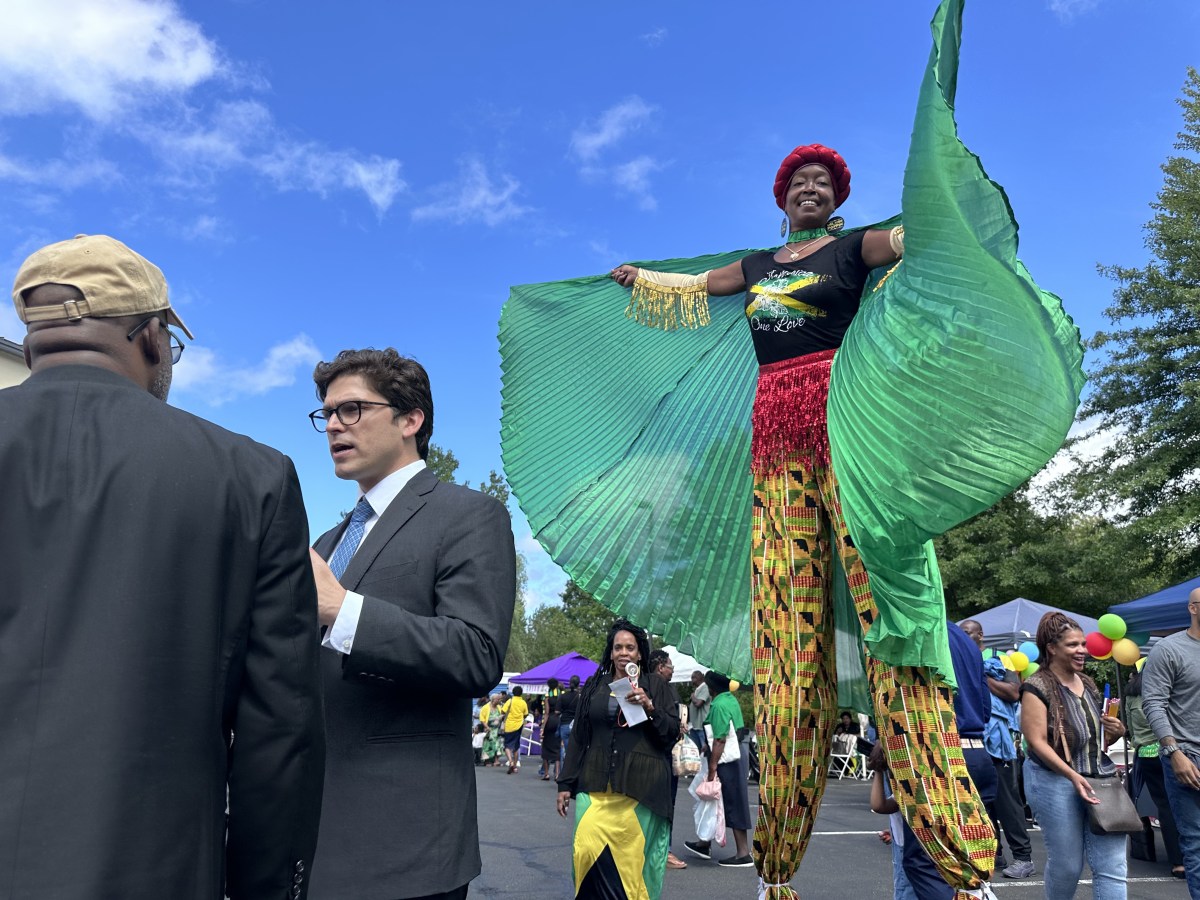
Fazio fell into deep conversation with Kirlew Alexander, who wore a black T-shirt with Jamaica’s flag underneath a black suit jacket, when a woman on stilts suddenly loomed behind them.
Alexander was dubious about Fazio’s plan to limit property-tax exemptions on some nonprofits, mainly universities and hospitals. Intently explaining his plans for property-tax reform to Alexander, the candidate was oblivious to the smiling performer, who swirled green gossamer wings as she danced behind him.
On his way to his black SUV, a Lincoln Navigator leased by his campaign, Fazio called for the ball from a gaggle of boys shooting hoops. He had been a recreation league player back in the day. He missed two before peeling off his suit coat, and missed two more before finding the range on his fifth try.
The boys whooped, and Fazio smiled.
The apparition on stilts reappeared, this time noticed by Fazio. She called down, asking for a photo. He responded with two thumbs up. He reached up to hold hands with the stilt-walker and pose. There was a wide grin on the face of the millennial generation’s wonkish and earnest new hope of the Connecticut Republican Party.
Correction: As originally posted, a photo caption incorrectly referred to Nuchette-Black-Burke as being born in Jamaica. She is U.S.-born of Jamaican descent.
