


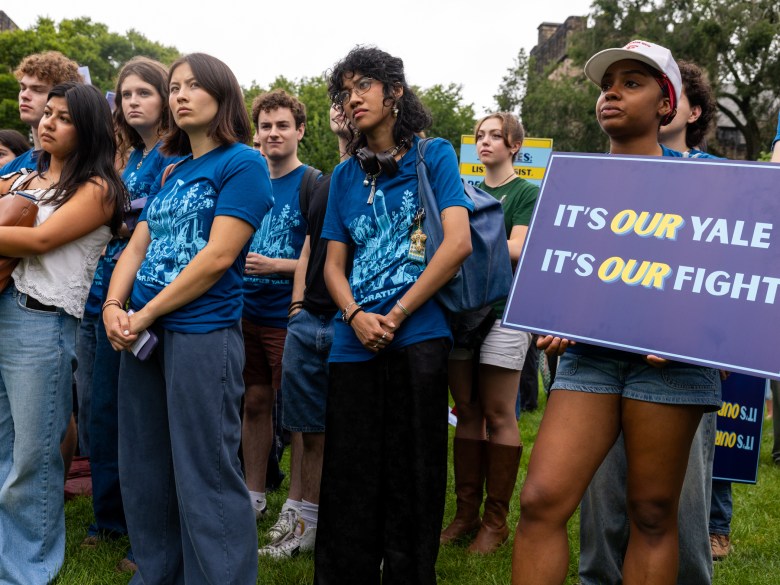
A large crowd of blue-shirted students, faculty and alumni gathered at Yale University’s Cross Campus Tuesday to protest what they described as the erosion of the elite school’s democratic values under the second Trump administration.
“Yale is cracking down on free speech and assembly. … It is negotiating with the Department of Justice over an unfounded admissions investigation, and refusing to codify academic freedom protections for its faculty, all under the governance of an undemocratic, unaccountable Board of Trustees,” Yale College Council President Alex Chen told the gathered demonstrators.
As he listed out the grievances, members of the audience booed and hissed.
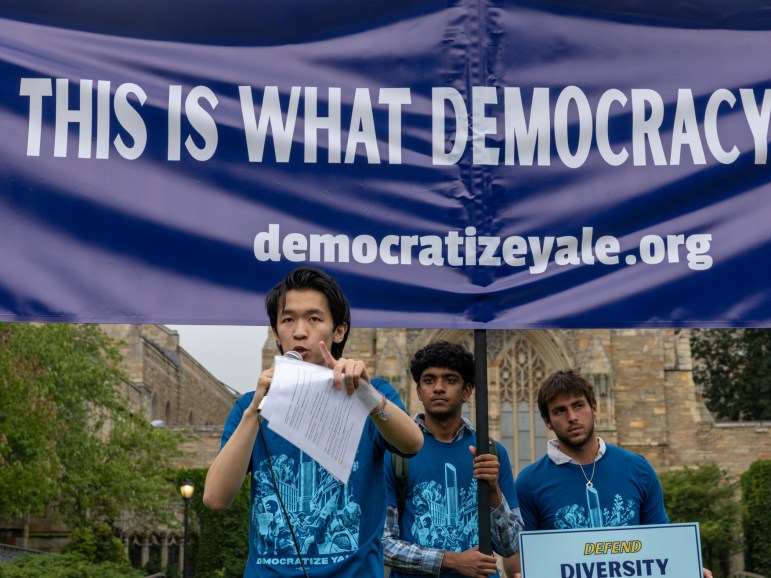
(During the event, Yale officials told journalists they were not allowed to attend and would have to wait by the street to interview participants after the fact.)
It was the first demonstration of its kind since students returned to Yale for the start of the semester. Discontent has been brewing for longer. Over the summer, student and faculty leaders began mobilizing after the New York Times reported Yale was negotiating a settlement with the Trump administration over accusations of admissions bias against white and Asian students.
The university’s decision to hire the law firm McGuireWoods, which previously helped the University of Virginia settle with the Trump administration, did not ease their concerns.
In July, attorneys working with the Yale chapter of the American Association of University Professors released a letter describing the Trump administration’s accusations as “bogus — cherry-picked, statistically weak, and presented without appropriate context or support in the record.”
Not long after, U.S. Sen. Richard Blumenthal held a press conference outside Yale Law School urging university leaders not to give in.
But if rumors of a DOJ settlement sparked the resistance, Tuesday’s event made clear there are broader concerns about Yale’s leadership at play.
Organizers laid out four demands of the university under the umbrella “Democratize Yale.” Those include reforming how members on the Board of Trustees are chosen; expanding free speech protections and limiting university interference in peaceful demonstrations; codifying a commitment to academic freedom; and exiting settlement negotiations with the DOJ.
The Connecticut Mirror reached out to Yale’s Office of Public Affairs but did not receive a response in time for publication.
Yale junior Isa Matos laid out the first of those demands in more detail. The majority of Yale trustees are chosen by the board itself; six are voted in by fellow Yale alums, but Matos said participation in that process was restricted after the university eliminated a petition process for aspiring candidates. That, she said, is what has empowered Yale’s current president.
“The successor trustee position avoids even the narrowest pretense of accountability. It allows current trustees to handpick colleagues who upheld their own financial and political interests. Faculty and staff who have dedicated their entire lives to Yale are left without representation,” Matos said.
She also criticized the board for keeping its meeting notes sealed for 50 years.
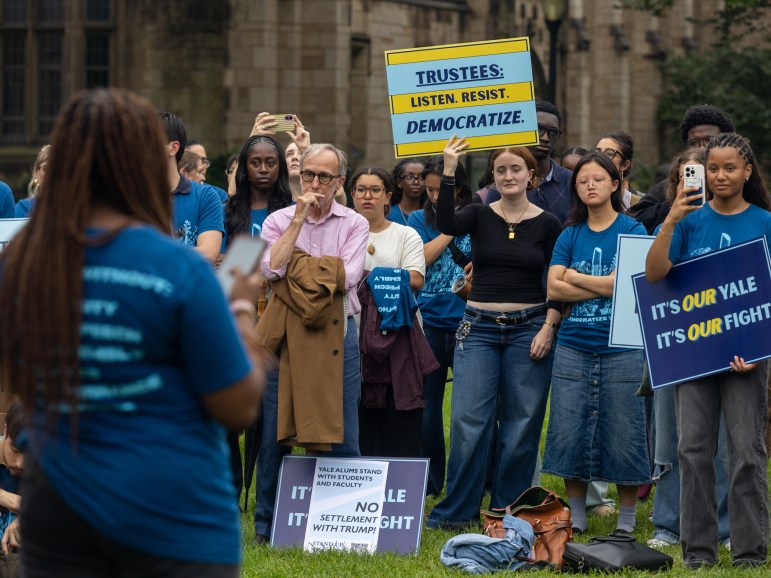
Standing amid the crowd, Yale alum Hosea Baskin described the turnout as “somewhere between fabulous and amazing.”
Standing next to him was fellow alum Susan Choi, a novelist and a leader in the group Stand Up for Yale, which has advocated against the DOJ settlement. “I’m thrilled, but I guess I’m not surprised, because of the opposition to the settlement talks and the concerns about what’s already happening on campus in terms of free speech and free expression for students,” Choi said.
Several speakers characterized this as a battle line in the fight against an authoritarian takeover of the United States.
“There’s more at stake here than one court settlement. It’s the future of something called the American experiment,” said David Blight, Sterling professor of history and Black studies.
“The greatest threat to you is in Washington. Get ready. You don’t even know what’s coming after this election,” Blight said. “A wounded Donald Trump is very dangerous.”
He encouraged students in attendance to imagine what they might tell their children and grandchildren about this moment in history.
“They’re gonna say, ‘What did you say? What did you do? What did you see?’ Think ahead to them,” Blight said.
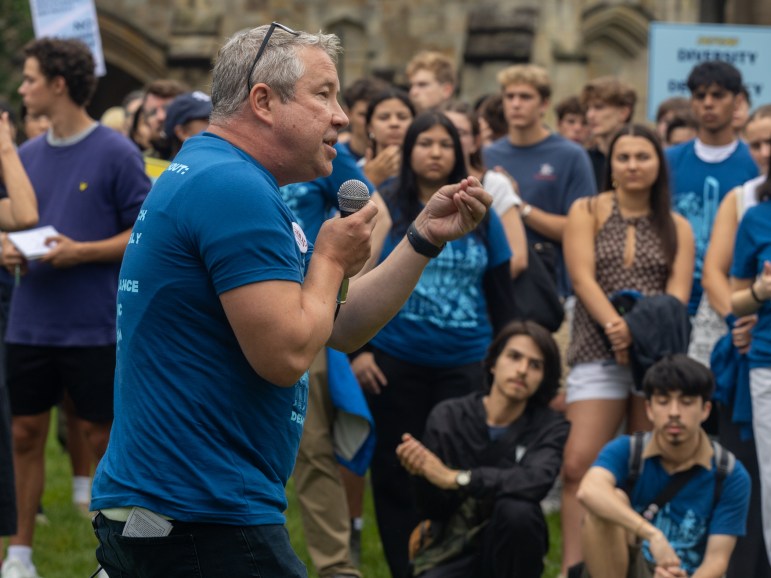
Yale AAUP President Daniel HoSang criticized the university administration for regularly disregarding the views of the people who teach and research there.
“You can’t be lecturing us about democracy and refuse to even take meetings with faculty,” HoSang said.
As it happens, Yale was set to host a mandatory event for freshmen, “The University and Democracy,” that day.
Chen, the college council president, described it as “glaring irony.”
“Yale’s mandatory panel comes as the university has increasingly betrayed many of the democratic values it claims to cherish,” he said.
Yale senior Carolina Lucas attended the demonstration with her mother, an alum who drove two hours from New Jersey to attend. She said she was motivated to attend by the repeal of DEI policies.
“The idea that DEI policy somehow takes meritocracy out of it … it’s just not true, and it’s frustrating,” Lucas said.
Like other attendees, she said she’s prepared to keep doing what she can to maintain pressure and rally more support.
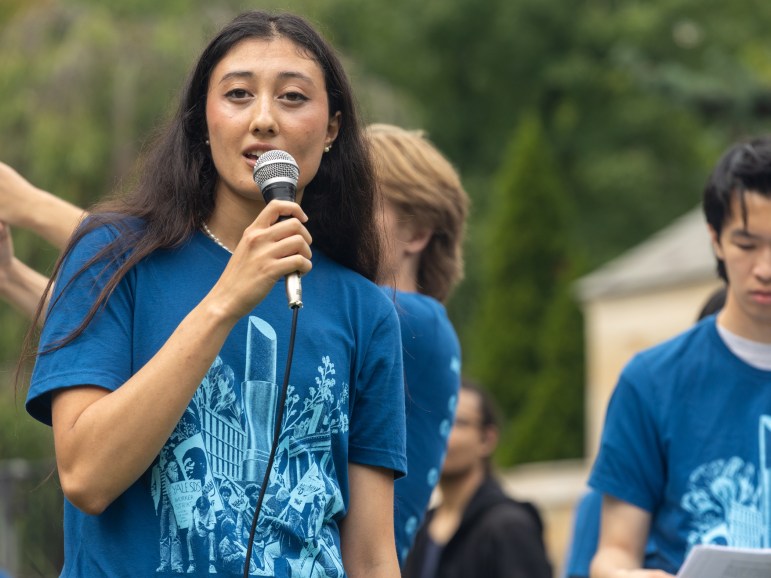
Senior Miles Kirkpatrick said there has been a “palpable desire” for change at Yale since he first arrived.
“Hearing that they were coming together for this event, I feel like I had to show up, if not for myself, at least for my friends,” Kirkpatrick said.
The news about the settlement, he said, drove home the stakes. “I think it made it feel a bit more concrete, tangible and close to my daily life here,” Kirkpatrick said.
Fellow senior Zoe Kanter — friends with Kirkpatrick since freshman year — said she’s witnessed the creeping of restrictions across Yale’s campus as a student leader with the university’s Women’s Center. At the end of last year, Kanter said, the university told the center it would have to stop holding political opinions or lose its financial support.
The center “has been unabashedly feminist since its beginning in the ‘70s,” Kanter said. That perspective, she said, is necessary for its functioning.
When it refused the university’s demand, “the center had to give up its ability to pay student staffers, a significant portion of its funding, and, a couple years down the line, its physical space,” Kanter said. “So, this is an example of one way that the administration is restricting student speech.”
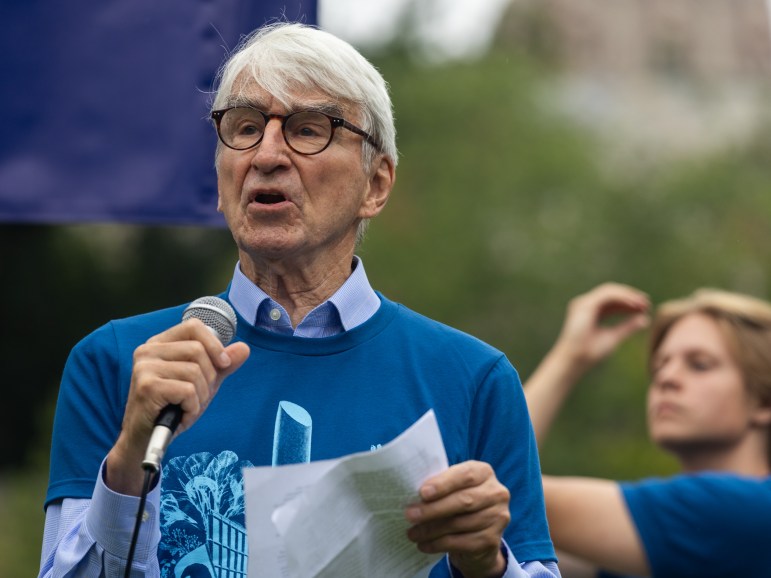
Closing out the event was actor and Yale alum Sam Waterston, who played Executive Assistant District Attorney Jack McCoy on “Law & Order.” Closing the circle on Blight’s comments earlier on, Waterston recalled a lesson he learned from his own father, who enlisted in the British military during the London Blitz.
“The lesson couldn’t be simpler … It’s as old as the schoolyard, as old as the Bible. And I won’t forget my father saying, after the war, with the finality and the quiet way that he said it: Never give in to a bully.”
