



A new budget proposal from the office of the Connecticut State Colleges and Universities chancellor has provoked outrage from students and faculty.
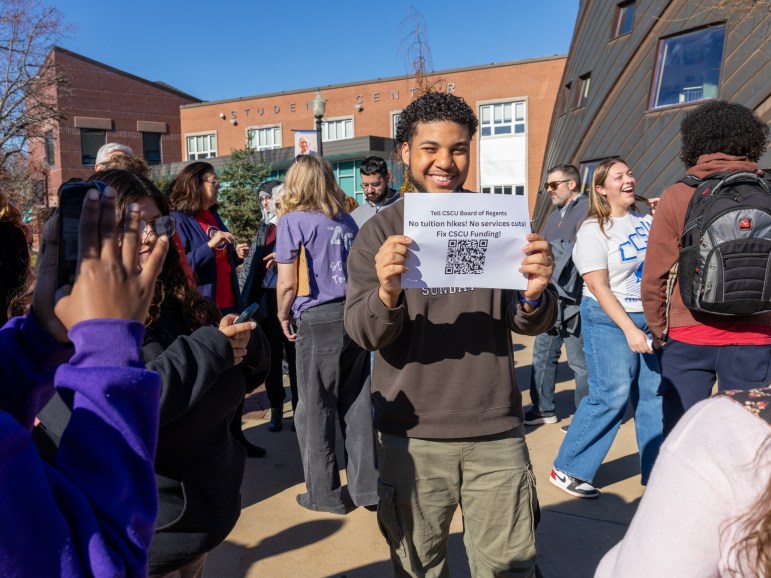
At a press conference Thursday, attendees demanded the Board of Regents vote to reject the proposal, which envisions a 3% tuition hike and savings from unspecified cost reductions for fiscal years 2028 and 2029. Attendees warned many students would find themselves priced out of higher education as a result.
“I personally can’t afford to pay more for tuition. I personally can’t afford to work more and to study less,” Anthony Ortiz, a student at Central Connecticut State University, told fellow rally-goers.
Several other students at the event shared similar sentiments.
“As it stands, I can barely afford to go to this university. I can’t afford a dorm. I can’t afford good maintenance on my car,” said Central student Rafael Romero. “A price increase would … potentially force me to drop out, wasting my three years that I’ve spent at this institution studying.”
Attendees called on the Board of Regents to vote down the budget proposal and instead push the state to ramp up its higher education funding. In fiscal year 2019, students provided 56% of CSCU’s institutional revenue to the state’s 44%. In fiscal year 2027, students are set to provide 67% to the state’s 33%.
In other words, the state is covering proportionally less of the cost than it used to. A 3% tuition hike would likely skew that balance further.
“Don’t balance the budget on our backs,” said CT State Quinebaug Valley student Lindsay Furbish.
As it happens, the budget proposal — developed by the office of interim chancellor Natalie Braswell — does make a big ask of the General Assembly: $168.8 million in additional state funding for fiscal year 2028 and $150.3 million for fiscal year 2029. CSCU spokesperson Sam Norton described it as one of the largest budget requests to date for the system.
Those numbers stem in large part from a gap between state-negotiated wage increases and state funding for said wages. A Nov. 11 presentation to the board put that gap at a combined $162 million for fiscal years 2026 and 2027. Other financial pressures include a $104 million loss from fringe benefit funding, $164 million in expiring one-time support and a $75 million difference between actual and projected personnel costs.
Norton acknowledged the financial challenges many students face.
“Many are balancing work, family responsibilities while navigating rising costs and, in some cases, food and housing insecurity,” Norton said. “The last thing we want is to place additional financial burdens on students unnecessarily.”
But, she said, “we must plan for the possibility that state support will fall short of what our institutions need.”
Louise Williams, president of CT State’s chapter of the American Association of University Professors, said “everybody knows there’s plenty of money in Connecticut.” She criticized Gov. Ned Lamont and state lawmakers for their unwillingness to loosen the state’s fiscal guardrails and enact progressive tax reform.
Cathryn Vaulman, Lamont’s director of communications, said in emailed comments, “Governor Lamont understands that affordability is important to students and families.”
“Since [Lamont] took office, state General Fund operating support for CSCU has increased by more than 50 percent,” Vaulman said.
Higher Education and Employment Committee co-Chair Sen. Derek Slap, D-West Hartford, said he agrees with students that the state can do more. However, he said “it’s way too early to know” what kind of state funding CSCU will get in the next budget. Deliberations over said budget will take place during the 2027 legislative session.
Slap acknowledged “you never want to see a tuition increase” but noted “the sticker price doesn’t necessarily correlate to what in-state students are gonna pay.”
“I think there probably is some room to increase it for out-of-state students, if you look at just kind of benchmarking it against other schools in New England,” he added.

Slap also pointed to recent efforts the state has made to reduce student debt. For example, students who get an associate’s degree can transfer to CSCU and finish debt-free. Slap said he plans to submit a bill next year to make all Connecticut’s public universities debt free.
“We don’t want students saddled with debt when they’re getting out,” Slap said.
Speaking at the rally, Charter Oak State College professor Ruth McDonald linked the proposed tuition hike to concerns about CSCU leadership.
“These tuition dollars will pay for years of mismanagement and administrative bloat,” McDonald said.
Williams concurred. “We are the world champions of higher ed dysfunction,” she said. “The board must be reorganized, redefined and repopulated.”
Seth Freeman, president of the union representing faculty and staff at state community colleges, called for greater transparency from CSCU leadership, which has been plagued by scandal in recent years.
“We are demanding an accounting for every dollar spent at 61 Woodland Street before you force students to pay more in tuition,” Freeman said.
The Board of Regents will vote Friday on whether to adopt the budget proposal. The result will not determine whether CSCU will implement the 3% tuition hike or not; instead, the board will vote in December on whether to raise tuition.
