


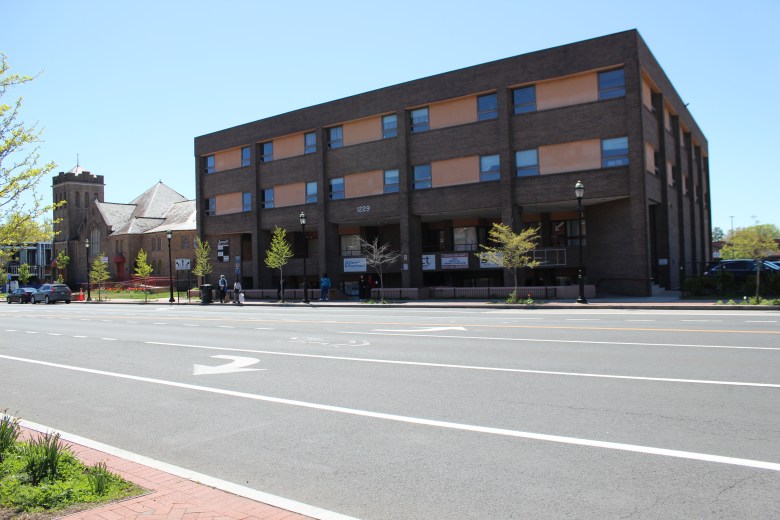
After poring through records for eight months, a team of auditors and forensic accountants was unable to find documentation to account for $2.4 million in taxpayer money distributed to businesses and nonprofits through the Blue Hills Civic Association, according to a new audit.
The audit was commissioned by the Department of Economic and Community Development after state officials learned that Sen. Doug McCrory, D-Hartford, used the Blue Hills Civic Association as a passthrough to subgrant millions of dollars to other organizations, including several businesses that are now the subject of an ongoing FBI investigation.
The 128-page audit highlights how little oversight the state had over the money that McCrory directed through the BHCA in recent years, and how poor the recordkeeping was at some of the organizations that received those funds.
The auditors from CliftonLarsonAllen noted that several of the organizations that received money from BHCA could not document how they used tens of thousands or hundreds of thousands of dollars, despite a requirement that they keep such records for at least three years.
“As a result of these conditions, in many instances CLA was unable to fully substantiate the allowability, timing, or purpose of expenditures reported by subrecipients,” the auditors wrote.
“These limitations increase the risk of unallowable costs, misuse of funds, and undetected instances of fraud, waste, or abuse,” the auditors wrote.
Meanwhile, one of the largest beneficiaries of the state grant funding refused to cooperate with the auditors entirely, citing the ongoing FBI investigation.
Sonserae Cicero, who is being investigated because of her alleged relationship with McCrory, declined to turn over any records to auditors even though her companies, which operate under different versions of the name SHEBA, received $1.2 million through the Blue Hills Civic Association.
“In response to document requests, legal counsel for Ms. Cicero indicated that, based on publicly available information suggesting a potential ongoing federal investigation into related matters, SHEBA would not provide any documents or information absent a legal obligation to do so,” the auditors wrote.
Cicero did not respond to a phone call seeking comment for this story.
The auditors noted that Cicero signed a contract that granted the state and its auditors access to the company’s records “upon request.”
Asked if DECD would pursue legal action to force SHEBA to open its books, spokesperson Jim Watson said, “DECD has taken all reasonable steps through available mechanisms to recover and/or hold any funding allocated to entities identified in the audits and will continue to evaluate whether any additional action is merited or likely to lead to the recovery of funds.”
The audit findings are the latest twist in a ongoing political scandal that has destroyed the Blue Hills Civic Association, contributed to McCrory losing his senate seat and forced state lawmakers to rethink how they hand out money.
McCrory, who had served in the legislature for two decades, did not respond to a phone call on Wednesday.
The auditors attempted to trace more than $6.5 million that was subgranted to 31 organizations in the North End of Hartford and other parts of Connecticut.
Auditors also sought records from RH Realty Services, a company that Blue Hills paid $225,000 over two years to provide mortgage coaching to low-income households.
Roberta Hoskie, who previously served on the state’s Minority Business Initiative Advisory Council with McCrory, gave auditors bank statements that they say suggested she may have used portions of that state funding for personal expenses.
The auditors noted multiple instances in which Hoskie’s company paid for meals, hotel stays and payments to a Jaguar-Land Rover dealership. There were also expenses for Edge Fitness, Mondovi Dental and Pearl Vision, as well as multiple ATM cash withdrawals.
The auditors questioned how those expenses related to the homeownership coaching program that Hoskie was supposed to be providing.
“The available documentation does not demonstrate how these expenses are directly related to program delivery, raising concerns that some may represent personal or mixed-use expenditures,” the auditors wrote.
Hoskie did not respond to an email sent to her business on Wednesday, and DECD officials said she stepped down from the state Minority Business Initiative Advisory Council in April.
The General Assembly passed a law in May that will set new limits on so-called legislative earmarks — money that individual lawmakers can direct to favored organizations.
That law will mandate additional documentation and reporting requirements from any entity that receives such funds. It also requires nonprofits, like the Blue Hills Civic Association, to obtain state approval before subgranting any money to other groups.
