



Bridgeport and Fairfield share a border. When it comes to school attendance, they can look like two different Connecticuts.
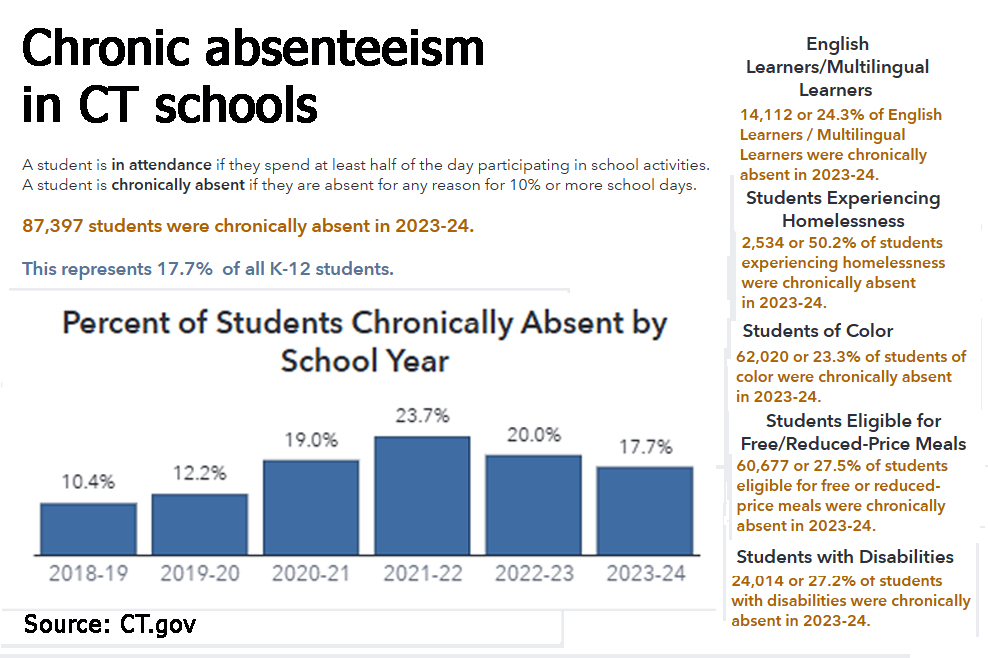
During the 2024–25 school year, 33.1% of Bridgeport Public Schools students were chronically absent, compared with 8.8% in Fairfield. Connecticut’s statewide rate was 17.2%. Chronic absenteeism means missing at least 10% of the school year, or roughly 18 days in a typical 180-day year.
We can look at that difference and ask why Bridgeport families aren’t getting their children to school. I think that’s the wrong question. I don’t believe parents become less invested in their children’s education when they cross a town line. A mother in Bridgeport doesn’t want less for her child than a mother in Fairfield. What changes are the circumstances around them and the demands placed on the institutions serving them.
I’ve seen that tension in my own work. In New York City Public Schools, I led community engagement efforts that brought families and educators face to face with system leadership. I learned quickly that what looks accessible from inside an institution can feel anything but accessible to the people trying to navigate it.
Bridgeport serves far more students experiencing economic hardship and far more multilingual learners than Fairfield. Those realities matter because attendance does not happen in a vacuum. But demographics cannot become our stopping point. A school system serving families facing greater barriers needs more time to solve problems, more staff who know families by name and more ways for parents to reach an actual person.
Think about something as ordinary as a 6 p.m. school meeting. One parent leaves work, drives ten minutes and takes a seat. Another loses an hour of pay by leaving early, catches a bus and still has to figure out who can watch the other children. Both may care just as much, however our systems are simply better at seeing one of them.
Children need to be in school. Missing weeks of instruction has consequences. But responsibility cannot belong only to families.
And this isn’t only a Bridgeport story. Waterbury’s chronic absenteeism rate was 25.8% in 2024–25. Regional School District 15, serving Middlebury and Southbury, reported 8.6%. Different communities but yet a familiar divide.
Connecticut’s Learner Engagement and Attendance Program, or LEAP, offers a useful lesson. LEAP sends trained school staff or community partners to meet directly with families, not to enforce attendance rules, but to build relationships and understand what is keeping a student from school.
A 2022 evaluation of students served during the 2021–22 school year found that attendance improved after LEAP visits. It also found that visits at a student’s home or school had significantly greater effects than visits conducted by Zoom or phone.
New Haven offers an even sharper lesson. The district did not initially conduct one-on-one visits as the LEAP model intended. Instead, a nonprofit partner canvassed neighborhoods with high concentrations of chronically absent students. The evaluation found no measurable impact on attendance there. New Haven later changed its approach to more closely match the model used in other districts. Same program name but yet a very different result.
Counting an outreach attempt is not the same thing as making a connection.
Bridgeport’s more recent numbers make this worth watching. The district reported chronic absenteeism at 22.6% in October 2025, down from 32% in October 2024. Those are preliminary, point-in-time numbers, not final school-year results, and no single program can claim credit for them. Still, the direction matters. Relationships aren’t the soft side of attendance work. They are part of the infrastructure.
Connecticut should start measuring them that way.
The Connecticut State Department of Education should pilot a family-responsiveness measure in districts with persistently high chronic absenteeism, including districts already doing relationship-based attendance work. And it shouldn’t be another satisfaction survey.
The families who find institutions hardest to navigate may also be the least likely to complete one. So measure what institutions actually do. How long does it take to respond when a family asks for help? When a school reaches out about attendance, did someone actually connect with the parent or guardian? When a problem is raised, was there follow-through? Those aren’t sentimental questions. They are questions about institutional performance.
Connecticut already includes chronic absenteeism in its 12-indicator Next Generation Accountability System. A family-responsiveness pilot could tell us whether measures of actual connection and follow-through reveal something our current indicators miss. If they do, CSDE should consider incorporating that information into the state’s broader accountability framework.
We are very good at counting whether families show up for institutions. We should become just as serious about whether institutions show up for families. Bridgeport and Fairfield share a border. Their attendance numbers tell us that proximity does not mean families experience public education in the same way. Before we decide that some families simply need to show up more, our institutions should answer the harder question of what have we done to make showing up possible?
Mychael Williams lives in Waterbury.