



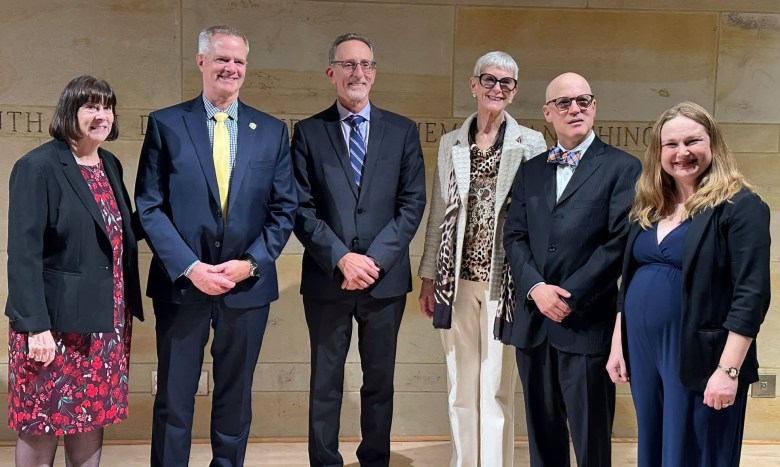
On Oct. 7, Ellington town administrator Matthew Reed was among five people named by the Connecticut Foundation for Open Government as a recipient of the Mitchell W. Pearlman Freedom of Information award. This is the text of his acceptance speech:
Thank you very much. I am truly honored to receive the Mitchell W. Pearlman Freedom of Information Award.
Receiving an award that bears Mitch Pearlman’s name is particularly meaningful. His career represents something that is easy to say but sometimes much harder to practice: that open government is not an inconvenience of public service —it is an essential part of public service.

I have had the privilege of viewing Connecticut’s Freedom of Information Act from several different perspectives over the course of my career —as a police officer and police chief, as an attorney with the Freedom of Information Commission, as an attorney, and now as a municipal administrator.
Those experiences have convinced me of something very simple: public records do not belong to us.
They do not belong to the police chief, the town administrator, the department head, the board or commission, or the employee who created them. We are merely their custodians. They belong, ultimately, to the public we serve.
That distinction matters.
An FOI request should never be viewed as a personal attack. A resident should not have to explain why he or she wants a public record, and government should not approach a request by first asking, “How can we avoid providing this?” Our first question should be, “How can we help this person obtain the public information they are entitled to receive?”
Sometimes that means picking up the phone and talking to the requester. Sometimes it means helping someone better define what they are looking for. And sometimes it means acknowledging that producing records can be inconvenient, time-consuming, or even uncomfortable. But transparency is most important precisely when it is inconvenient or uncomfortable.
The same philosophy applies beyond records requests. It means writing agendas that actually tell the public what its government intends to discuss. It means using executive sessions only when the law permits them —not simply because a conversation would be easier behind closed doors. And it means remembering that the public’s ability to observe its government and examine its records is not an obstacle to effective government. It is part of what makes government legitimate.
Connecticut has been fortunate to have a Freedom of Information Commission that, for decades, has served not merely as an enforcement agency, but as an educational resource for public officials and citizens alike. I was fortunate to spend part of my career there, and the lessons I learned during that time have remained with me throughout every position I have held since.
One of those lessons is that compliance with the Freedom of Information Act should be the floor —not the ceiling.
The goal should not simply be to avoid an FOI violation. The goal should be to create a culture in which openness is the default, where public employees understand why transparency matters, and where residents recognize that their government belongs to them.
That requires leadership. It also requires patience, education and occasionally the willingness to tell colleagues something they may not particularly want to hear.
Throughout my career, I have tried to do that.
I am deeply grateful to be recognized for those efforts, and especially humbled to receive an award associated with someone who devoted so much of his professional life to protecting the public’s right to know.
Thank you to everyone responsible for this recognition, to the people I have worked alongside throughout my career, and to the public officials and employees who work every day to make government more accessible and transparent.
And most importantly, thank you to the citizens who continue to ask questions, attend meetings, request records and hold their government accountable.
Open government only works when people exercise the rights the law gives them.
Matthew Reed is the Ellington Town Administrator.