



In December 2012, after 20 children and six educators were murdered at Sandy Hook Elementary, Connecticut successfully did something that most states only talk about. Lawmakers came together across the aisle and passed some of the most stringent gun safety laws in the country.
In Connecticut, there is a ban on military-style assault weapons, limits on high-capacity magazines, and a permitting system that asks a simple, yet rarely asked, question before someone acquires a firearm: should this person have one?
More than a decade later, that framework is under attack from two different fronts, and Connecticut residents have a right to know what is at stake.
The first front is the U.S. Supreme Court. This summer, the justices agreed to hear a challenge to Connecticut and Chicago’s assault rifle ban. The version of the ban now before the court was written after Sandy Hook. If the court strikes it down, the consequences don’t stop at Connecticut’s borders, with a dozen other states having similar laws.
This is a national attack on national gun violence prevention laws. The gun lobby has spent years funneling cases toward this court in hopes of exactly this outcome.
The second front is closer to home. In October, the U.S. Department of Justice’s Civil Rights Division opened a new investigation into how Middletown and Waterbury issue firearm permits, suggesting that local police may be “unnecessarily” delaying or denying them.
Consider what this actually means. The office created during the civil rights movement to protect voting rights, combat housing discrimination, and manage police misconduct is now being turned against local police. These police departments are doing their jobs, carefully screening the people who apply to carry handguns.
The local judgment is the backbone of another important innovation: the Extreme Risk Protection Order (ERPO). In 1999, after a gunman killed four people at the Connecticut Lottery headquarters , Connecticut passed the nation’s first “red flag” law, allowing police to ask a judge to temporarily remove guns from someone who poses an imminent danger.
In 2021, lawmakers expanded it to allow family members, household members, and medical professionals to petition the court directly. When an order is issued, the person is flagged in the system police use to review permit applications. That’s how these protections fit together: a family raises the alarm, a judge acts, and a local officer reviewing a permit application knows to say no. A federal investigation that pressures police to process permits faster and ask fewer questions threatens every link in that chain.
It is worth nothing what the DOJ has not said. It has offered no public evidence or explanation as to why Waterbury and Middletown were chosen. Its own letters, also, acknowledge it has reached no conclusions. It seems like there is a message being sent: screen too carefully, and federal investigators may come knocking.
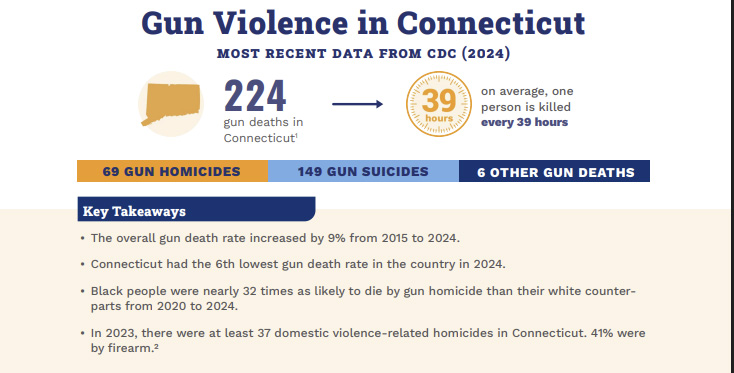
The exact approach being attacked is one that has historically worked in Connecticut. In 2024, Connecticut had the sixth-lowest gun death rate in the country, less than half the national rate. When Johns Hopkins researchers studied the permit-to-purchase law, which requires handgun buyers to get a permit through local police and pass a background check, they found it was associated with a 40 percent drop in gun homicides over the following decade. The local permit review DOJ now wants to second-guess isn’t red tape. It’s one of the most effective tools we have.
So what can Connecticut do?
We must hold our congressional delegation accountable. They should demand that DOJ explain the basis for this investigation. Attorney General William Tong deserves our full support as he defends the assault weapons ban before the Supreme Court. Middletown and Waterbury officials should continue to follow state law and should not let federal pressure push them toward rubber-stamping applications. And state lawmakers should be prepared now, whatever the court decides, to protect the strongest possible version of Connecticut’s laws.
After Sandy Hook, Connecticut made a promise: never again. We kept that promise with laws that work. We cannot let Washington break it.
Gray West of Middletown writes for Brady United: Team ENOUGH.