


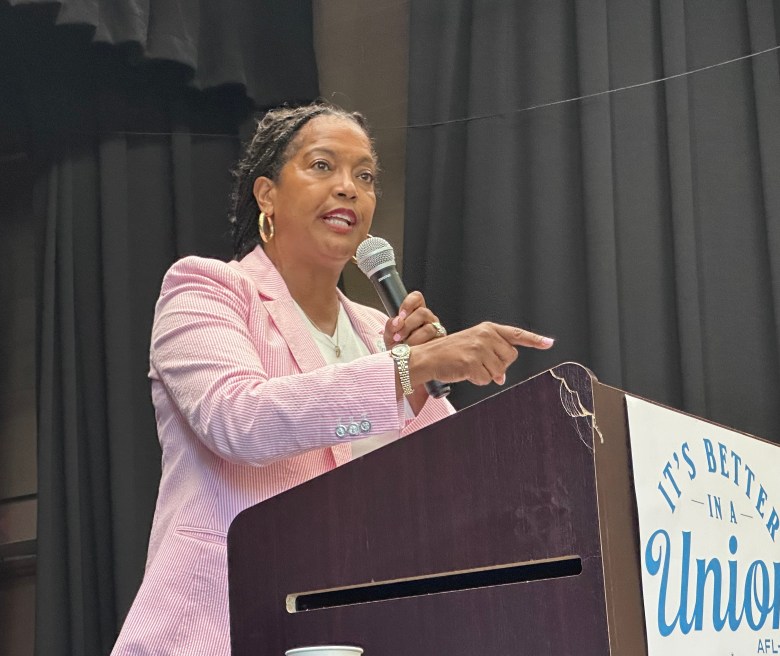
A fiery U.S. Rep. Jahana Hayes, D-5th District, was introduced by the president of the Connecticut AFL-CIO at a Labor Day kickoff breakfast Friday as “the future chair of the labor and education committee.” The lawmaker did not object to the description.
Politico reported this week that Hayes, who is favored to be reelected to a fifth term in November, was weighing a bid to become chair of the House Education and Workforce Committee if Democrats regain the majority in the closely divided House of Representatives.
To an audience of more than 200 union activists at a trade union hall in Hartford, Hayes accused congressional Democrats of slow-walking a labor agenda when the party enjoyed a trifecta of controlling the House, Senate and White House for the two years after Joe Biden was elected president in 2020.
“I’ve been thinking a lot about the promises that were made to labor, and a lot about how we should have done more when we had a majority trifecta, to not have to deal with the problems that we’re having right now today,” Hayes said. “That cannot happen again. If there is any lesson to be learned, that has to be it.”
The complaint of timidity could be read as a criticism of 79-year-old Congressman Bobby Scott of Virginia, the ranking Democrat on the Education and Workforce Committee and panel’s chair when the party was in the majority. Scott has stated he would seek the chair again.
Among those in the audience Friday was Luke Bronin, 47, the former Hartford mayor who defeated 78-year-old Congressman John B. Larson, D-1st District, in a primary last month. After making no endorsement before the primary, the AFL-CIO endorsed Bronin this week.
The House is the most favorable battleground for Democrats to end the trifecta enjoyed by Republicans with President Donald Trump back in the White House and narrow GOP majorities in the Congress.
“When we get back in the majority — when — we have to deliver on the promises that we’ve made, we have to make sure we’re fighting for everyone,” Hayes said.
Hayes, 53, was selected national teacher of the year in 2016 while a history teacher at John F. Kennedy High School in Waterbury. Encouraged to run by U.S. Sen. Chris Murphy, she won the open 5th District seat two years later, becoming the first Black woman elected to Congress from Connecticut.
Hayes did not enumerate those unmet promises in her formal remarks, but in a brief interview, she mentioned the proposed Protecting the Right to Organize Act, better known in labor circles as the PRO Act. Among other things, it would protect workers from being fired for attempting to join a union.
Under Trump, the National Labor Relations Board has been neutered, Hayes said. The panel no longer has enough members for a quorum, leaving it unable to resolve complaints of illegal firings and disputes arising from union organizing efforts.
“A lot of the labor protections, there’s no enforcement there,” Hayes said.
Scott did introduce a version of the PRO Act in 2021, when Democrats held all levers of power. It passed the House but fell short in the Senate, where the Democratic majority was not large enough to avoid a Republican filibuster.
Unions are thriving in terms of public popularity, said Ed Hawthorne, the president of the Connecticut AFL-CIO.
“We are meeting at a moment when working people across the country are rightfully feeling angry about just about everything. We’re exhausted by the cost of living. We’re tired of the gridlock, and we’re frustrated with the political institutions that so often fail to show up,” Hawthorne said. “But right now, in the middle of all that cynicism, something extraordinary is happening. Trust in America’s labor unions is rising again.”
A Gallup survey released Tuesday showed unions with a 71% approval rating that extends a six-year period in which approval has stayed between 67% and 71%, rivaling the heyday of the labor movement’s popularity in the 1950s.
Nearly half of Americans want labor unions in the U.S. to have more influence than they do today, slightly more than double the 23% who want unions to have less influence, Gallup found. Another 26% want unions’ influence to remain the same.
The Labor Day breakfast is tied to unions ramping up campaigning on behalf of endorsed candidates. Hawthorne noted that a schedule of door-to-door canvassing had been distributed throughout the union hall.
“The trust in our labor movement is precisely why our union-to-union labor walks are so important,” Hawthorne said. “Starting next Saturday, we will do what we do best: talk to our members about the issues that matter most to working families and elect our champions, many of whom are in the room with us here.”
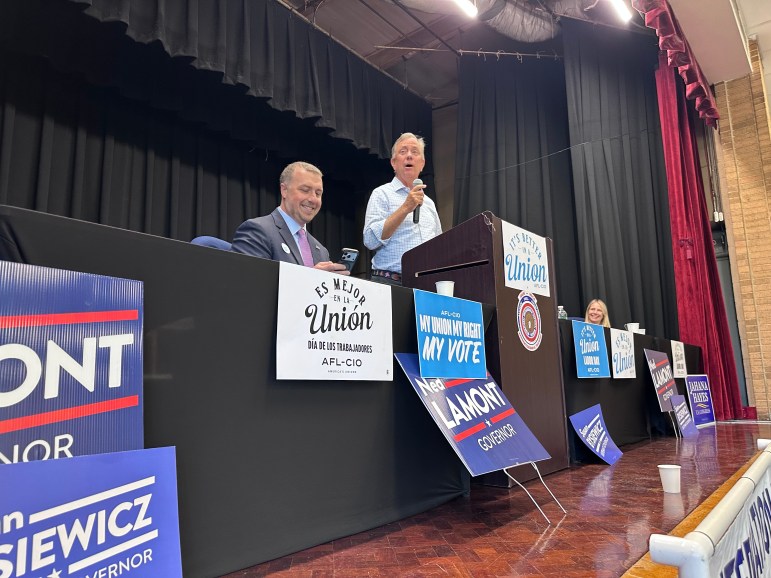
With Hayes and Gov. Ned Lamont on stage with him, Hawthorne pointed to other polling showing that trust in unions exceed trust in the Democratic Party by a wide margin.
“Hey, you don’t have to rub it in that labor leaders are 20% more popular than Democratic politicians,” Lamont said. “But I’ll tell you why — because we live in a day and age where I think working families, the middle class, feel like they’re getting screwed. They want to make sure that people are standing up for them. And every day, your labor union is stepping up for you, fighting for you, fighting for wages, fighting for the benefits, fighting to make sure our society is just a little bit fair.”
While the labor approval rating is high, union membership is not. Only 5.9% of private sector workers are unionized in the U.S., versus 32.9% in the public sector.
At 16.1%, Connecticut is tied with Rhode Island at fifth for the states with the highest overall union membership.
The state ranks first in union strength among state employees, according to a survey by the Commonwealth Foundation.
