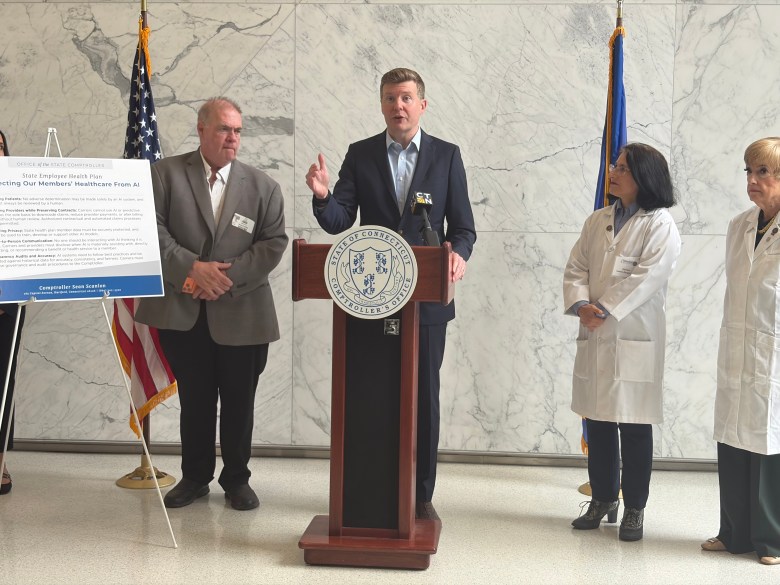
Amid a surge in the national debate about the dangers of artificial intelligence, Comptroller Sean Scanlon on Wednesday announced regulations governing the use of AI technology by health insurance companies that administer benefits for the state employee health plan — rules he wants lawmakers to extend more broadly in 2027.
The new rules will apply to the more than 270,000 enrollees in the state employee health plan and the Connecticut Partnership Plan for municipal and other public-sector employees outside state government.
The five policies put in place include a ban on the exclusive use of AI for activities like down-coding claims or reducing payments, as well as a guarantee that plan member data will not be used to train other AI models. The regulations will go into effect Jan. 1, 2027.
“Our world is changing rapidly and government needs to change with it at the same speed in order to protect people,” Scanlon said at a press conference on Wednesday morning. “That’s what this policy is all about.”
Negotiations between the comptroller’s office and insurance companies have been underway for about a month — even before a former Anthropic researcher set off a national conversation about the potentially disastrous outcomes if AI development forges ahead at breakneck speed.
Connecticut’s state employee health plan works with multiple providers, Scanlon said, and they’ve all agreed to the policies. Anthem administers medical benefits for active employees, Cigna administers dental coverage and Aetna administers the Medicare Advantage plan for retirees. Caremark is the state plan’s pharmacy benefits manager.
Scanlon said he believes the same protections should extend beyond enrollees in the state plans. In January, he will recommend lawmakers require all state-regulated plans to adhere to the same policies.
“There is a national reckoning happening on this right now, and I think there will be an expectation of the legislators that are there next year that they do something about this from their constituents,” Scanlon said. “I’m going to try to work with them to make sure that we do.”
States are limited when it comes to which insurance plans they can regulate. Only what are known as “fully insured” plans fall under their jurisdiction. “Self-funded” plans, which are the type most commonly used by large employers, are regulated by the federal government.
In Connecticut, about 220,000 people — or 6% of residents — get health coverage through state-regulated plans.
As more insurers use AI to determine if medical care should be covered, patient advocacy and physician groups have warned of the potential harms to access. Three companies — Humana, UnitedHealth and Cigna — are all facing lawsuits over AI and algorithm-based denials of care.
Despite the legal actions, insurers aren’t slowing down. In recent months, UnitedHealth announced a $1.5 billion investment in AI across more than 1,000 potential use cases, including claims processing and prior authorization.
Tom Swan, executive director of the Connecticut Citizen Action Group, called the state employee health plan regulations “a really great step,” adding that lawmakers and the governor need to pass legislation in 2027 to bring similar safeguards to the state more broadly.
“Without meaningful oversight, this is really dangerous,” Swan said. “Patients and providers need protections.”