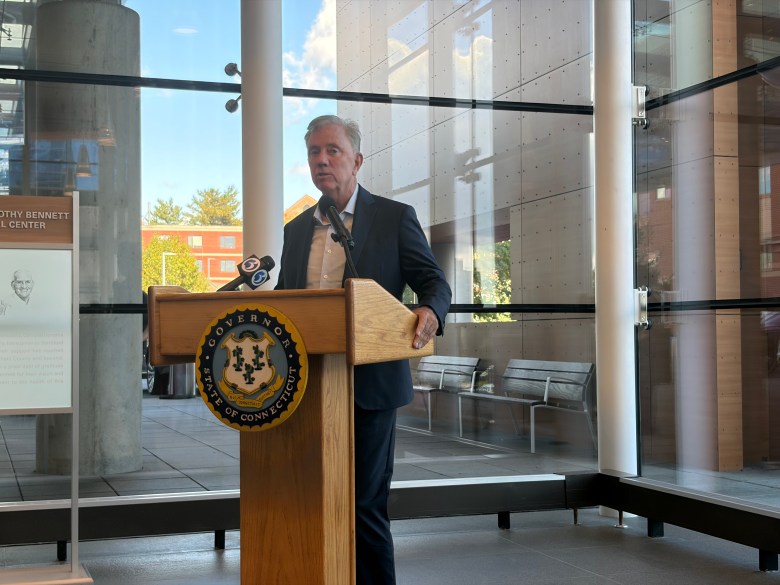
Gov. Ned Lamont and other state officials gathered in Stamford on Monday afternoon to spotlight Connecticut’s efforts to protect residents’ Medicaid coverage in the face of pending federal changes to the program taking effect on Jan. 1.
“This is a purposeful effort by the federal government to slow things up, put in place a layer of bureaucracy, make it more complicated for people to be able to enjoy decent health care,” Lamont said. “We’re going to push back.”
Beginning Jan. 1, HUSKY D enrollees must demonstrate compliance with new work and community engagement requirements. That means proving they work at least 80 hours, or earn a minimum of $580 per month. Or they must demonstrate at least 80 hours of monthly community service or participation in a qualified training program. Though there are various exemptions.
The changes — passed as part of House Resolution 1 or the “One Big Beautiful Bill Act” — threaten coverage for roughly 108,000 residents enrolled in HUSKY D, the Connecticut Medicaid program for low-income adults without dependents, Department of Social Services Commissioner Andrea Barton Reeves said.
[RELATED: About 110,000 poor CT adults could lose Medicaid coverage]
The state has stepped in with funding to help fill the gap in the wake of some federal cuts, including putting up $115 million from an emergency response fund to help offset the expiration of federal subsidies for Affordable Care Act plans.
But Lamont stopped short of pledging state dollars to help offset federal cuts to Medicaid.
“My first priority is what we’re doing right here. Make sure everybody that is eligible for Medicaid and SNAP take advantage of that. Before I go running to the state taxpayers, I’d like to see the feds step up and do what their piece of the responsibility is as well,” Lamont said. “We’ll figure out what the need is at the end of this year.”
In the meantime, Barton Reeves said DSS has been working to set up systems to ensure as many people as possible can be verified for eligibility through an “ex parte” process. In these cases, the state has access to data that can confirm eligibility without the enrollee having to take any action.
DSS has also set up a website, MedicaidMattersCT.org, to help people determine whether the Medicaid changes apply to them.
The agency expects roughly two-thirds of the more than 300,000 residents with HUSKY D coverage will go through an “ex parte” verified, a spokesperson confirmed.
The Department of Social Services is also working to ensure anyone who is eligible qualifies for an exemption to the community engagement requirement based on what’s called “medical frailty.”
People can qualify as “medically frail” if they are, for example, blind, disabled or diagnosed with chronic substance use disorder or serious medical conditions, including cancer and HIV.
Based on preliminary conversations with the U.S. Centers for Medicare and Medicaid Services (CMS) before the release of an interim final rule on Jun. 1, state leaders believed that using medical records to prove someone had a certain diagnosis would be enough to deem them “medically frail” and exempt from work requirements.
But federal officials added another layer of complexity in the interim final rule: Instead of just proving “medical frailty,” states must also prove the condition “significantly impairs” a person from fulfilling work requirements.
“The interim final rule is still open for comment and has not been finalized by CMS, yet DSS has also identified a compliant approach that we expect will allow the vast majority of medically frail individuals to be exempted through the ex parte process,” DSS spokesperson Christine Stuart wrote in an emailed statement.
At Monday’s event, Stamford mayor Caroline Simmons and Stamford Health chief strategy officer Ben Wade discussed the HUSKY Stay Covered Task Force, a partnership between the city, the hospital and community organizations to spread the word about the Medicaid changes and help Stamford residents stay covered.
State officials applauded Stamford and pointed to the city as a model that other municipalities could emulate.
While work requirements don’t take effect until Jan. 1, there have already been other H.R. 1-related Medicaid eligibility changes. On Oct. 1, several groups of lawfully present immigrants lost Medicaid coverage, including refugees, asylees and victims of human trafficking.