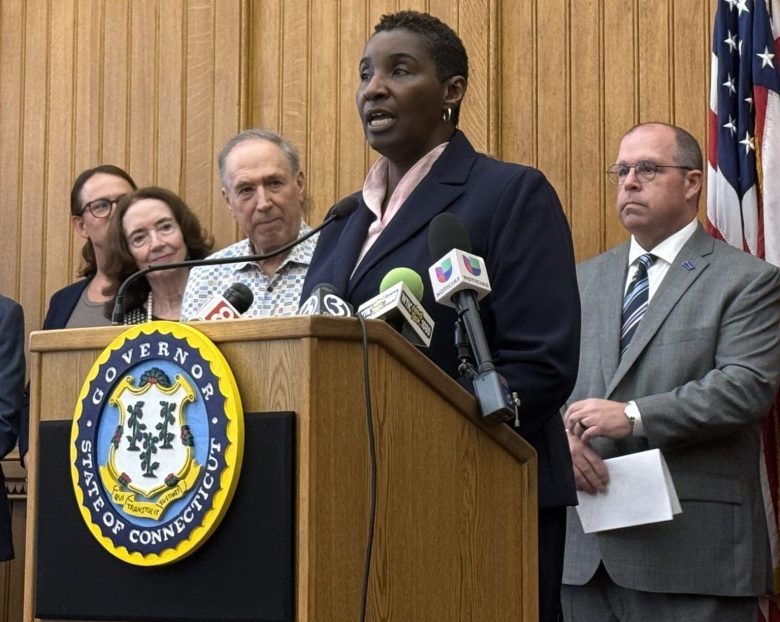
With about 110,000 poor adults at risk of losing Medicaid coverage under new federal work rules this January, officials are scrambling to avert a swell in uninsured patients forced to seek care through hospital emergency departments.
And while maintaining preventative care for thousands remains a foremost concern, some officials fear this trend could strain hospitals’ finances — just months after state tax changes dedicated hundreds of millions extra each year to the industry.
“This is the most irresponsible piece of legislation in American history,” state Sen. Matt Lesser, D-Middletown, co-chairman of the General Assembly’s Human Services Committee, said of the Medicaid rules changes enacted last July by Congress and signed by President Donald Trump.
The ramifications of that legislation on states, Lesser added, “are staggering and completely boneheaded.”
The state Department of Social Services estimates that 110,000, or 35%, of the 316,000 poor adults without children insured through the Medicaid-funded HUSKY D program are at risk of losing coverage in six months unless they can demonstrate compliance with new work and community engagement requirements.
That means proving they work at least 80 hours, or earn a minimum of $580, per month. Or they must demonstrate at least 80 hours of monthly community service or participation in a qualified training program.
Under existing rules, HUSKY D recipients cannot earn more than 138% of the Federal Poverty Level. That caps earnings at $22,032 for an individual and $29,868 for a household of two.
Critics charge these rules changes — part of a broad package of human services cutbacks needed to finance big federal tax cuts — won’t bolster employment but rather strip coverage from some of the nation’s most vulnerable residents.
Many of those targeted struggle with disabilities and chronic illnesses, and a new federal definition of “medical frailty” only exacerbates this problem.
Shrinking the at-risk Medicaid population
Andrea Barton Reeves, Gov. Ned Lamont’s social services commissioner, said the administration is doing everything possible to preserve coverage. Working with nonprofit community action agencies, hospitals and others, “we’re determined to find a way to make sure that they can stay enrolled,” she said.
That means helping some members with job training or employment searches. Others might need help understanding how to claim valid work exceptions. In other words, push is on to whittle down that 110,000 total of at-risk patients as much as possible.
The Connecticut Hospital Association and Comptroller Sean Scanlon are hoping other regions will mimic collaborative efforts in the greater Stamford area to identify at-risk Medicaid recipients and preserve eligibility for as many as possible.
Launched in February by Mayor Caroline Simmons and Stamford Hospital, a new task force leverages other health care providers, nonprofit social services agencies, local housing authorities, library staff and others to reach and assist patients.
“The goal of the task force is to get ahead of the [federal] changes,” Simmons said, adding that keeping residents insured and in regular contact with doctors “is going to keep our community healthier, safer.”
But Sen. Cathy Osten, D-Sprague, co-chairwoman of the Appropriations Committee, said while the effort in Stamford is laudable, other parts of Connecticut will have a harder time reaching at-risk Medicaid patients.
Osten, whose district in southeastern Connecticut is dominated by poor rural communities, said neither municipal governments nor the human service agencies in the region have the resources to launch a major outreach effort.
That almost certainly means some of the 110,000 at-risk patients will lose HUSKY D coverage, Barton Reeves said, adding no one is certain yet just how large that group will be.
‘Medical frailty’ rule could boost numbers of patients who lose coverage
Further complicating matters is the issue of “medical frailty” and a change at the federal level that could push uninsured patient totals higher.
The federal Centers for Medicare and Medicaid Services issued an interim final rule on June 1 meant to help guide states in implementing the new Medicaid work requirements. The guidance differed significantly from what states had expected, particularly when it came to the definition of a key exemption that allows people to bypass the new requirements.
People can qualify as “medically frail” if they are, for example, blind, disabled or diagnosed with chronic substance use disorder or serious medical conditions, including cancer and HIV. Based on preliminary conversations with CMS before the release of the interim final rule, states believed that using medical records to prove someone had a certain diagnosis would be enough to deem them “medically frail” and exempt from work requirements.
The Department of Social Services estimated that roughly 57,000 Connecticut residents were likely exempt from new work requirements because of “medical frailty” alone.
But the feds added another layer of complexity in the interim final rule: Instead of just proving “medical frailty,” states must also prove the condition “significantly impairs” a person from fulfilling work requirements.
“That two-pronged test — diagnosis and impairment — is seismic in its effect on the coverage loss projections,” said Connecticut Hospital Association Vice President Mark Schaefer.
Barton Reeves said it’s too early to tell what the impact will be on coverage, but she did acknowledge that states are not prepared to prove “significant impairment.”
“We now have to have an additional layer of medical review to determine whether or not their medical frailty, as defined by the federal statute, actually significantly impairs their ability to work,” she added. “No one in any state agency that I’ve spoken to across the country has medical staff in place with the subject matter expertise to make that determination.”
Will CT again spend local dollars to supplant vanishing federal aid?
And while Connecticut officials are focused, for now, on trying to keep as many HUSKY D patients on the rolls as possible, some other questions loom large a few months from now.
State legislators this spring tasked the Lamont administration to assess options, including some form of state-subsidized “Medicaid-lookalike” program for former HUSKY D recipients who lost coverage, Lesser said.
The Middletown lawmaker added that assisting this population likely would be “a huge priority” during the next regular General Assembly session, which begins Jan. 6.
Connecticut already has used its fund to partially offset reduced federal support for nutrition assistance and for subsidies that help low- and middle-income households buy health insurance on the state exchange.
Osten, who co-chairs the legislature’s Appropriations Committee, agreed with lesser than protecting HUSKY D recipients would be a priority in January.
“I think there’s always going to be a role for the state to play” when Washington sharply reduces human services programs, she said.
But shoring up HUSKY D coverage may not be the only issue the General Assembly must track closely next year.
Lawmakers this spring secured big new federal funding for its hospitals by revising the state tax on the industry for the next five years.
On paper, hospitals pay hundreds of millions annually in taxes to the state, which redistributes all that funding, plus more, back to the industry. Those return payments technically count as state health care spending, which then qualifies Connecticut for a big Medicaid reimbursement payment from Washington.
Most states employ this back-and-forth arrangement to leverage federal dollars.
Under the plan state lawmakers and Lamont approved last month, hospitals would gain an extra $240 million in the fiscal year that begins July 1. And that assistance would grow annually, reaching $433 million beyond the current level by 2031.
Hospitals are focused now on helping the state identify at-risk patients and working with them to preserve coverage for as many as possible, Schaefer said.
But the hospital association also is watching the situation closely because it could place new fiscal pressures on an industry that says it already loses $1.5 billion yearly due to Medicaid payments that fail to meet the full cost of delivering service.
Patients who lose HUSKY D coverage would have no choice but to seek care at emergency rooms but would be unable to pay.
Projections for patients losing coverage are too volatile now to make firm conclusions, Schaefer said. But the worst-case financial impact on hospitals could be in the low hundreds of millions of dollars annually.
“I personally think we need to step back and completely reassess how bad the coverage losses can be,” he added.
Scanlon, who negotiated Connecticut’s new taxing arrangement with hospitals, said part of the reason the state dedicated big new support for the industry was because it anticipated a portion of the HUSKY D population losing coverage.
“I think the deal that we agreed to this year, that will give the hospitals over $1 billion in the next five years, is a transformational arrangement between a state and its hospital system that is, I think, pretty unprecedented in the country,” Scanlon said.
Still, the comptroller added that state officials are dedicated to maintaining the financial health of Connecticut’s hospitals.
“Our relationship with the hospitals is a live one,” Scanlon said. “This isn’t such that ‘we’ve done this, it’s a five-year deal, and then we’re not going to talk for five years, right?’ As long as this [Trump] administration is bent on radically altering the relationship between the federal government and state governments, we’re going to have to be in the foxhole with our partners — in this case, with the hospitals and the community health centers — to make sure that they’ve got the resources that they need.”