Four rural Connecticut hospitals are getting millions in federal grant dollars that will be used to expand and upgrade imaging, telehealth and transport services, among other initiatives.
The Connecticut hospitals — Charlotte Hungerford, Day Kimball, Sharon and Windham — each received a share of $46 million, officials announced Wednesday. An additional $4 million is going to Mathematica, a computing software system used to provide technical assistance for the four rural hospitals, officials said.
The money comes from the Rural Health Transformation Program, a $50 billion federal effort aimed at improving healthcare in the rural U.S. In total, Connecticut received $154 million through the program.
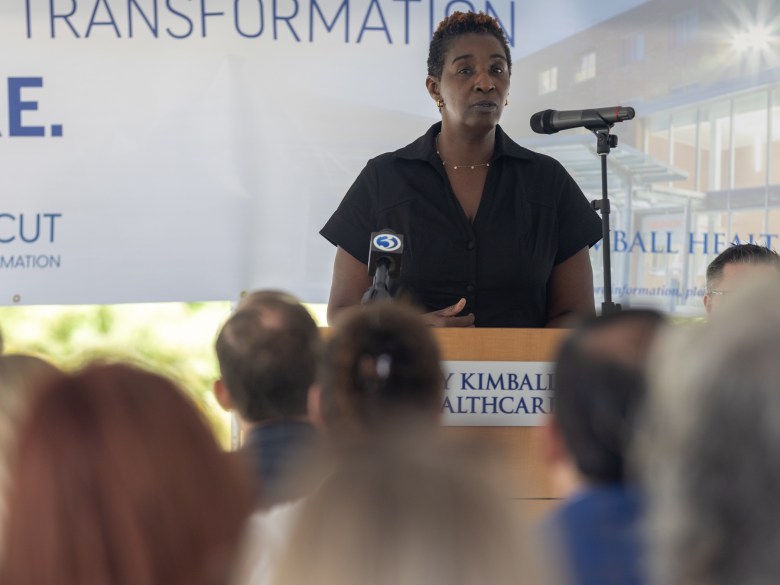
“We were awarded $54 million above the base of $100 million because of the work that we’ve done,” DSS Commissioner Andrea Barton Reeves said at a press conference at Day Kimball Hospital on Wednesday. “We’ve demonstrated that substantial work has happened here, and substantial work can continue to happen to transform rural communities in the state of Connecticut.”
The remaining $104 million not going directly to hospitals or hospital technology assistance will be used for a range of projects across the state, from healthcare workforce development in rural areas to maternity and postpartum services, mobile health services and the expansion of a multiuse trail to encourage outdoor fitness.
Day Kimball Hospital in Putnam, which has faced serious financial difficulties, is receiving $20.2 million — the largest share of funding for any one hospital.
Currently, some of the hospital’s MRI services are situated in a trailer outside the building. Kyle Kramer, CEO of Day Kimball, said the “first” of the upgrades will be to replace the trailer with a fixed facility for advanced imaging.
“[This] will allow us to keep patients here as opposed to their having to go elsewhere for advanced imaging services,” Kramer said. “That’s exciting, and it’s transformative.”
Kramer also said the funds will be used to expand patient transport services, remote patient monitoring and virtual care initiatives. He said all these upgrades are important to improve access, equity and affordability of care.
Two Hartford Healthcare hospitals — Charlotte Hungerford in Torrington and Windham Hospital in Willimantic — are getting $12.6 million collectively.
Charlotte Hungerford plans to use the funds to establish the state’s first mobile stroke unit to serve the northwestern corner of the state. This unit is essentially an ambulance equipped with CAT scan and ultrasound equipment, as well as telehealth capabilities to communicate with doctors across the state. The Hartford Healthcare hospital’s will also expand telehealth and in-patient monitoring services.
Sharon Hospital, like the other three recipients, will use the funds to expand virtual care and rehabilitation services as well as introduce a healthy aging program.
The additional $104 million in statewide funds is going toward more than 100 contracts across 30 projects. These projects are overseen by 10 state agencies, including the Department of Public Health, the Office of Early Childhood, the Department of Education and the Department of Energy and Environmental Protection.
Daniel Sinclair, statewide project director for Connecticut’s program, said the federal Center for Medicare and Medicaid Services is closely monitoring the deployment of funds. Every year, the state will be required to submit annual reports that track progress on the initiative in order to determine the next year’s funding levels. The first report was submitted Aug. 31.
“They’ve set up a pretty rigorous program,” Sinclair said.
Gov. Ned Lamont thanked the members of the state’s leadership team for the Rural Health Transformation Program as well as hospital leaders for their support. He said he hopes the funds will improve care in Connecticut.
“We can get you into a specialized center with a really good doc there, but you have remote access to the very top specialists at, say, UConn Health help with that particular thing,” Lamont said.
He added that the result is “saving people transportation, providing more accessible, more affordable, faster service than we had before.”
CT Mirror reporter Katy Golvala contributed to this story.