

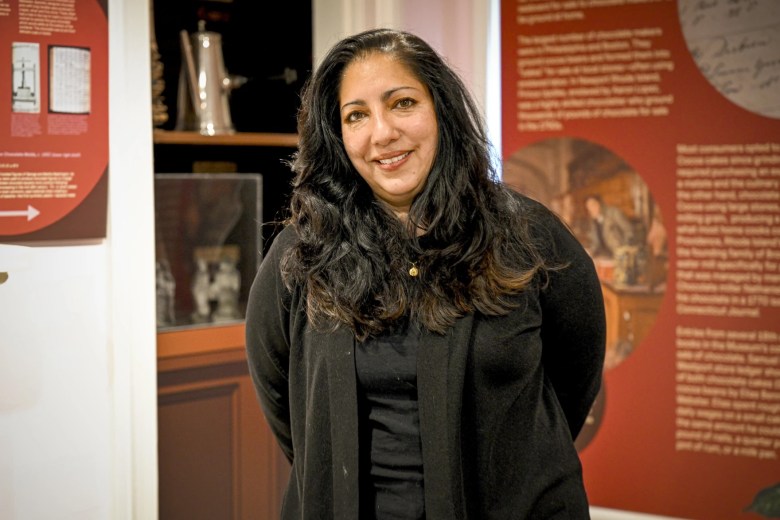
When the Westport Museum for History & Culture announced a new strategic plan eight years ago, the organization reimagined what Westport’s history could look like. Now, Executive Director Ramin Ganeshram and board members are putting out an emergency fundraising appeal, without which the organization may have to leave its historic building by next year.
That news came from the museum last week, as it launched a campaign to raise $750,000 by the end of the calendar year, funding that will sustain its already scaled-down operations and let it stay in the Bradley-Wheeler House, a 1795 home out of which it has operated since 1985. The organization itself dates back to 1889, when it was recognized as the Westport Historical Society (it has also operated as the Saugatuck Historical Society and the Westport-Weston Historical Society).
“I think people don’t realize the value of the institution,” said Ganeshram, a journalist and scholar who stepped into her position in January 2018. “It’s no longer a historical society with a house museum,” but a space with interactive, rotating exhibitions and installations backed by research.
She nodded to the museum’s tag line, “Making History Whole,” then continued, “Our approach to history is to respect our visitors’ intellect enough to be able to share with them complex ideas.”
The reason for the appeal, and its urgency in this moment, is multi-pronged, Ganeshram said in an interview last week. For years, she and members of the museum’s staff and board have fought the misconception that the organization receives funding from the town of Westport, the municipal hub just a minute away across Myrtle Street.
While the Town of Westport does provide support to civic institutions such as the Westport Public Library, it does not provide operating funds to the museum. In 2022, it regranted $20,000 of Westport’s overall $8.4 million federal American Rescue Plan Act (ARPA) funds to the organization, for project-based funding that has since supported “The Real Revolution,” an exhibition that celebrates and explores the full breadth of America’s semiquincentennial.
Per a series of guidelines that the town implemented around the grants, the museum hired local illustrators and writers, and worked on a ”a reusable resource packet for fifth graders,” Ganeshram said. Like many other small museums and historical societies across Connecticut, the Westport Museum for History & Culture also does not receive any dedicated line item funding through the state.
“We’re completely private,” and reliant on grants, institutional funders, and individual donations to raise a $400,000 annual operating budget, Ganeshram said. Despite small grants from organizations like CT Humanities ($1,000 for a dinner and dialogue last year, for instance, or $2,715.15 for summer youth programming in 2024) and more significant donations from the Daniel E. Offutt III Charitable Trust, that still leaves Ganeshram with hundreds of thousands of dollars to raise each year.
“I haven’t cracked the code,” Ganeshram said. “Funders, grantmakers, as well as donors believe that Westport has money, and therefore should be funding its institution.”
When asked Monday, Westport First Selectman Kevin Christie confirmed that the museum, as an independent and private organization, does not receive funding from the town, which has allowed it to maintain “the autonomy that comes from being privately funded and outside the municipal budget process.”
“There have been some informal inquiries about potential Town support, but I have not proposed municipal funding,” he said in an email Monday afternoon, adding that “the museum plays an important role in preserving Westport’s history,” and he does hope it is successful in its emergency appeal. “Any such funding would need to go through the Town’s established budget and appropriation process, including review and approval by the appropriate funding bodies.”
“With the cost of living an increasing concern for many residents, as well as significant financial obligations and competing priorities facing the Town, we need to be disciplined about the use of taxpayer dollars. That applies to funding requests from any independent organization, including those that make important contributions to our community.”
The call for funding comes after eight years of growth and transition for the museum, including a name change, several capital improvement projects, a new museological approach that includes rotating exhibitions, new gallery spaces, and historical markers that acknowledge Connecticut’s history of enslavement and its original inhabitants, members of the Paugesset Tribe who stewarded the land for generations.
After her tenure began in 2018, Ganeshram built and streamlined the collections management process, began planning exhibitions that pulled from the museum’s extensive archives, and focused on all of Westport’s residents, including those who had long been pushed to the historical margins (in 2024, she held a formal dedication to the Black and Indigenous residents of Westport, including the Golden Hill Paugussett Tribe, framing the history as one that continues to evolve).
In 2019, one year after her appointment, the museum opened the exhibition “Remembered: The History of African-Americans in Westport,” an exhibition that received recognition from the Institute for Museum and Library Services (ILMS), American Association for State and Local History, and Connecticut League of History Organizations.
The mission was not just to bring attention to Connecticut’s history of enslavement, which remained legal until 1848, but also shine a light on the long and sometimes fraught history of Black residents of the town, and the way their local stories intersected with national history.
Zach Terrillion, who grew up in Westport and worked on the exhibition as a high school intern, remembered the thrill of discovering history through the museum’s archives, and the ways in which the exhibition opened his eyes to facts about Westport that he had missed out on in the city’s public schools. He learned, for instance, that both the civil rights activist Martin Luther King, Jr. and the prophetic Black writer James Baldwin had visited and spoken at Westport’s Temple Israel, next to which he attended elementary school, in the 1960s.
He, and other visitors to the exhibition, also learned that the state’s history of enslavement was more complicated than it had seemed in school, where slavery was largely framed as something that happened in the American South. In fact, slavery was legal in Connecticut through 1848; the last known sale of enslaved people took place on the New Haven Green in 1825.
In Westport, Greens Farms Parish records from the eighteenth and nineteenth century indicate almost 250 enslaved people, including children, between 1742 and 1822 — a fact that the museum included in the exhibition, and has since commemorated in a brick walkway that leads up to the historic house.
“It was this moment of local history connecting to national history” that later informed his decision to study public humanities at Oberlin College, Terrillion said. He added that “understanding those uglier parts of the local history are very very important, but I think the museum touched upon excellency and success” of Black Westport residents in a way that made, and continues to make, him proud.
During those first years of Ganeshram’s tenure, which coincided with the Covid-19 pandemic and a move to increased digital content, the museum also raised $3 million that allowed it to tackle long-deferred maintenance projects on its grounds and building. That included, for instance, a $500,000 restoration of the 1846 Bradley Wheeler Cobblestone Barn by the Middletown-based company Kronenberger & Sons Restoration, $450,000 in updates to the museum’s grounds, including the addition of free WiFi, and updates to the museum’s collections management systems.
Ganeshram pointed to the importance of protecting and preserving archives that date back to the 1670s, and are often the foundation for the museum’s exhibitions as staff and volunteers do research, and tie in Westport’s history. She said that another chunk of that funding went toward general operating support, including utilities and building needs that can be as much as $150,000 in a given year.
In recent years, though, raising funds to keep the museum going has become harder, due in part to a nonprofit landscape in which both state and federal dollars are drying up after an ARPA boom, and individual donors are giving less money, less frequently. In the last year, the museum staff has shrunk from six full- and part-time employees to just three, including Ganeshram and two part-time staffers.
The museum now operates just two days per week, on Fridays and Saturdays. It has continued to run limited programming, which brings in a very small percent of its annual income stream.
Even as Ganeshram has brought in new visitors, including several young volunteers eager to get to work in the archives, she said she’s also seen significant pushback to the museum’s expanded mission, including its new gallery spaces and focus on Black, Indigenous, and LGBTQ+ people often excluded from historical narratives of the town.
According to the CT Data Collaborative, 78 percent of Westport is white. Ganeshram, whose mother is Iranian and whose father is Trinidadian, acknowledged the discomfort the museum’s expanded mission can create for people who have not had to reckon with their own history, or the history of their ancestors.
“Our tagline is ‘Making History Whole,’ and it’s just too much for some people,” she said. But history, by its very nature, “is uncomfortable … [and] it’s more painful to ignore it than to explore it.”
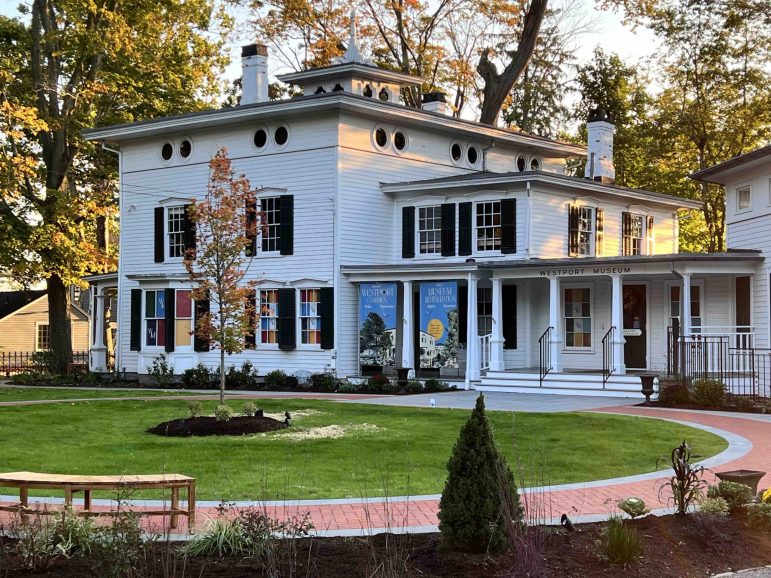
If the museum does not raise $750,000 by the end of the year, Ganeshram added, it will likely mean that “we would sell the asset [the Bradley-Wheeler House] and keep the mission.” Because the museum’s archives include almost 400 years of town history, the organization would probably move into a smaller space where it could preserve those documents, keep its research mission, and continue to offer programming, including out of its newly-restored barn.
If it is able to raise those funds (Ganeshram pointed to an upcoming fundraiser on November 13), the museum will continue programming, stay open for a limited number of days per week in its current spot, and likely hire a professional fundraiser while working on a new strategic plan. Ganeshram said that the museum would not be able to return to full staffing capacity immediately.
“I think it’s pretty devastating,” Terrillion said, remembering field trips that he took to the museum as a kid. “Even before I started volunteering at the museum, I understood the importance of the space … the space is at basically the heart of the community. It’s hard to imagine what it would be like if there was not a museum, a historical space within that historical home, there.”
“I think it is a space that is worth investing in,” he added, lauding the diversity of visitors, community events, and programs that he’s seen and been a part of during his young adulthood.
Kathy Nixon, a lifelong resident of Westport who has volunteered, served on the board of, and worked at the museum over the last three and half decades (she is currently one of two part-time staff members left), said that she would likewise be crushed to see it leave its longtime home.
After growing up in Westport, and wearing multiple professional hats at the museum, she sees it as a vital space for learning the full history of the place that she calls home. She never knew, for instance, that in 1950 — just a decade after her own parents had put down roots in Westport — that a housing complex on the town’s Main Street caught fire, displacing dozens of the town’s Black residents, some of whom permanently left the town.
It was an example of how Westport, often heralded for its Blue Ribbon Schools and progressive ideals, was part of a larger narrative of direct and indirect “slum clearance” efforts, some removed from federal housing policy of the same name, that took place in the mid-twentieth century. Nixon (who suspects that the fire was arson, although that has never been confirmed) was both surprised and not surprised at all that she’d grown up in the town and never known.
“When they [board members] hired her [Ganeshram] and some people had left, I thought, ‘I just am gonna stick this out and see what she can accomplish,’” she said in a phone call Thursday evening. “And she has accomplished everything they wanted her to do.”
She added that Ganeshram has become not only a colleague, but a friend. “I’m proud of all of that,” she said. “I’m proud of sticking it out. I’m thrilled to be working with Ramin.”
In a press release sent out by the organization earlier this week, TEAM Westport Chair Harold Bailey echoed that sense of urgency, championing the work that Ganeshram has done to fold in voices from all of Westport’s residents. TEAM Westport is a committee within the town’s government “with the mission to make the Town of Westport increasingly welcoming with respect to race, ethnicity, religion and LGBTQIA+,” according to its website.
“The innovative approach Ramin has brought to presenting and interpreting subject matter has added remarkable new dimensions of breadth, depth, and relevance to museum exhibitions locally, regionally, and nationally,” he said. “Her work has enabled generations of visitors—both longtime museumgoers and new audiences—to encounter familiar subjects through fresh, compelling, and often unexpected perspectives.”
In the meantime, Ganeshram has continued to keep programming running, including an upcoming workshop for Connecticut K-12 educators in collaboration with George Washington’s Mount Vernon. Titled “Setting Down Liberty: Washington and the Black Experience in the Founding Era,” the workshop is a day of learning for educators at the museum, centered on the country’s semiquincentennial. Ganeshram is a library fellow at Mount Vernon, which has made the programming possible.