


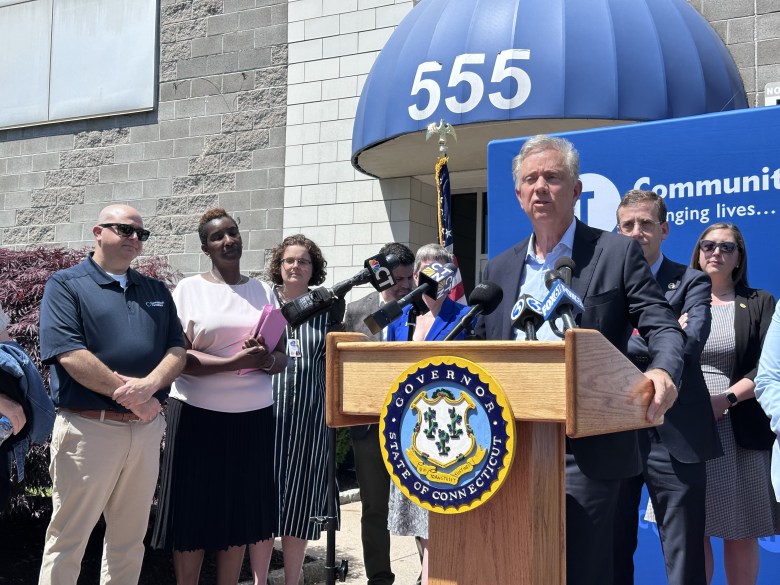
Nearly five months after Gov. Ned Lamont pledged $300 grocery gift cards to 25,000 poor residents who’d lost federal nutrition benefits, his administration has delivered just 2,000, the Department of Social Services reported Tuesday.
And while the administration vowed to intensify efforts on Oct. 2 when the Connecticut Mirror disclosed the relief program had bogged down, distribution has slowed since then.
Meanwhile, anti-hunger advocates predicted Tuesday that the breakdown would expand legislative support for a new state-funded nutrition grant to assist some of the tens of thousands who’ve stopped receiving federal Supplemental Nutrition Assistance Program benefits, commonly known as SNAP.
“We are almost a year into the SNAP crisis caused by the federal budget, and Connecticut still has not come up with a plan to get people fed,” said Meghan Holden, communications director for The Connecticut Project, a philanthropic research group focused on economic opportunity and affordability.
The governor, a Democrat campaigning for a third term, announced on June 3 that grocery store cards would be released in early August to complement millions of dollars in supplemental state contributions to food banks and pantries.
“Here in Connecticut, we’re stepping up and looking out for you,” Lamont said at the time.
But the social services department didn’t provide local nonprofits assisting with card distribution with full contact information for all eligible recipients until early September, a department spokeswoman said. Officials wanted to ensure that transfer wouldn’t violate federal privacy rules.
By early October, two months after the program had started, only 1,425 former SNAP beneficiaries had received a collective $427,500, with 23,570 food-insecure residents still awaiting about $7.1 million.
Despite pledges to intensify efforts, the department, which got relief to an average of 712.5 residents during the first two months of distribution, reached only about 575 more during the bulk of October, spokeswoman Christine Stuart said Tuesday.
The department also announced several new steps to streamline distribution.
Though residents eligible for gift cards were notified via text this summer, they were re-notified by post cards recently by nonprofit groups assisting the department.
Those eligible don’t have to make an appointment but can simply visit any of the nine nonprofit Community Action Agencies helping with distribution “and receive a gift card immediately upon quick verification.”
Though the agency staff still can explore options to restore card recipients’ access to federal benefits — such as enrolling in job training or volunteer work — that is not necessary to receive the $300 benefit.
And while gift cards were transmitted electronically in the past, the agencies now will be providing physical cards.
“DSS will continue working closely with the agencies to remove barriers to keep the process simple and respectful,” the department wrote in a statement.
Rhonda Evans, executive director for the Connecticut Association for Community Action, added that “we encourage individuals who have received notification that they are eligible to visit their local agency to verify their identity and receive their card. Our goal is to ensure eligible individuals can access the support they need as easily as possible.”
Lamont has faced increasing pressure to intervene since July 2025, when Congress and President Donald Trump ordered major cutbacks to SNAP and other federal human services programs.
Veterans, people experiencing homelessness, former foster youths and parents with children older than 14 all face tougher work requirements. Many lawfully present immigrants, including refugees, lost eligibility. And critics say tougher error penalties from Washington have led states to unfairly disqualify many SNAP applicants.
The Center on Budget and Policy Priorities, a fiscal policy group based in Washington, D.C., reported earlier this month that SNAP enrollment is at its lowest point nationwide in 17 years. Connecticut Voices for Children, a local policy and research organization, noted in August that nearly 63,000 Connecticut residents, including almost 19,000 children, have lost federal nutrition benefits since July 2025.
Lamont’s critics, on both sides of the aisle, said there are lessons to be learned from the grocery card situation.
“It’s surprising and a bit frustrating that DSS hasn’t been able to get these cards out the door,” said Sen. Matt Lesser, D-Middletown, co-chair of the Human Services Committee and advocate for a state-funded nutrition benefit. “We really do need to set up a more permanent program.”
Sen. Cathy Osten, D-Sprague, co-chair of the Appropriations Committee and another advocate for a state-funded nutrition benefit, said “gift cards don’t change the dial” enough in a hunger crisis.
“We need to get people food,” she said. “We shouldn’t be waiting to hand out gift cards months later.”
Republican gubernatorial candidate Ryan Fazio has opposed using state funds to offset federal human service cutbacks. But he also has chastised Lamont for touting the assistance at campaign press conferences while failing to deliver the actual relief to many.
“Gov. Lamont got the headlines, took credit for fighting the federal government, and then what?” Fazio said, noting that 92% of those the governor pledged to help feed five months ago have received nothing.
“This isn’t just an administrative delay. It’s failed leadership. … The governor must be held accountable for his broken promises.”
But Lamont and his fellow Democrats in the legislature’s majority have used hundreds of millions in state reserves to offset federal cutbacks in healthcare, heating assistance and other social services.
Lamont also has criticized Fazio for opposition to any state intervention and for failing to speak out against cuts that analysts say will remove more than $1 trillion from federal human services programs by 2034.
“Talk is cheap,” Lamont campaign spokeswoman Lauren Gray said Tuesday. “When Connecticut families needed help, Gov. Lamont proposed the Federal Cuts Response Fund to protect them. Ryan Fazio said no. That’s the difference between talking about helping people and actually showing up for them.”
Note: The Connecticut Project is a funder of The Connecticut Mirror.
