

Federal education policy cast a long shadow at the annual Special Education Equity for Kids in Connecticut conference Friday.
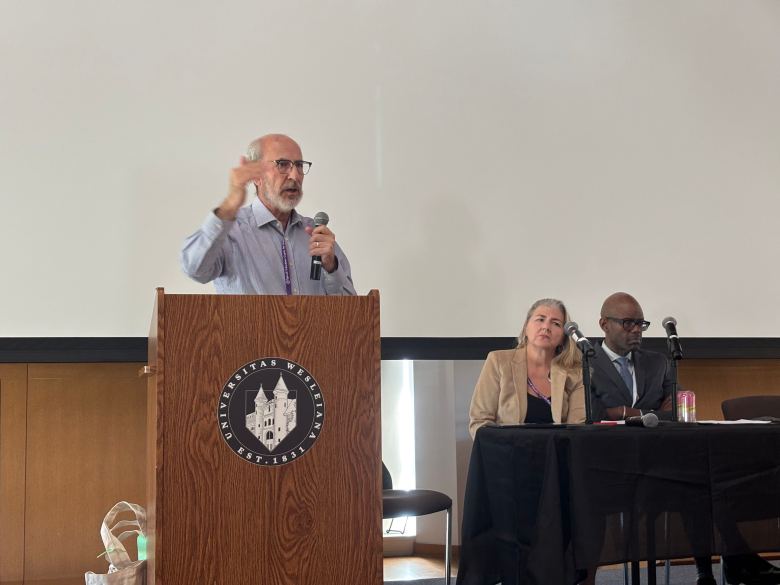
The event’s two keynote speakers, attorney Matt Cohen of Chicago and University of Connecticut professor Preston Green III, spoke in grave terms to a packed house at Wesleyan University about the danger they believe the Trump administration poses to public education — and, by extension, special education.
“As public education goes, guess what? Special education goes, too,” Cohen told the audience.
Topping their list of threats: the Federal Scholarship Tax Credit, which turns federal dollars into scholarships for students. Those scholarships can cover a wide range of expenses — private school tuition, for example, or afterschool tutoring — but only if a state’s governor opts in.
Gov. Ned Lamont has not yet indicated whether he will. His Republican opponent, Ryan Fazio, has called the program a “win-win.”
Proponents of school choice, and particularly of private school voucher programs, tend to support the FSTC, which brings federal dollars into what has until now been a state-by-state effort. Conversely, leaders with the Connecticut Association of Public School Superintendents and the state’s teachers’ unions have been critical of the program. They argue the scholarships lack oversight, exacerbate inequality and will likely prompt cuts to other federal education programs.
[RELATED: Proposed Federal Scholarship Tax Credit rules fail to win over CT educators]
Now, prominent special education advocates — including attorneys parents hire to spar with teachers and school administrators over Individualized Education Programs — are joining the latter in agreement.
Green, the UConn professor, said he fears parents and students who use the FSTC to send their kids to private schools will find themselves walking into a trap.
“When they participate in these programs … they sign their rights away to IDEA,” Green said.
That’s because private schools are not subject to the same requirements as public schools under the IDEA. Green said states with their own voucher programs often specify that using a voucher means forfeiting one’s IDEA rights. In that case, he said, parents lose the main tool they and their attorneys could otherwise use to push back if they’re unhappy with the services a school provides.
Cohen said many of his clients see the FSTC as their ticket out of a public education system that has failed them.
“They’re thrilled about this scholarship program,” Cohen said. “They’re being hoodwinked.”
Cohen echoed a concern common among critics of the FSTC: that most of the beneficiaries of FSTC-backed private school scholarships will be affluent, nondisabled children. Private schools have fewer obligations when it comes to students with disabilities than their public counterparts and can refuse to admit students altogether in some circumstances.
“You’re left with public schools that have predominantly kids who have great needs,” Cohen said, while the funding to meet those needs — typically based on enrollment — will be going down.
Not everyone shares that outlook. Researchers with Edunomics Lab at Georgetown University published an opinion piece in The 74 detailing how states can build a system that captures some FSTC dollars and funnels them to public school students. They argued it could translate to more than $1,000 per pupil for what the authors referred to as “K12-plus” — “stuff like field trips, tutoring, homework help, assemblies, clubs or other services not required in the state’s definition of required public education.”
That last part is important. The scholarships go to students, not to schools themselves. Students then use the money to pay for an eligible expense. Core public school services — the classes students take every day, for example — are free for students and required by state law. They are ineligible. (Private schools don’t have this problem since tuition is an eligible expense.)
This makes the relationship between the FSTC and special education somewhat complicated, Michael Morton of the School and State Finance Project said.
The federal Individuals with Disabilities Education Act gives all students the right to a free appropriate public education, or FAPE. Broadly speaking, that means every child who needs special education has a right to it in whatever form is appropriate for that individual — at no cost.
Consequently, any organization that grants FSTC-backed scholarships “would need to be very careful that the approach is not essentially charging families for services they are legally entitled to,” Morton said.
If districts can’t meet a student’s needs in-house, they typically have to outplace the student to an approved private special education provider. These outplacements are often enormously expensive, and state relief is patchy, meaning districts end up eating the cost themselves. Advocates routinely ask the state to cover more of those excess costs, and so far, they’ve been disappointed.
Crucially, though, it’s still not the parents who pay.
Morton said it’s not clear the FSTC could be used to pay for those private outplacements instead. In theory, it could — but not if the family has to start paying for something they should get as part of FAPE. Morton said it’s possible future guidance from the IRS would clarify whether and how scholarship granting organizations (SGOs) can thread that needle.
ConnCAN Executive Director Steven Hernandez said there are other services for students with disabilities the FSTC could certainly help pay for. For example, a student with dyslexia could receive a scholarship that pays for supplemental reading programming or high-dosage tutoring.
The key, Hernandez said, is to have a trusted SGO set up that will hand out scholarships for that purpose. He pointed to The Future School Fund, which was founded by former Rhode Island Commissioner of Education Deborah Gist, as an example.
Hernandez said he shares critics’ concerns when it comes to the FSTC, but he still believes Lamont should opt Connecticut in.
“We’ve taken the position of, ‘Leave no dollar behind,’” Hernandez said — though he acknowledged they are “strange dollars” because of how the money actually flows.
Unlike most educational funding, the FSTC isn’t a legislative appropriation. Instead, individuals donate to scholarship granting organizations, then claim up to $1,700 as a dollar-for-dollar tax credit. At the end of the day, the money still comes out of the federal government, but it is individuals, and the SGOs they donate to, who decide where it goes.
That, Hernandez said, is why it’s all the more important for Connecticut to opt in.
“The fact is that in Connecticut, there are many philanthropists who are maximizing their tax credits … in order to support things that they think are worthy,” Hernandez said. Those philanthropists will probably snap up the FSTC’s dollar-for-dollar $1,700 credit no matter what, but the money will leave Connecticut unless Lamont opts in.
Critics of the FSTC said the trade-off isn’t anywhere close to worth it. If the state opts in, it would have to allow all kinds of SGOs, including those giving private tuition scholarships. Those scholarships are what Cohen and others believe will pull students out of public schools and leave the public system with fewer resources to help students with high needs.
Hernandez said that’s a possibility, but he noted those pressures — declining enrollment and rising needs — are already getting worse without the FSTC. As a member of the governor’s Blue Ribbon Commission on K-12 Education Funding and Accountability, he’s been speaking regularly with other state education leaders about this for months.
“This is a problem already that we need to address, and this Blue Ribbon Commission needs to address this. This legislature, this governor needs to address this,” Hernandez said.
That’s true, he said, regardless of whether Lamont opts into the FSTC or not.
“This is not a panacea for any of these children, whether it’s children with disabilities and children living in poverty or kids of color in the state,” he said. “None of this is going to address the problems that Connecticut has failed to address for years now.”
