



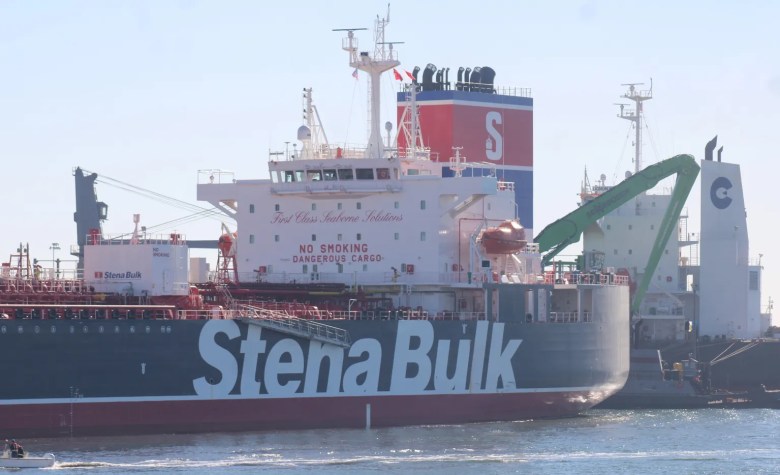
The U.S. Army Corps of Engineers has begun a long-planned effort to deepen the navigation channel within the New Haven Harbor by five feet — with the goal of allowing bigger ships carrying steel, cement, and oil to travel to and from the city’s industrial port.
That New Haven Harbor Improvement Project began on Friday, according to Troy Darr, the chief of public affairs for the New England District of the U.S. Army Corps of Engineers (USACE).
The project dates back roughly two decades, and will see the removal of roughly “4.5 million cubic yards of sand, silt, and rock to deepen the entrance channel, main shipping channel, and turning basin from 35 feet to 40 feet below mean lower low water, while widening the critical transit corridor,” according to Darr.
The U.S. Army Corps of Engineers has awarded this project to contractor Great Lakes Dock and Dredge Company.
The work should take place over the course of “two dredge sessions” — from October 2026 to March 2027, and from October 2027 to March 2028.
“This work will allow the port to accommodate modern, deeper-draft commercial vessels—significantly boosting shipping efficiency, lowering transportation costs, and enhancing navigation safety,” Darr told the Independent in an email comment. “Furthermore, a substantial portion of the dredged material will be beneficially reused directly within harbor to improve important fish habitat, enhance oyster grounds and build a new rock reef.”
Sally Kruse, the executive director of the New Haven Port Authority, welcomed the beginning of this project as “very exciting” not just for the port, but also for New Haven.
“It represents a major investment” by the federal and state governments in making ship transportation in and out of the port more efficient, she said. She said that larger vessels tend to be newer, more efficient, “more modern,” and even more eco-friendly — potentially allowing for “the same amount of material coming in” to the port with fewer vessels.
She said that the channel-deepening project should allow vessels to come in to New Haven’s port “without waiting for high tide. The current depth means that some of the largest vessels cannot come in without doing so.”
In an Oct. 21 press release announcing the start of the project, Darr wrote that New Haven is “the largest port of call in Long Island Sound, the third-largest port in New England by tonnage, and Connecticut’s busiest port.”
New Haven’s port is not a so-called “container port.” The products that are transported in and out of the city’s harbor are not, for example, big boxes of furniture or food.
Instead, the city’s port is a way station for “petroleum products, home-heating oil, aggregates, equipment, and scrap metal,” as Darr put it.
The Oct. 21 press release states that roughly 1.7 million cubic yards of dredged material will be used “to support aquatic ecosystem improvement of shellfish and reef habitat, including filling of relic borrow pits that have existed in the harbor since the 1950s.”
In addition to the deepening of the channel from 35 to 40 feet below Mean Lower Low Water (MLLW), this project will also see the widening of the entrance channel from 500 feet to 600 feet outside the breakwaters; the widening of the channel bend between the breakwaters from 560 feet to 800 feet; the widening of the main channel from 400 feet to 500 feet inside the harbor; and the “optimizing” of the turning basin “for more efficient use by larger vessels.”
“The improvements will support energy production with optimized delivery of critical petroleum, products such as gasoline, jet fuel, and heating oil as well as commodities such as road salt, steel and chemicals vital to our nations industry,” Craig Martin, senior project manager with the USACE New England District, is quoted as saying in the press release.
The work has been coordinated with the U.S. Coast Guard, Connecticut Port Authority, and New Haven Port Authority, among others.
Click here and here to read more about the project, including about how the Senate Committee on the Environment and Public Works authorized a feasibility study back in July 2007 regarding navigation improvements for the New Haven Harbor.
This story was first published Oct. 27, 2026 by New Haven Independent.