


Connecticut Gov. Ned Lamont and state leaders are trumpeting the state’s efforts to equip its workforce with AI skills and expertise, even as some economists and labor leaders raise broad concerns about its potential to upend the nature of employment.
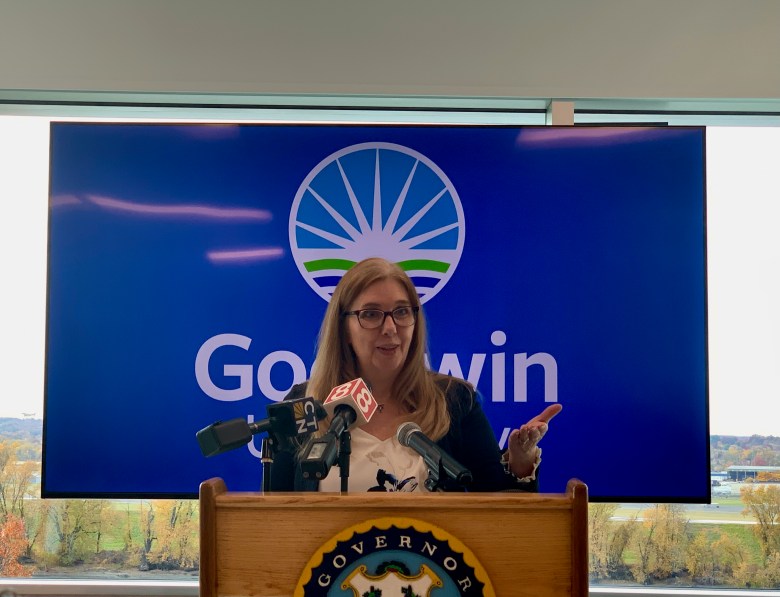
At a press conference in East Hartford Wednesday, the governor joined university leaders, state officials and members of the business community to lay out state workforce development programs aimed at easing the AI transition and supporting workers.
“We’re putting our employers first and helping pull students through that process in order to build the skills, knowledge and abilities that they need to be successful,” said Kelli-Marie Vallieres, the state’s chief workforce officer.
Much of the event focused on highlighting the importance of Connecticut’s “Tech Talent Accelerator,” a four-year-old workforce development program that facilitates partnerships between higher education institutions and businesses.
In February, the state announced that it was launching the Tech Talent Accelerator 3.0, a more artificial intelligence-oriented version of the program. The Office of Workforce Strategy is supporting several AI pilot programs, including an AI accounting and entrepreneurship course at Connecticut College, an AI for Cybersecurity program at the University of New Haven, and an online course on AI in healthcare business innovation at Quinnipiac University.
The goal, Vallieres and others said, is to work collaboratively with businesses in the state to connect students and companies well before graduation day.
Nicholas Schilling, a software engineer at IT and business consulting firm CGI, shared his experience of how that sort of relationship helped him.
Schilling entered the University of St. Joseph with few ideas of the career he wanted to enter after school. But that changed when he was connected with CGI at an event. Schilling went on to study computer and data science, later completing an internship with CGI. After graduation, he went to work for the company full-time, and he now provides mentorship to students.
“Because I had spent so much time with CGI as a student, the transition to full-time employment was seamless,” he said. “I was able to focus on growth rather than trying to find my footing.”
[RELATED: CT redoubles efforts to equip workforce for AI economy]
In the hopeful eyes of Lamont, AI brings the potential for new opportunities and increased economic opportunity — and it fits into a broader push from state leaders to shift the state’s economy in a tech-oriented direction.
“I’m pretty bullish because I think the world is moving in our favor in the sense that much more knowledge-based, skilled-based is where our future is,” Lamont said. “A lot of that will be better directed, better guided, and much more effective for people learning how to use artificial intelligence.”
A multifaceted approach
The scene that unfolded Wednesday has become a familiar one: Lamont, surrounded by state officials and university leaders, describing the state’s unlimited potential and early success in various AI or technology initiatives.
Over the summer, the state celebrated a grant award from the National Science Foundation that will help build out its quantum computing sector. The project is also slated to receive $121 million in funding from the state.
Around the same time, Lamont’s office announced that it was entering a partnership with RAISE US, a nonpartisan organization that offers workers displaced by AI a mix of retraining and upskilling. As part of the collaboration, Connecticut will pilot programs training workers to interact with AI. The lessons from Connecticut and other partner states will inform a national workforce strategy.
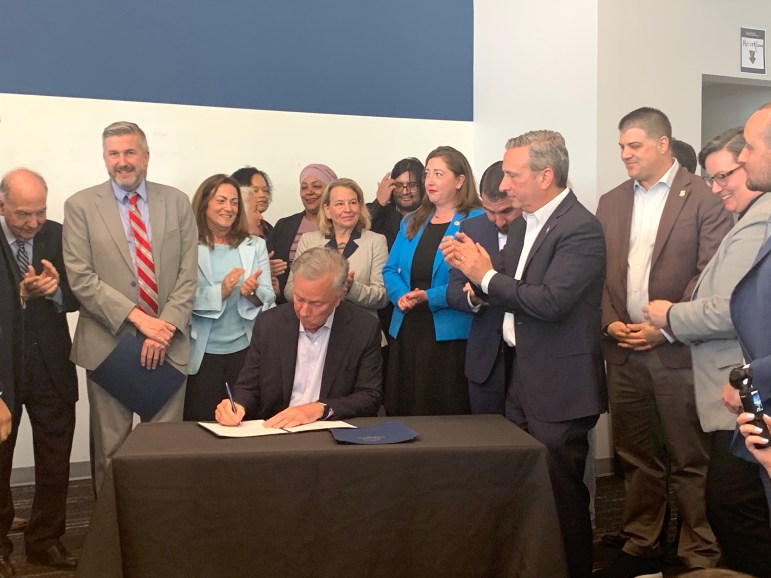
State officials framed the partnership as a chance for Connecticut to provide leadership on a national issue.
“States are where the rubber really hits the road,” Dan O’Keefe, commissioner of the Department of Economic and Community Development, told CT Mirror in July. “I think the federal government has been a bit hands-off on things, and we felt the need to fill the gap.”
The state has also launched other efforts, including the Connecticut AI Academy, a free online school that offers certificate programs in AI literacy and AI fluency. The academy is expected to expand to offer AI learning for teens, teachers and small businesses.
And in August, DECD announced a $20 million investment into an applied AI workforce center in Hartford, a project that will help train workers in new AI skills and technologies.
The relationship between workforce development and artificial intelligence is also being closely examined in the work of the state’s Career Pathways Commission, which is currently developing a plan for work-based learning and career exposure to create pathway opportunities beginning in kindergarten through adulthood.
“AI is not a major by itself, but it tends to be a minor in all the things you’re doing,” Lamont said. “So you learn how to apply it. That’s where Connecticut’s lead and its strength is going to be.”
Connecticut is not alone
In recent months, several states have announced efforts to arm workers for the potential impacts of AI and what those impacts might mean for the future of work.
Many of these efforts, like Connecticut’s, have revolved around helping those most likely to be displaced by AI to develop new skills working with the technology.
In New York for example, Gov. Kathy Hochul recently announced the Pursuit AI Jobs Institute, a Queens-based workforce center that aims to train 40,000 workers in work-relevant AI skills by 2032. The center, which is expected to be completed in 2027, is being supported by $10 million in public investment.
It’s supported by a National Advisory Council, to be chaired by former U.S. Education Secretary, and previous Connecticut Education Commissioner, Miguel Cardona. Cardona also currently serves as chair of Connecticut’s Career Pathways Commission.
In Arkansas, the state is partnering with RAISE US on a career navigation program called ArkansasLAUNCH. In Maryland, RAISE US is supporting career transition programming and other support for displaced workers.
The variety of state efforts suggests there could be numerous ways to approach workforce development and skill training as AI technology develops. In the coming months and years, the question will be which efforts turn out to be most fruitful.

As the event at Goodwin University came to a close Wednesday, Lamont argued that Connecticut’s initiatives, while multifaceted, will all support the same goal: good jobs and economic stability for workers.
“We’re not going to be the R&D for AI, that’s happening elsewhere” Lamont said. “But we are going to be leaders when it comes to how to apply AI in the next generation of professions.”
