


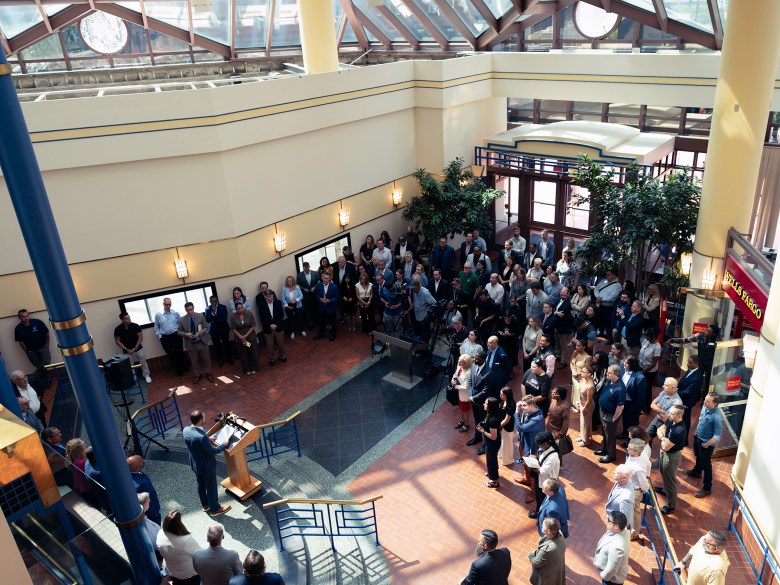
City and state officials, business leaders, and academics gathered in downtown Hartford Thursday morning to celebrate a major milestone: a new $20 million state award intended to jumpstart innovation efforts in Connecticut’s capital city.
The money, which comes from the Department of Economic and Community Development’s Innovation Clusters program, will be used to support the creation of the “Hartford Innovation Center,” a 100,000-square-foot facility intended to support workforce development and education around applied artificial intelligence technologies.
Aside from the state grant, the project has secured several supporters and financial backers including Hartford HealthCare, The Hartford, Travelers, Nassau, Google and QuantumCT.
The facility will be housed within a portion of the State House Square complex in downtown Hartford, which will be renovated.
Speakers at the Thursday event framed the award as part of a technological transformation that will push Hartford and the state to the front of national innovation efforts.
“You’re not going to need to go to Silicon Valley to use AI in the most effective way possible,” said Gov. Ned Lamont. “You can do it right here in Hartford.”
[RELATED: CT redoubles efforts to equip workforce for AI economy]
When completed, the facility will serve as the flagship campus for workforce development and advanced technology efforts in the city, using technology to support industries from insurance to healthcare. The downtown campus is expected to include a number of labs, project spaces and classrooms, all with the goal of fostering “a dynamic environment where residents, youth, startups, corporate partners, and higher-education researchers develop real-world solutions and accelerate responsible AI adoption across Connecticut industries,” according to a press release.
Matthew Pugliese, deputy commissioner of DECD, said that the $20 million from the state will be used in two ways. First, $3.5 million of the money will support the operations and the initial activities of the Hartford Innovation Center. The remaining $16.5 million will be used for capital project components tied to the effort.
Pugliese called it “an investment in people and space focused on collaborative labs, classrooms, and project spaces that will help our capital city and partners succeed in this period of immense technological advancement.”
Innovation in Hartford comes with concerns
City officials said the money will help Hartford claim a position at the forefront of community-oriented innovation efforts in the country.
“This is a statement about where we are going as a city and how we can control our destiny,” said Mayor Arunan Arulampalam. “It is a statement that the state is fully invested and bought into this vision of who we are and where we are going.”

The award, he added, comes” at a time when people are more scared than ever before about what this technology means, what it will mean for us, what it will move for our economy, and who’s going to get left behind.”
That latter point was repeatedly raised on Thursday, with city and state officials using the announcement as a chance to address community concerns about the project.
Hartford’s innovation cluster was originally pitched as an “applied AI center” that would be located at a former data center site bordering Hartford’s North End, a part of the city that has faced significant disinvestment and still struggles with high poverty rates.
The city’s original applied AI center framing quickly raised concerns in the community, with residents worried the project was data center in disguise. The city has since pushed back on that framing, saying the intention is to help people around Hartford, but particularly its most vulnerable communities, access the skills and training needed to fully participate in the workforce of tomorrow.
“This is going to allow communities in Hartford, communities that would otherwise be locked out of this economy that is being built, to have full access to these tools that they need to thrive, to grow, to use their skills to make this city better,” Arulampalam said on Thursday.
Jeff Auker, director of the city’s Department of Development Services, said the new innovation center will serve three primary functions: to operate as a marketplace for ideas around innovation and advanced technology; to serve as a front door for community members, students and businesses looking to learn more about AI and the skills necessary to use it; and to support a larger ecosystem around artificial intelligence in the state.
The goal, he said, is to support already strong projects and organizations around the state, while also providing new avenues for innovation and workforce development.
“This is not to replace or to centralize,” Auker said. “This is to augment.”
Jennifer Widness, president of the Connecticut Conference of Independent Colleges, noted that the Hartford effort, which started a few years ago, has already fueled new educational endeavors. That includes the Connecticut AI Alliance or CAIA, a group of academic institutions and community organizations that are working to establish Connecticut as a key hub for AI innovation.
“Our colleges and universities have tremendous talent, research, and expertise in AI,” Widness, a CAIA co-founder, said. “But Connecticut will be much more competitive if we find ways to connect those assets across institutions and with, in partnership, employers, government and our communities.”
“Hartford is an especially exciting place for us to do this,” she added.
Additional organizations will also come online in the coming months to support AI in Hartford. The Trustworthy AI Network (TWAIN), a 501(c)(3) nonprofit organization that will help manage parts of the innovation center, will be launching later this year, according to the governor’s office.
A new city joins CT’s innovation clusters effort
The $20 million awarded to Hartford marks the second award from DECD’s Innovation Clusters Program. Announced in 2024, the program is a $100 million initiative that encourages municipalities to partner with a private sector entity or university to propose an economic development initiative that could benefit from state support.
The program focuses on industries the state wants to see grow because they support highly skilled, high-paying jobs: emerging technologies like artificial intelligence and quantum computing, as well as more established fields like financial technology and advanced manufacturing. It replaces an older initiative known as “Innovation Corridors” that set out to accomplish a similar goal but ended after early struggles.
Speaking with The Connecticut Mirror last year, DECD Commissioner Dan O’Keefe said the Innovation Clusters program has been more intentionally structured.
“We’re seeking to activate ecosystems. We want to activate private sector dollars. We want to activate stakeholders,” he said. “We want these programs to bring people together and to catalyze investment energy and collaboration in a way that wouldn’t necessarily happen if it weren’t for these programs.”

In 2025, DECD announced three finalists for the grant: the now-reimagined Applied AI Center in Hartford that would support training in artificial intelligence technology; an AI Innovation Institute in Stamford aimed at new technologies in cybersecurity and fintech; and a Quantum and Bioscience Cluster in New Haven intended to take advantage of local industry and universities to support the expansion of quantum technology.
Last year, the state announced its first award winner, giving $50.5 million to the city of New Haven. That award also dedicated money to QuantumCT, an ongoing effort to ignite a quantum computing industry in the state. QuantumCT is also involved in the Hartford innovation cluster.
With the latest award, the state has now given out $70.5 million of the money. DECD has not publicly said how the rest of the Innovation Clusters funding will be allocated or whether Stamford will receive an award.
The Hartford Innovation Center will also share space with a forthcoming $18 million learning center developed by Junior Achievement, an organization focused on promoting youth skills development, financial literacy and economic mobility. For now, the city is using a different space downtown to house its AI innovation efforts.
The project moves forward as Connecticut continues to stake a claim that it is a national innovation leader, with government, the private market, and education institutions working on a number of interconnected initiatives.
The state has also adopted new artificial intelligence regulations in the hopes of balancing economic competitiveness with protections for state residents.
Supporters of those efforts also spoke Thursday, saying the combination of new projects and legislation has put the state in a strong position moving forward.
“One of the true promises of AI is the ability to democratize access to technology, and that anyone who has an idea can try to make that happen,” said state Sen. James Maroney, D-Milford, a co-chair of the legislature’s AI Caucus. “In this center, that will happen.”
Currently, the city does not have a timeline for when the Hartford Innovation Center will be open to the public. But officials emphasized that when the final space does open its doors, it will be a place capable of supporting more than Hartford — it will be a resource for the entire state.
“We’re writing a different story, in which our city can be in control and in the driver’s seat of where we are going,” Arulampalam said. “In which innovation isn’t something that happens to us, but something we create, something that we guide.”
