

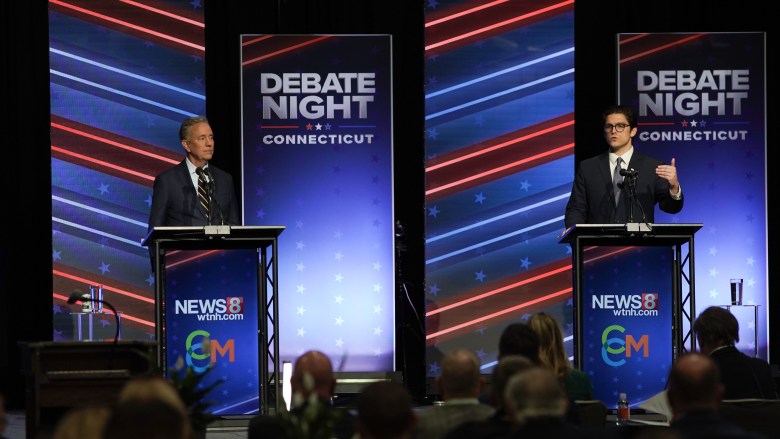
One of this year’s candidates for governor gravitates toward country breakout Ella Langley and enjoys Beyoncé’s “Cowboy Carter” during a workout. The other has long favored Bob Marley and the Wailers to soundtrack his campaign events, and recently added Bad Bunny to his playlist. Their tastes overlap when it comes to stars like Dolly Parton, though they may disagree on her greatest song.
Those selections, and what they might telegraph to voters, landed on reading lists and earworm-heavy playlists that incumbent Gov. Ned Lamont and his challenger, state Sen. Ryan Fazio — both of Greenwich — revealed to The Connecticut Mirror ahead of this year’s general election.
The candidates said books and music have informed their political philosophies, broadened their worldviews, and carried them through gnarly moments on and off the campaign trail.
“Music has a very important place in our soul,” Lamont said.
The playlist trend was first popularized by President Barack Obama in the summer of 2015. He still releases listening suggestions and a summer reading list each year.
Stephen Dyson, a professor of political science at the University of Connecticut who hosts the “Pop Culture Professors” podcast with fellow political scientist Jeffrey Dudas, offered some skepticism of the candidates’ selections.
Dyson, who grew up in the United Kingdom, recalled a moment in the early 2000s when Conservative Prime Minister David Cameron named the indie rock band The Smiths as one of his favorites, in what many saw as an attempt to appear hip. Around the same time, Labour Party Leader Gordon Brown cited a fondness for the Arctic Monkeys, but couldn’t name a single track.
“So you’re obviously gonna get some political signalling from candidates,” Dyson said. And yet, as an academic who still remembers making mixtapes and burning CDs as a young person, he thinks there’s something endearing about it.
It’s as if the candidates are saying to Connecticut residents, “Look, I burned you a CD,” he said.
There’s a similar feeling when it comes to a reading list, Dyson said, particularly at a time when the act of reading itself is becoming an increasingly rarefied one.
“If someone recommends a book to you, that’s a generous act,” he said. “It’s an interesting communicative act. It’s not just saying, ‘I read this and related to it,’ … it’s also saying, ‘We have this in common.’”
The playlists
When Lamont dips into his list of most-loved songs, he said, some of them are simply pieces he grew up with — he will never not include something from the Grateful Dead or the Rolling Stones. Others are songs he’s come to love through his wife, Annie Lamont, children and young grandchildren. That’s how Taylor Swift’s “Cruel Summer,” off her 2019 album “Lover,” found a place on the list.
The governor said he likes to dance, and some of the songs on his playlist are there specifically for when he feels like moving. He called the Black Eyed Peas’ “I Gotta Feeling,” his favorite song to dance to at a Connecticut Association of Realtors conference in 2023. And he said Walk The Moon’s “Shut Up and Dance” is hard to listen to while standing still.
“It’s just a cool dance song,” he said, chuckling at how many people suggested he not dance in public after a video of him dancing at the 2019 inaugural ball went viral.
Some selections were songs that informed his path to politics; others have come to his attention since spending time in the capital city.
For years, he has loved Bob Marley and the Wailers’ “Get Up, Stand Up,” for both the song’s revolutionary message and Marley’s own history. He’s been known to sing it on the campaign trail, from labor union rallies in New Haven to a No Kings Protest in Greenwich last year.
He included Bob Dylan’s “The Times They Are A-Changin’” and Dolly Parton’s “9 to 5″ for similar reasons. He said he sees the latter as a singular ballad of both workplace equity and female empowerment. “It’s really about women standing up and fighting for their rights,” he said.
Bad Bunny’s “DtMF” was a more recent addition. A director in the governor’s office, Mellaney Castro, turned him on to the artist, whose cultural reach has extended from Puerto Rico to Connecticut and back several times over. In February, he took a break from budget season to watch the musician perform at the Superbowl’s halftime show.
“Look, I thought the guy was just magic,” he said.
Fazio’s musical tastes range from “the type of music I fell in love with from a young age” to contemporary country music, with recent favorites like Ella Langley and Toby Keith and veteran musical voices in the genre like George Strait. “I’m an Ella fella!” he said of Langley.
His selections also have a nostalgic bent. Fazio is especially fond of Creedence Clearwater Revival; the Eagles; Crosby, Stills, Nash & Young; Bob Dylan; and Elvis Presley. Often, he said, he reaches for the soulful sound of the 1960s and 1970s, with selections from Otis Redding, Sam Cooke and Billy Preston.
“I’m mostly listening to music if I’m on a run or working out,” Fazio said. Some of his favorites that keep him going during a workout: Parton’s “Jolene,” Don McLean’s “American Pie,” the Eagles’ “Take It Easy” and Billy Preston’s catchy “Nothing From Nothing.”
While it does not live on his list, he said he also has an appreciation for Beyoncé’s 2024 album “Cowboy Carter,” which became a flashpoint in the country music world. He said he particularly likes the tracks “Texas Hold ‘Em” and “16 Carriages.”
Reading lists
The governor described his reading list as a mix of “aspirational” and well-loved books that he comes back to again and again. He regularly reads “The Little Engine That Could” to his grandson, who gravitates toward anything with trains. And he said he’s returned dozens of times to the first sentences of the Declaration of Independence and to Walter Isaacson’s “The Greatest Sentence Ever Written.”
Keith Richards’ memoir, “Life,” holds special meaning for Lamont, after he had the chance last March to present the founding member of the Rolling Stones with the first-ever Connecticut Governor’s Award of Excellence. Referring to his music, Lamont told Richards at the ceremony, “You’re one of my top advisors.”
Like many Connecticut residents, Lamont said he has books on his list that he still wants to get to. They include Colson Whitehead’s “Harlem Shuffle” and Barbara Kingsolver’s “Demon Copperhead.”
“Reading really broadens the mind,” Lamont said. “I read an awful lot of history, and I think it tends to put the consternation of today’s political world into a little bit of perspective.”
Here is Gov. Ned Lamont’s reading list:
- “The Little Engine That Could” by Watty Piper
- “1929: Inside the Crash” by Andrew Ross Sorkin
- “The Greatest Sentence Ever Written” by Walter Isaacson
- “Never Stop” by Dan Hurley
- “The Rise of Theodore Roosevelt” by Edmund Morris
- “Life” by Keith Richards
- “Harlem Shuffle” by Colson Whitehead
- “Demon Copperhead” by Barbara Kingsolver
- “The Great Gatsby” by F. Scott Fitzgerald
- “The Overstory” by Richard Powers
Fazio’s reading list is packed with sweeping historical novels, political and economic commentary, spy thrillers and 20th-century history that he was most excited to talk about. That starts, not in Greenwich or Hartford, but with two novels that take place a world away in 19th-century Russia: Leo Tolstoy’s “Anna Karenina” and Fyodor Dostoevsky’s “The Brothers Karamazov.”
“It was so striking to me that the heroes of those books — it wasn’t the most intellectual or the most secular or the most revolutionary [people], it was the ones who were the most steady, the most faithful and focused on protecting their family and their friends and doing what was right, even if it was considered banal or outmoded,” he said. “Anna Karenina is not the hero of that book. She showed that the flouting of basic ethics for dramatic and romantic reasons was bad for the soul.”
When Fazio first discovered the books in his 20s, they became a reminder, if not a blueprint, for how to remain “steady,” he said. For a time, he was for a period spiritually adrift, and they helped bring him back to his Christian faith. In literary characters who remained unwavering in their faith, he saw a reflection of his late maternal grandmother, Anne Gadaleta, who Fazio has often cited as both a personal role model and an example of self-determination.
Other selections have shaped how he governs and how he sees the world of politics and economics, which he studied at Northwestern University. Alongside texts like Milton Freidman’s “Capitalism and Freedom,” which informed Fazio’s fiscal conservatism, he said he returns to Harry Jaffa’s 1959 “Crisis of the House Divided.”
The book focuses on the spirited verbal sparring of then-Rep. Abraham Lincoln and Illinois State Sen. Stephen Douglas during the 1858 debates for U.S. Senate. When Fazio thinks of the book, he said, he’s especially struck by Lincoln’s unwavering nature and interpretation of the Declaration of Independence.
Fazio’s belief in the American brand of freedom, or at least the idea of it, might also explain his interest in spy thrillers and novels about government overreach and the surveillance state, like John Le Carré’s “Tinker Tanker Soldier Spy” (in an email that strayed briefly to movies, he includes the 2006 film “Das Leben der Anderen,” or “The Lives of Others,” in the same spirit).
Here is state Sen. Ryan Fazio’s reading list:
- “Anna Karenina” by Leo Tolstoy
- “The Brothers Karamazov” by Fyodor Dostoevsky
- “Gulag Archipelago” by Aleksandr Solzhenitsyn
- “The Sun Also Rises” by Ernest Hemingway
- “Capitalism and Freedom” by Milton Friedman
- “The Road to Serfdom” by Friedrich Hayek
- “Crisis of the House Divided: An Interpretation of the Issues in the Lincoln-Douglas Debates” by Harry Jaffa
- “The Spy and the Traitor: The Greatest Espionage Story of the Cold War” by Ben Macintyre
- “Tinker Tailor Soldier Spy” by John Le Carré
- “Vision of the Anointed” by Thomas Sowell