


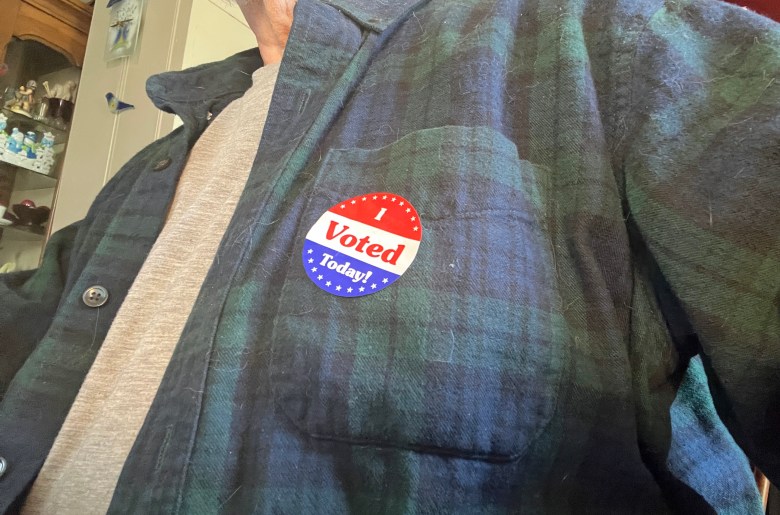
With the outcome of the midterm elections fast approaching, it’s only natural that many of us have taken up political forecasting as something like a second job.
Will Democrats win the Senate? How deep into Trump country can their House candidates compete? Why does Susan Collins, the Republican senator from Maine, seem so resilient?

Obviously, election outcomes are an uncertain matter. Opinion polls can provide clues about what may happen, but elections today are decided by tiny margins, and the methodological choices about which polls, weights, or turnout models to trust make knowing what’s about to happen even harder.
However, it’s not terribly difficult to predict what a given person expects to happen. In modern politics, an overwhelming majority of voters expect their “side” to win.
That’s the headline finding from my new research article in the journal Political Behavior. Today, ahead of presidential elections, about 90% of voters expect their preferred candidate to win, and the pattern appears similar ahead of this year’s midterms.
Of course, unwarranted optimism isn’t a new phenomenon (your author is a Mets fan). Going back nearly a century, we have known that people occupy information bubbles that make them likely to expect victory. An early study found 71% of Herber Hoover voters expected him to win in 1932, despite the ravaging effect of the Great Depression.
Yet over the past 15 years, what I refer to as “partisan wishful thinking” has grown to an all-time high. Throughout the mid-20th century and into the early 2000s, the percentage of voters expecting their candidate to triumph hovered in the low-70s by percentage. That spiked with the tea party’s ascent ahead the 2012 cycle and has grown even stronger across the three elections featuring Donald Trump.
My article uses seven decades of survey data to study the factors that predict this optimism, and to see what has changed about voters today. The core finding is that the more a person wants an outcome, the more they are likely to expect it. Historically, this has taken the form of wanting your own side to win, but more recently, people also want the other side to lose.
Indeed, much of political behavior today is driven by what we call negative partisanship, or animosity toward supporters of the “other side.” While this animosity can increase participation, and some may be necessary to ensure social progress, the downsides are huge. People who actively dislike the other party are more gullible in the face of misinformation, accepting of their own party’s bad behavior, and willing to dehumanize people with whom they disagree.
What’s scary about sky-high wishful thinking is that it may make this polarization worse. The problem with everyone expecting to win, of course, is that few are prepared to lose — even though one of them must.
Using surveys that interviewed people before and after presidential elections between 1996 and 2024, I found that people suffering from “dashed hopes” came out with greater animosity toward the other side in most of these elections. Importantly, this was not merely a Trump-era effect; disappointed Bob Dole and John Kerry supporters also showed the same dynamics.
So, what does this mean ahead of the coming election? As my grandfather would tell me before the Mets took the field each April, “Don’t get your hopes up.”
While Democrats lead in generic ballot polls, the difficulties forecasting who shows up to vote are well-documented, and Democratic Senate candidates will need to win in red states to wrest control of Congress.
The ideal posture for a small-d democrat — one committed to seeing our democracy succeed — would be to consider good-faith reasons why their party may lose. Research shows that intellectual humility can be a valuable bulwark against polarized politics.
For my part, I can see Republicans losing because they oversee an economy with drastically higher gas prices than a year ago, seemingly because of a war that most view as optional. Then, amid the president’s use of his pardon powers to help allies, Americans perceive corruption in government to a greater degree than at any point in recent history.
Democrats, meanwhile, seem to be “running against Trump” for the 10th consecutive year, and are struggling to make an affirmative case for themselves. They ended their last presidency as failed defenders of the gerontocracy, and when they belatedly got a younger candidate in Kamala Harris, had trouble articulating a coherent agenda on the economic issues that swing voters care most about.
None of this is to say there aren’t reasons to get excited about the midterms or see good in a party’s positions. But with more modest expectations, and ideas about how our own side can improve, we can help make democracy self-improving no matter how the results turn out.
Seth Warner is an Assistant Professor of Political Science at the University of Connecticut.