

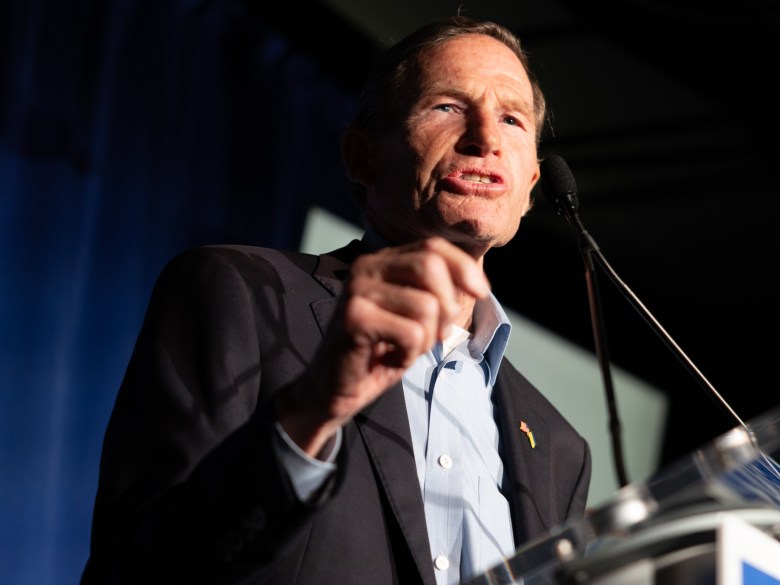
U.S. Sen. Richard Blumenthal engaged in a written back-and-forth this week with a U.S. attorney over the role of congressional oversight, setting up an early preview of when Democrats regain the majorities next year and prioritize investigations into the Trump administration.
Blumenthal, in his capacity as the leading Democrat on the Homeland Security and Government Affairs Committee’s Permanent Subcommittee on Investigations, has already launched a number of congressional inquiries from the minority, including one looking into private donors helping to finance the construction of a ballroom at the White House and whether they got preferential treatment from the administration.
He expects to return as chairman of that panel next year in the Senate.
But this week, the White House and the U.S. Department of Justice are giving a prelude into how they plan to respond — and fight back — against investigations and inquiries conducted by congressional Democrats over the final two years of Trump’s term.
“They’re clearly trying to intimidate us and deter and discourage our uncovering the truth about corruption,” Blumenthal said in an interview on Thursday. “It would be ludicrous if it were not so serious, and they’re misusing and weaponizing the prosecutorial power of the Department of Justice.”
Aaron Reitz, the U.S. attorney for the Southern District of Texas, posted a letter on social media Wednesday afternoon that was directed at the Connecticut Democrat and how he’s conducted an inquiry into the ballroom project. Reitz accused Blumenthal of threatening citizens who are donating and associating themselves with the president.
Reitz requested that Blumenthal preserve all documents, communications and “all potentially relevant evidence related to your efforts to suppress associational activities for philanthropic projects throughout the nation’s capital.”
“Failure to do so may result in sanctions, adverse-inference instructions, or other penalties, and may carry significant legal consequences,” Reitz wrote. “This demand applies to you, your staff, employees, agents, consultants, campaign personnel, and any other person acting on your behalf or in concert with you.”
Blumenthal said he sees that request as a threat of initiating an investigation, arguing it’s an attempt “to intimidate members of Congress for engaging in constitutionally protected activity.” He wrote back that Americans deserve to know who’s donating money to Trump’s projects “and whether lawsuits were dismissed, contracts were awarded, or regulations went unenforced in exchange for that money.”
In an interview with The Connecticut Mirror Thursday, Blumenthal said one of those donors, Nvidia, will be “front and center.” The tech company donated $25 million to the project, according to The Washington Post.
Blumenthal said his subcommittee will investigate whether Nvidia “received more favorable treatment on its requests for chips” and whether Trump ignored intelligence about the company’s CEO Jensen Huang and his ties to a suspected Chinese spy, with whom he had an affair. Huang resigned on Thursday following those revelations.
The Connecticut senator sent his own letter responding to Reitz on Wednesday night with a request similar to the prosecutor’s: preserve all correspondence, documentation and “all communications with the White House or senior officials at the Department of Justice, related to the decision to draft and post your letter.”
“Not only are these appropriate subjects for congressional oversight, but such inquiries are among the constitutional duties that members of Congress must undertake to become informed about matters on which legislation may be necessary,” Blumenthal wrote.
When reached for comment about Blumenthal’s letter, Reitz referred to his response to the senator over the platform X.
“Received. Valid investigations must be conducted for a legitimate legislative purpose,” Reitz posted. “I believe that your threatenings may constitute the initiation of unconstitutional investigations conducted for reasons other than a legitimate legislative purpose. Semper Fidelis.”
The pushback to Blumenthal and his inquiries comes as the White House more broadly seeks to set the tone on how it plans to respond to investigations stemming from Congress.
White House counsel William Scharf sent a letter earlier this week to U.S. Rep. Robert Garcia of California, the incoming chairman of the House Oversight Committee, warning about what they see as the limitations of congressional oversight and implications of criminality, according to The New York Times.
“Beyond being inconsistent with the clear, well-recognized constitutional limitations on your investigative functions, threats to executive branch officials designed to deter them from public service, or process designed merely to abuse or instill fear in the recipient may cross the line into blatant criminality,” Scharf wrote in the letter. “And issuing unlawful subpoenas with the intention of depriving citizens of their constitutional rights and privileges may warrant further investigation.”
Garcia had a similar response to Blumenthal and noted in a statement that the Constitution provides the legislative branch with the authority to conduct oversight.
Blumenthal has co-led a series of public forums with Garcia, seeking to cast a light on the practices and conduct of federal immigration agencies, such as U.S. Immigration and Customs Enforcement, under the Trump administration. Blumenthal said he expects a “very cooperative working relationship” with Garcia from the majority next year.
As Democrats gear up for majorities in both the Senate and House in early January, Blumenthal won’t likely be the only member of Connecticut’s delegation who will conduct oversight from their committee perches.
Several Connecticut lawmakers are expected to claim the gavel of committees that have varying levels of jurisdiction and issue areas. But there’s a common theme: They plan to wield their influence around oversight of the administration.
U.S. Rep. Rosa DeLauro, D-3rd District, appears poised to return next year as the head of the House Appropriations Committee. U.S. Rep. Jim Himes, D-4th District, will likely be appointed as the chair of the House Intelligence Committee. And U.S. Rep. Joe Courtney, D-2nd District, is expected once again chair of the Armed Services’ Seapower and Projection Forces Subcommittee.
U.S. Rep. Jahana Hayes, D-5th District, is also running in a contested race to become chair of the House Committee on Education and the Workforce.
The House Permanent Select Committee on Intelligence has oversight over U.S. intelligence agencies as well as some issues concerning the Pentagon and other government agencies. As a potential chairman, Himes has previewed oversight as a main objective.
Himes has already issued warnings to defense companies about cooperating with congressional oversight, specifically on a potential investigation into corporate donations for the construction of the White House ballroom.
DeLauro has said she envisions handling some oversight “in my lane” by taking a look at where federal dollars are flowing and whether some money “has been transferred illegally.”
Courtney also see opportunities for oversight, whether that’s on the Air Force One plane gifted by Qatar or the White House’s battleship proposal. He believes oversight over the war in Iran and U.S. Secretary of Defense Pete Hegseth’s tenure will be “front and center” for the full House Armed Services Committee. (House Republicans blocked an effort on Tuesday to impeach Hegseth over his handling of the war.)
Blumenthal said Thursday he and his colleagues will move forward with their investigations for the remaining weeks of the session and as they move into the majority in the 120th Congress.
“The whole purpose of this letter is simply to intimidate,” Blumenthal said. “I absolutely refuse to be bullied or threatened in this way. We’re going to continue our investigation undeterred.”
The Connecticut Mirror/Connecticut Public Radio federal policy reporter position is made possible, in part, by funding from the Robert and Margaret Patricelli Family Foundation.
