




Elisabeth Kübler-Ross was born 100 years ago this past July. She is remembered, almost entirely, for five words: denial, anger, bargaining, depression, acceptance. They make up a model of grief so thoroughly absorbed into the culture that it now turns up in sports commentary and breakup advice.
The five stages made her famous, but another lasting legacy of hers took root in Connecticut. A never-published letter from her archives shows how the ambitions she shared with a Yale nursing dean helped give the country its first hospice, and how far American end-of-life care still has to go.
Earlier this year, her family shared with me a letter she typed on Jan. 1, 1971, to Dame Cicely Saunders, the British physician who had opened St. Christopher’s Hospice in London four years earlier. Buried in casual conversation about her 10-year-old son and an upcoming trip, she asks whether Saunders knows that she and Florence Wald, former dean of the Yale School of Nursing in New Haven, have “secret ambitions to have a St. Christopher in USA.”
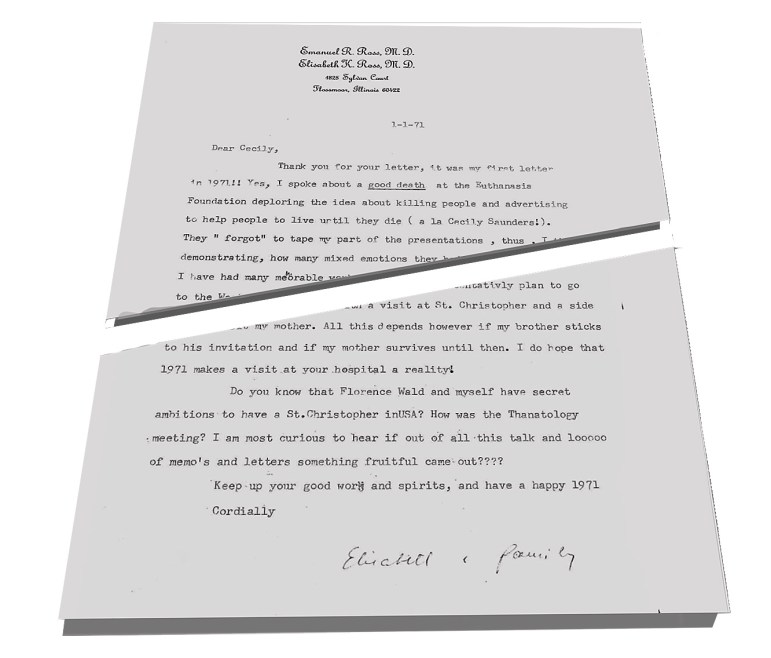
That phrase deserves translation. In 1971, the United States did not have a single hospice program. The ambitions did not stay secret long. Nineteen months later, on Aug. 7, 1972, Kübler-Ross told the U.S. Senate Special Committee on Aging that Yale had applied for grants to start a hospice like St. Christopher’s.
By 1974, Wald’s team of nurses, physicians and clergy was caring for seriously ill patients in their homes from a small office in New Haven. Their organization, now known as Connecticut Hospice, was the nation’s first hospice. That year, state regulators approved construction of the country’s first hospice facility in Branford, which opened to inpatients in 1980. Connecticut Hospice still cares for patients on the Branford waterfront today.
Idaho Sen. Frank Church opened the 1972 hearings by noting that at least 80% of Americans were then dying in institutions. During her testimony, Kübler-Ross recounted a story that crystallized the problem: a 28-year-old mother of three with liver disease had been moved to the last room at the end of a long hallway, far from the nursing station, with no visitors. One day Kübler-Ross found her sitting on the edge of the bed, holding the telephone receiver off the hook. When asked what she was doing, the woman replied that she simply wanted to hear a sound.
By the time she testified, Kübler-Ross had interviewed more than 500 dying patients. Her research found that people at the end of life were not, for the most part, terrified of death. They were terrified of being left alone with it. She told the Senate that patients needed, besides hope, reassurance that they would not be deserted, even though most felt deserted anyway.
A decade later, in 1982, Congress passed the bipartisan Medicare hospice benefit, widely regarded as one of the great achievements in American health policy, with roots traceable directly to Kübler-Ross’s “secret ambitions.” Today, the benefit provides care to more than 1.8 million American seniors each year at a cost of $28 billion and growing. In 2024, for the first time, a majority of Medicare decedents, 52.9%, were in hospice when they died. Roughly a third now die at home, the most common single place of death.
The results are extraordinary. Yet the work Kübler-Ross set out to do remains unfinished. In her centennial year, let us recommit ourselves to three remedies for problems she identified during her life’s work. Those problems persist today, and they are as much psychological as they are matters of policy.
First, pay for palliative care from the moment of diagnosis, not after the last treatment fails. The median hospice stay in America is 19 days. Kübler-Ross envisioned relationships measured in months — enough time for denial, anger, and bargaining to do their work, enough time to finish what she called unfinished business. Nineteen days is barely enough to learn a family’s names.
In her Senate testimony, she drew a distinction clinicians should find uncomfortable: most of the nursing-home patients she met had not reached acceptance but resignation, which she described as a feeling of defeat. Acceptance takes time and company. Resignation only takes waiting. The clinical case for early palliative care is settled; Medicare’s payment structure should follow it. And we should reimburse providers commensurate with the level of care delivered, rather than the one-size-fits-all per diem in place since the benefit’s creation.
Second, protect the integrity of the Medicare hospice benefit. In 1972, Kübler-Ross told the Senate that Medicare and Medicaid, as designed, “tend to enhance institutionalization” — the very first response, she said, was “Let’s hospitalize the patient.” Today’s distortion is different but no less harmful.
When Medicare first certified hospices in 1983, one in ten was for-profit; by 2024, four in five were. Nonprofit hospices have declined nearly 15 percent in just five years while for-profits grew by 60 percent, and research published in Health Affairs last fall found that private-equity-owned hospices reported the highest margins and the lowest spending on direct patient care. The market has grown at a pace no oversight system was built to police — fraud severe enough that in May, Medicare froze enrollment of new hospices nationwide. Yet enrollment records still do not require hospices to disclose private equity ownership, and regulators cannot police what they cannot see. Ownership transparency, real oversight to root out fraud, and quality measures that assess whether a person’s life was better — not simply how many days were billed — are overdue.
Legislation introduced this spring would attempt the first real modernization of the benefit since 1982. Congress should take it up on a bipartisan basis. Scale, which was always the goal, has become the problem; quality must become the standard.
Third, treat connection as clinical care. The abandonment Kübler-Ross documented is now a public health epidemic we call social isolation. In 2023, the U.S. Surgeon General issued an advisory on loneliness calling it “far more than just a bad feeling – it harms both individual and societal health.” Roughly one in four adults over 65 reports being socially isolated, and the consequences are staggering: chronic loneliness is linked to a 50 percent increased risk of dementia, a 29 percent increased risk of heart disease, and a 32 percent increased risk of stroke — as harmful to health, research has found, as smoking 15 cigarettes a day.
In March of last year, I testified before the same Senate committee she did, 53 years on. The terminology has changed; the need has not. We should screen for isolation the way we screen for pain, and we should support the roughly 59 million family caregivers providing more than $1 trillion in unpaid care annually — increasingly the frontlines of care for our aging population — with real financial, emotional, and workplace support.
Kübler-Ross understood that hospice was never merely a service delivery model. It was a philosophy of care grounded in dignity, honest communication, and accompaniment. The dying are not problems to be managed. They are people to be met, heard, and supported.
One hundred years after her birth, the question before us is whether our health care system will continue to honor that legacy. I can think of no better way to mark her centennial than to advance her “secret ambitions” together.
Andrew MacPherson is senior adviser to the National Partnership for Healthcare and Hospice Innovation (NPHI), serves on the board of the Elisabeth Kübler-Ross Foundation, is founder and executive chair of the Foundation for Social Connection Action Network (F4SC-AN), and co-founded the Global Initiative on Loneliness and Connection. He is the founding principal and managing partner of Healthsperien, a Washington health care advisory firm.