


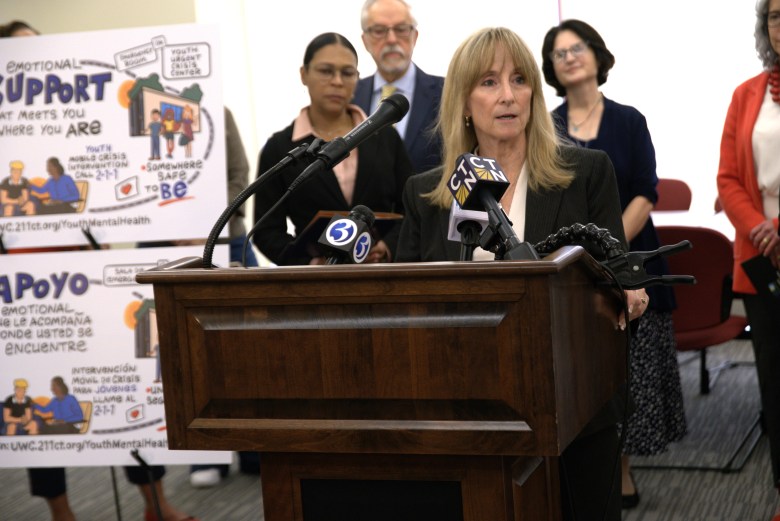
Gov. Ned Lamont announced Wednesday that the Department of Children and Families will see its third commissioner leave the agency since 2024. Susan Hamilton, who was confirmed as the embattled agency’s leader in April, will retire less than a year later on Feb. 1. This was Hamilton’s second turn as DCF commissioner, having led the agency before from 2007 to 2011.
The Lamont administration is launching a nationwide search for her successor, following three consecutive commissioners — Hamilton, Jodi Hill-Lilly and Vannessa Dorantes — who came up in its ranks. Some say it’s a chance for DCF to look for a fresh perspective on an agency that has faced numerous challenges over the past year, from recruitment and retention to questions about its handling of cases that led to tragic deaths of children who had contact with the agency before they died. Lawmakers passed a bill in 2026 packed with reforms for the agency, including the creation of a new oversight committee.
Whoever is selected to fill the role will almost certainly take charge of the agency after the Lamont administration has already proposed its biennium budget, which normally happens in February. This means the timing of the appointment could leave the new commissioner pursuing reforms at the agency based on numbers that reflect the priorities of current leadership.
“Throughout her career, Susan has shown dedication and commitment to safeguarding the most vulnerable youths in Connecticut,” Lamont said in a press release. “I thank her for her service to our state, and I wish her nothing but the very best on this well-earned retirement.”
Lamont indicated that he’d known Hamilton’s tenure as commissioner would be short, noting that when she took on the role of interim commissioner in 2025, he knew she planned to retire. Hamilton took on the job to head the agency during a difficult time, and heading into an election year: “Her extensive experience and leadership has been immensely valuable during this period,” Lamont said.
Hamilton said in the press release that it had been her “distinct honor and privilege to serve Connecticut’s children and families over the last 33 years in the fields of youth justice and child welfare.”
“I deeply appreciate Governor Lamont’s trust in me and his steadfast commitment to improving outcomes for the people we serve. I am sincerely grateful to our DCF staff for their unwavering dedication to our critical mission, often under very difficult circumstances,” she said. “We carry out that work in partnership with an incredible network of lived experts, communities, private providers, sister state agencies, the legislature, the courts, advocates and, most importantly, the children and families we serve.”
Sen. Ceci Maher, co-chair of the legislature’s Committee on Children, said Wednesday that Hamilton’s departure represents a chance for the agency to go in a different direction.
“We’ve had in the past four years three commissioners, all of whom came up through the Connecticut DCF system and while that has been tremendously beneficial in some ways, it has not allowed Connecticut to draw on a national perspective of leadership that comes from a different area and perhaps brings a new way of looking at the problems with new solutions,” she told The Connecticut Mirror.
Maher said she was hopeful that Lamont would find a candidate outside of Connecticut who could “look at our DCF system through a new lens.”
Like her predecessors, Hamilton spent many years at DCF. She was a social worker and social work supervisor in the 1990s, then directed DCF’s legal division and was appointed commissioner in 2007 under Gov. Jodi M. Rell.
During her first appointment as commissioner, the agency saw some slippage in progress toward meeting children’s basic service needs, according to reports. Hamilton’s initial tenure as DCF commissioner took place while the agency was under the supervision of a court monitor, assigned as part of a 1989 federal civil rights lawsuit on behalf of “Juan F.,” an anonymous 10-year-old boy representative of a class of children whose needs were unmet by an agency run with poor resources and guided by outdated policies.
The court monitor issued regular reports on the agency’s progress toward reform until DCF was released from the order in 2022.
A 2009 report from the monitor reported on by Children’s Rights, Inc. found that nearly half of the children in DCF care weren’t having their basic service needs met, and that the state was losing ground in its court-assigned reforms.
The agency saw a drop in the percentage of children who were reunified with their parents from about 72% of cases studied to 56%, reported Children’s Rights, Inc. The group noted that DCF was meeting 15 of the 22 indicators for success, after previously meeting 17 of 22, marking “the state’s worst performance since Susan Hamilton was appointed commissioner of DCF in June 2007.”
Hamilton ended her first stint as commissioner in 2011 and operated her own private law firm until 2014. Then she served as a public defender for nearly a decade before returning to DCF in 2023 as the agency’s general counsel. She was announced as interim commissioner by Lamont in September 2025 and then confirmed as commissioner by the legislature in April of this year.
During her confirmation process, Hamilton faced tough questioning and criticism, including from Maher. Maher, who announced her own retirement from the legislature earlier this year, asked Hamilton why she wasn’t advocating more forcefully for the agency.
“I’m not seeing the passion or the vision for what you see the future could be. And that to me is very, very concerning,” Maher said.
A statement from Hamilton that she understood the budget process and the “importance of data-driven allocation decisions,” alarmed Maher as wonky, insider-speak. “I would say that understanding them [budgetary decisions] often is tantamount to accepting them as opposed to pushing for what you might need from the governor’s budget, from the legislature,” Maher said at the time.
Recently, the agency has been questioned for its effectiveness in addressing a key part of its mission: administering services for youth mental health. Workers at Solnit South, a psychiatric facility for youth in Middletown, protested conditions there this summer after the facility’s hospital was taken over by UConn John Dempsey Hospital.
Child Advocate Christina Ghio said in a statement that the churn of commissioners at DCF has been a challenge in the quest to make system-wide improvements. She too said she was cheered to hear that Lamont would be searching nationwide.
“We need a Commissioner who is committed to staying on long term,” she wrote, “who understand DCF’s role as both the state’s child protection agency and mental health agency, and who has experience managing a large agency with a need for systemic improvement.”
“I urge the Governor to bring in a candidate who will focus on improving support for both child protective services and child behavioral health,” Maher said.
Former Child Advocate Sarah Eagan, now executive director of the Center for Children’s Advocacy, called Hamilton a “consummate professional,” who has spent her career committed to making a difference for children and families.
“Moving ahead the next commissioner will need to steer DCF through very turbulent waters as Connecticut children and families dependent on DCF are struggling profoundly without adequate community supports, foster homes, and services,” Eagan added in a statement. “In the months ahead CCA hopes to work with policymakers, state agency leaders, and families to ensure meaningful investment and innovation that will support the safety and support of the most vulnerable children in our community.”