


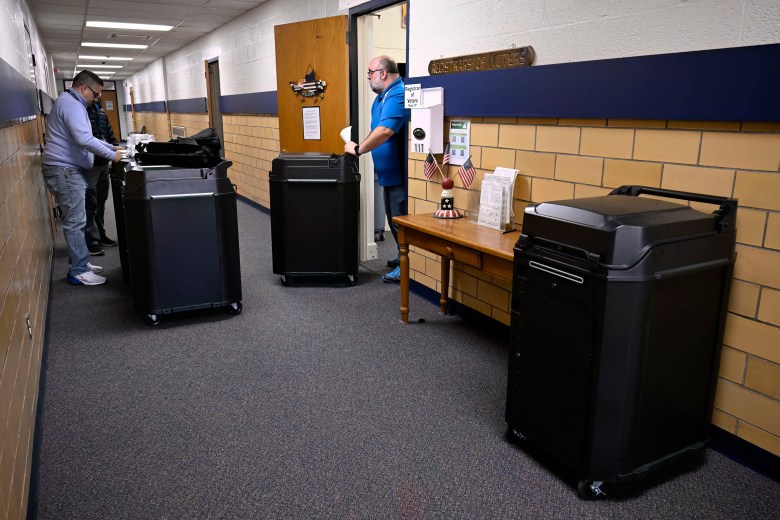
Five Connecticut communities have been ordered to recount votes cast in the 2026 midterm election after the discovery of a programming error that could have resulted in the double-counting of votes for cross-endorsed candidates.
Secretary of the State Stephanie Thomas said in a press release that the error could have resulted in double-counting of votes in cases where a person marked more than one line for a candidate who was endorsed by more than one party.
The five communities are Andover, East Hartford, New Hartford, Norwalk and Scotland. The error was caused by the vendor who programs the ballot tabulators, not by the communities, the secretary of the state said.
Cross endorsements are common in Connecticut. For example, Gov. Ned Lamont appeared on the ballot on the Democratic and Working Families lines, and his challenger, Ryan Fazio, appeared on the Republican and Independent lines.
Two other statewide candidates, Thomas and Comptroller Sean Scanlon, appeared on three ballot lines: Both are Democrats cross-endorsed by the Working Families and Independent parties.
Connecticut uses paper ballots that are counted by digital tabulators programmed to catch double voting. If someone votes for more than one candidate — say, both Lamont and Fazio for governor — the tabulator rejects that ballot.
In cases where someone votes for a cross-endorsed candidate on more than one line, the tabulators are programmed to count only one of the votes. But that creates a secondary problem: In the returns, which of the extra votes should be discarded — ones cast on the major or minor party lines?
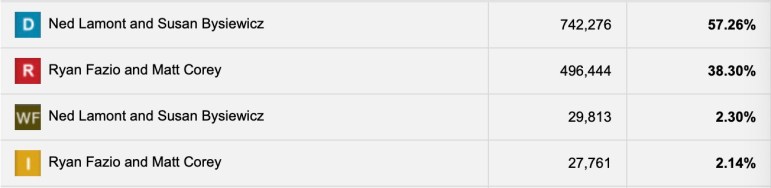
The answer is that those votes initially are listed as being cast on “unknown” ballot lines, then assigned a party affiliation in the returns based on the proportion of the overall vote.
Officials at the University of Connecticut, who oversee and test the accuracy of the tabulators, noticed that five communities had no votes listed as an “unknown” party line.
Thomas said UConn, state election officials and the equipment vendor reviewed results from all 169 municipalities and found that no additional towns were affected.
“Our system is designed to get to the root of any issue that might come up, and when one does, we do something about it,” Thomas said.
A hand count known as a recanvass was ordered in all five towns.
