


Connecticut must spend almost $3.4 billion next fiscal year to fund pensions promised to state employees and municipal teachers.
But while that burden likely will consume a healthy share of the next state budget, about 12% according to analysts, it would be almost $1 billion greater if Connecticut hadn’t reformed its savings habits, Gov. Ned Lamont announced Tuesday.
“Paying down our pension debt is one of the smartest investments we can make for Connecticut taxpayers,” the governor said, referring to nearly $11.5 billion in surplus the state has poured into its two pension programs since 2020.
Connecticut must contribute a minimum amount yearly that’s based not only on the thousands of retirees drawing benefits, but also on the assets those pension funds hold. And for decades prior to 2011, governors and legislatures found legal loopholes to short-change those required payments.
But by voluntarily depositing surplus funds — in addition to making the full, required payment — state officials have stopped those mandatory contributions from growing exponentially and stealing resources from other vital programs, Lamont said.
“That’s money we can put toward the services Connecticut families rely on instead of old debt,” he added, “and it keeps retirement secure for the teachers and public employees who earned it.”
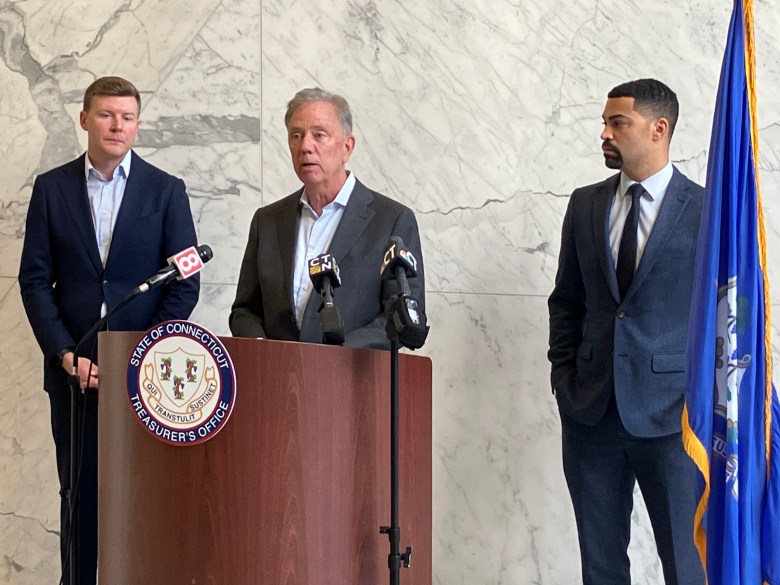
“Connecticut continues to demonstrate what disciplined fiscal management and thoughtful, long-term planning can accomplish,” said state Treasurer Erick Russell, who joined Lamont and Comptroller Sean Scanlon in announcing the pension savings Tuesday in the State Office Building. “We will continue to build on this momentum to ensure the retirement security of teachers and public servants for generations to come.”
But Lamont and the General Assembly will be hard-pressed to continue to dedicate as much surplus to pensions in future fiscal years as they did over the past seven.
Many of the governor’s fellow Democrats in the legislature’s majority say the budget caps that forced surpluses averaging $1.9 billion yearly over the past decade — representing 8% to 9% of the General Fund — were too aggressive. Those caps stripped more dollars from education, healthcare, social services, municipal aid and other vital programs than surging, mandatory pension contributions would have, some have argued.
But it was easy for officials to compromise most of those years because Connecticut received more than $4 billion in emergency federal COVID grants through the American Rescue Planning Act and the Coronavirus Relief Fund. And Lamont and lawmakers could use huge chunks of those dollars annually to backfill traditional state revenues stripped from the General Fund by budget caps.
That pandemic relief now has been exhausted and Democratic legislative leaders are calling for Lamont to modify savings efforts somewhat. They argue Connecticut still can enjoy budget surpluses, albeit smaller ones, while devoting more resources to core programs.
Lamont, a fiscal moderate, said Tuesday he was cautious about making any major changes to budget caps. Despite having enough assets in each pension fund to cover more than 65% of long-term costs, the state still carries nearly $29 billion in unfunded obligations, according to the governor’s budget office.
And Lamont likely will have some support from minority Republicans, who also have warned against significant adjustments.
“The challenge now is protecting the system that made it possible, one built through good bipartisan reforms in 2017,” said Rep. Joe Polletta of Watertown, ranking House Republican on the Finance, Revenue and Bonding Committee. “The threat will come from Democrats in the legislature, members of the governor’s own party, who are willing to not only cut pension payments so they can spend one-time, volatile revenue, but also change the rules to put even more of it into government programs instead of tax relief.”
Scanlon, who has said he believes the budget caps need some adjustments to allow investments in important programs such as municipal aid, said Connecticut nonetheless has been very successful with its savings efforts in recent years.
“Connecticut’s finances have seen a complete turnaround in the last eight years, and we should be really proud of that as a state,” the comptroller said Tuesday. “Our mission now is to continue that progress and combine it with sustained economic growth and an aggressive effort to lower the costs businesses and families are dealing with.”
Scanlon and Lamont said much of their focus over the next few years will be to contain surging healthcare costs, both for the state as well as Connecticut families and businesses.
