


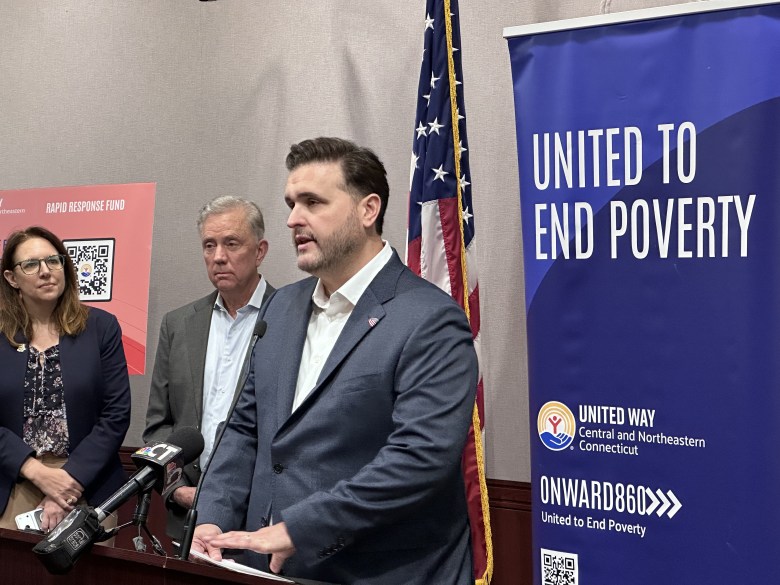
As homelessness increases for the fifth consecutive year, a regional United Way that serves 56 communities in Connecticut has reactivated its Rapid Response Fund, a flexible, cold-weather initiative designed to pay bills for people that could mean the difference between being housed or on the street.
“We work with our local municipalities, our other community partners, to provide this direct cash assistance to individuals and families who are at risk of homelessness,” Eric Harrison, the president of the United Way of Central and Northeastern Connecticut, said Tuesday.
The program’s resources, while nearly doubling from last year, are relatively modest: United Way is upping its spending on Rapid Response from $100,000 to $190,000.
It gives municipal social workers and others access to grants of up to $1,000 to buy heating oil, repair a car or stave off an eviction.
“One of the greatest benefits of these funds is they are unrestricted, allowing recipients to use the assistance where it is needed most, while also providing our social service departments greater flexibility and ease in distributing funds quickly and efficiently,” said Christina Morra-Tiu, a social worker employed by Wetherfield.
In other words, there is no red tape.
“Traditional systems take a lengthy amount of time to get support. This is quick. This is easy. This gives families more autonomy in what they need, which is something that we’re definitely missing,” said Kelly Murphy, the manager of the city of New Britain’s community services office.
Being able to afford a car repair might be the difference between keeping or losing a job. Providing a security deposit could keep a family off the streets. Murphy said grants filling those needs not are only vital for the recipients, but they ultimately are cost effective.
“This also reduces long-term costs when you’re thinking about how the city will support residents,” Murphy said. “When residents are financially stable, parents maintain employment, there’s less housing interruption, children have housing stability, and there’s more neighborhood connection.”
Last year, 216 households across what United Way calls the “860 region” received rapid assistance totaling $120,618 — an average grant of less than $560. United Way budgeted $100,000, then continued to raise money — as it is doing this year.
“We have helped individuals and families purchase heating oil while waiting for heating assistance, pay rent to prevent evictions, and cover utility bills to avoid shut-off,” Morra-Tiu said. “We have also provided temporary motel accommodations for several individuals and families experiencing homelessness, giving them a safe place to stay while awaiting placement in a shelter.”
A wealthy state falls short
The United Way, with Gov. Ned Lamont and Rep. Kate Farrar, D-West Hartford, announced the the reactivation Tuesday at a press conference at the Legislative Office Building. The funds became available Monday.
Lamont is an enthusiastic supporter of the philanthropic initiatives combatting hunger and homelessness. Last week, he highlighted the 27th annual campaign by Connecticut Foodshare, with financial backing by Bank of America, to provide 40,000 Thanksgiving meals.
Such events are double-edged, underscoring the inability of the administration to fully address housing and food insecurity in Connecticut, a wealthy state with a problem named ALICE.
That is an acronym for “Asset Limited, Income Constrained, Employed,” an annual United Way research initiative focused on the vulnerability of the working poor. This year, it found 39% of households have income below what is needed to afford basic necessities such as housing, food, child care, health care, technology and transportation.
It calculated that in Connecticut the “ALICE Household Survival Budget” is $40,140 for a single adult and $116,304 for a family of four with two adults, an infant and a preschooler. By comparison, the federal poverty level is $15,060 for a single adult and $31,200 for a family of four.
“Look, the state does a lot,” Lamont said. “The need is more. But I also love the spirit of giving.”
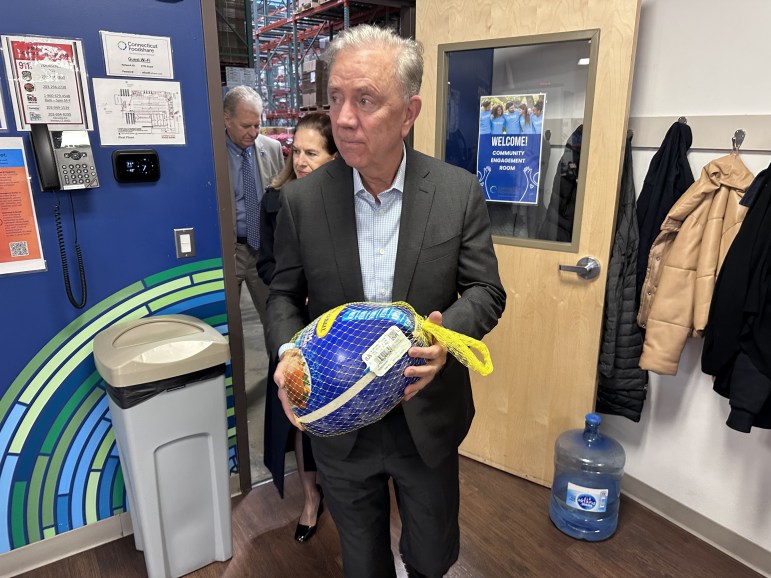
Jason Jakubowski, the chief executive officer of the nonprofit Connecticut Foodshare, said last week that federal agencies have cut their contributions of food to places like Foodshare by 50% or more.
“There’s at least one family in each of the 169 towns in Connecticut that don’t know where their next meal is coming from,” he said. “It ends up being 536,000 Connecticut residents — one in every seven individuals, one in every five kids here in the state of Connecticut.”
The federal cuts have both increased demand — nearly 63,000 people have lost SNAP benefits — and availability of food that Foodshare distributes to food pantries and at mobile distribution sites.
The Lamont administration and General Assembly have been responsive, he said.
“You’ve got Democrats and Republicans, came together and said it’s unacceptable the cuts that we have gotten from the federal government,” Jakubowski said. “This year, between appropriations and between emergency funds, Connecticut Foodshare is getting $17 million from the state government.”
Every penny must go to the purchase of food and cannot be used for overhead or other administrative purposes, he said.
