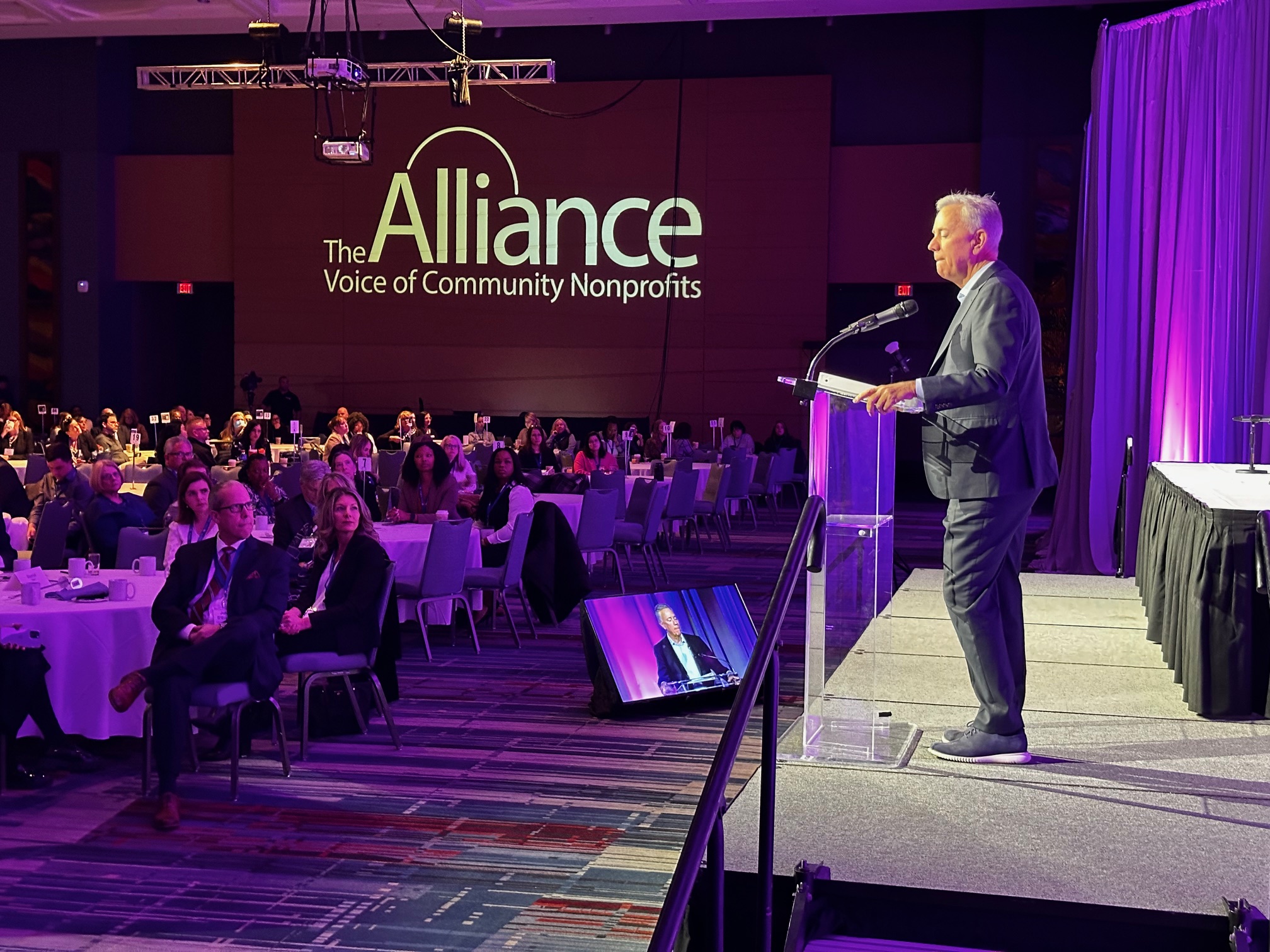
Gov. Ned Lamont offered thanks and holiday wishes Wednesday to the alliance that represents nonprofit service providers, but he made no promise of more funding in the next fiscal year for struggling agencies that he says are essential to preserving Connecticut’s safety net.
The audience of more than 600 people at the Connecticut Convention Center interrupted him with applause only once — when Lamont noted that their leadership tells him that even after a current-year budget increase, “We still have a lot of catching up to do.”
Lamont waited for the applause to subside, then said, “The need’s grown.”
Community nonprofits went at least a decade without funding increases after the Great Recession hit in 2008, leaving the administrations of M. Jodi Rell and Dannel P. Malloy to cope with revenue shortfalls. They’ve had three years of increases, mostly for wage hikes in a time of high inflation.
In the current budget, the state provided a 2.5% increase in reimbursement rates. The Connecticut Community Nonprofit Alliance asked for 9% this year and another bump of 7% next year.
Gian-Carl Casa, the executive director of the alliance, said the group has yet to make its request for revisions in the second year of the biennial budget the General Assembly adopted in June.
“We’re still calculating the number,” Casa said.
Other than more money for day care, Lamont has yet to drop hints about who might benefit from budget revisions his administration will propose after the General Assembly returns for its 2024 session in February.
In his remarks Wednesday, the governor all but invited the nonprofits to lobby him. While waiting to speak, he heard Casa talk about the alliance’s advocacy on their behalf.
“Just remind us every day what you do and how you make a difference in people’s lives,” Lamont said. “Just remind the governor, the legislators, the private sector … of the amazing things you do. And we’ve got some catching up to do with the not-for-profit community.”
Lamont said he was struck at a recent awards ceremony for state troopers by the fact that most were celebrated for acts of empathy in moments of crisis, such as preventing a suicide or intervening in cases of domestic violence.
Before the alliance meeting, Lamont spoke at the annual fundraiser of the Governor’s Prevention Partnership, where he heard details of an increase in addiction and the related consequences. He recounted those details to the alliance.
“There is still stress in our society, and it’s the good work that you do on behalf of people that help hold us together,” Lamont said.
Lamont cast his recent budgets as making progress by increasing funding for day care and affordable housing, among other things. He left to applause, not taking questions from the audience. He departed to attend a press conference announcing plans to redevelop the old Fuller Brush factory in North Hartford into a 160-unit apartment building.
His audience at the Convention Center included Julie Savin, the chief executive of ECHO, a developer and provider of affordable housing in eastern Connecticut. She said the first two years of the Lamont administration was a dark time for affordable housing, with a freeze on spending.
“We were dead in the water for 18 months,” she said.
But she said money is now flowing through the state Department of Housing and the Connecticut Housing Finance Authority to subsidize the cost of financing new apartment construction, a key to providing affordable rents.
“I’m seeing more money hitting the streets now,” she said.
Nearly as important, she said, the state housing bureaucracies are moving efficiently. Closings on loans that once took a year now are finished in 90 or 60 days.
“We’re making progress,” Lamont said after addressing the group. “I hope they feel like we’re making progress. Everybody wants more of everything. And sometimes you got to figure out how you do things better as well. And I think those are the folks that really know how to get it done.”
Lamont has been steadfast in his commitment to maintain the state’s so-called fiscal guardrails, including a volatility cap that has required that surpluses go into the budget reserve or pay down the state’s unfunded pension liability.
His position is a source of tension with some fellow Democrats who would like to see more spending on social services. The governor, who was reelected by a lopsided margin a year ago and enjoys the highest approval rating of any Democratic governor in the U.S., said his fiscal approach is paying dividends.
“I think by how we’ve managed the budget over the last five years, we’ve been able to expand the economic pie. I think growth has led to a lot of new revenues. And they [nonprofits] may think that it’s all going to paying down pension, it’s all going to balance budgets. But it’s also worth remembering, we’ve had the biggest increase in investments in our not-for-profits, probably in our history.
“And we’ll continue to be able to do that, you know, if we can keep this economy growing.”