



Sandie Pope is just trying to be realistic about her immediate future.
She doesn’t spend much time daydreaming about her long-term goals of having a family and a career in criminal justice.
For the 23-year-old part-time student and political canvasser, moving out of her mom’s apartment in New Britain and buying an inexpensive car are daunting enough.
Those hopes took a hit this spring when Gov. Ned Lamont and legislative leaders left a new income tax credit that would have sent hundreds of millions in relief to low- and middle-income renters out of the state budget.
The renter’s credit is part of a larger but stalled push to rebalance Connecticut’s upside-down tax system, one the state’s own analysts conclude excessively burdens the poor and middle class.

Credit: Julia Levine / CT Mirror
But while the call for tax reform gains momentum yearly among rank-and-file lawmakers, the major proposals cannot get past Lamont, who is focused paying down Connecticut’s massive pension debt.
“It kind of feels like this generation, like, for Gen Z, we’re gonna lose,” Pope said. “It’s so unrealistic for any of us to be saving for a house. … We can’t even save thousands of dollars for a security deposit on an apartment, so there’s no way in hell.”
A New Britain native, Pope has been working low-paying jobs — day care, retail, substitute teaching — while attending Tunxis Community College part-time and helping her mom, a dental assistant, with rent and groceries.
She stopped her last apartment search after finding many one-bedroom units in her home city renting for $2,000 per month or more, unaffordable for someone saving for classes and a car.
Pope this past year began working as a canvasser to promote the renters’ credit when she realized her situation wasn’t unique.
“Most people I know are literally living check to check, and I’m definitely one of them,” she said, adding that her friends who rent must have a roommate to split costs and still struggle with a monthly bill that is “unreasonably high” for anyone hoping to save money.
Renters’ credit made a big splash in its first year
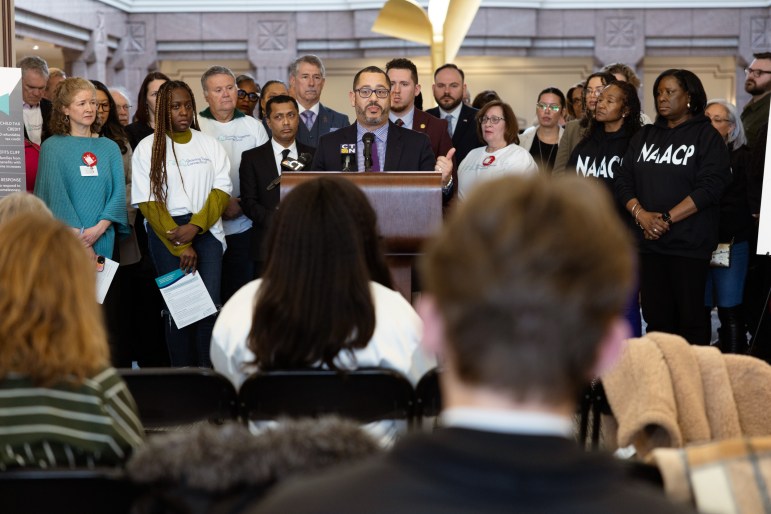
The renter’s credit proposal made big strides in its first year at the Capitol this spring. Spearheaded by The Connecticut Project, a policy group dedicated to making the state more affordable for the working class, credit proposals appeared in two bills, one introduced by House Majority Leader Jason Rojas, D-East Hartford, and one by the Finance, Revenue and Bonding Committee itself.
They would have provided renters’ credits ranging from $1,000 to $2,500 per filer. The annual cost to the state would be $200 million at the low end and $575 million at the high.
“The majority of working-class people are renters, and what we’re hearing consistently in the field, in polling, anytime we talk to folks, is that rent is, if not No. 1, the No. 2 issue that folks are facing for being able to afford living in our state,” said Meghan Holden, communications director for The Connecticut Project.
Five states, including Maine and Vermont, and the District of Columbia currently offer a broad-based income tax credit for renters, she added.
The Connecticut Project estimates about 20% of rent paid here goes toward landlords’ property tax obligations, said Tyler Mack, the project’s policy and advocacy strategist.
The state’s own research suggests that number could be greater.
Since 2014, the Department of Revenue Services has been tasked with generating tax incidence analyses, which identify assesses how tax burdens can be shifted, and who ultimately pays.
Besides landlords baking property tax obligations into rent, another example involves gasoline distributors and filling stations, which add the wholesale gasoline tax they pay into the price motorists face at the pump.
Over the past decade, these incidence analyses have described similar situations.
The lowest earning 10% of Connecticut workers effectively lost 40% of their income to state and municipal tax burdens in 2022, according to the most recent study, done in late 2025. The middle three deciles lost 16% to 20%, and the highest-earning decile lost 10.6%.
“It’s clear that there’s fairness that we need to be talking about,” said Mack, who added that most legislators understand the need for relief. “We know that renters are cost-burdened, and we know that they do pay a good portion of our property taxes.”

More than half of CT legislators introduced a child tax credit bill
But if the renters’ credit made big strides in its first year, another form of income tax relief elevated its support to rarely seen levels.
On paper, a bill creating a state income tax credit for low- and middle-income households with kids already has enough support in the General Assembly to reach Lamont’s desk, at least.
Slightly more than half of the House of Representatives, 76 out of 151, and almost two-thirds of the Senate, 23 out of 36, co-sponsored at least one bill to create a child tax credit.
And many bills draw support from legislators outside the group that formally introduces them.
The most popular version would have provided $600 per child, up to a maximum of $1,800 per household, costing the state about $350 million to $400 million per year.
The child tax credit has been in play since 2021 and has high-profile supporters like state Comptroller Sean Scanlon and Senate President Pro Tem Martin M. Looney, D-New Haven.
Connecticut tried a one-year experiment with a child-related tax rebate in 2022, but an ongoing credit never has been included in the state budget.
“I think we’ve built some incredible momentum,” said Lisa Tepper Bates, president and CEO of the United Way of Connecticut, one of the organizations spearheading this credit.
The United Way estimates about 40% of Connecticut households can’t fund a basic “survival budget” that covers food, housing, utilities, child and health care and transportation.
It also notes that of the 42 states with an income tax, Connecticut is the only one that offers no child-related tax break.

And though the credit is touted by some as a tool to help families save, many say it’s needed just to cover the bare essentials.
Marinda Monfilston of Cromwell said the high cost of living — and astronomical daycare prices — forced her and her husband to postpone having a second child for years. Monfilston, a credit union engagement coordinator, and her husband, an accountant, earn about $120,000 per year.
“We couldn’t afford having two kids in daycare at the same time,” she said.
Though it would be nice to send their daughter to summer camp or swimming lessons, Monfilston said, any tax refund boosted by a child credit likely would be consumed by childcare, grocery and other essential bills.
“I find that we are just getting by.”
Not Lamont’s preferred form of tax relief
Leaders of the Democratic-controlled General Assembly counter there is real relief in the $28.1 billion budget adopted last month for the fiscal year that starts in July.

The plan provides $280 million in new aid to cities and towns and orders a $320 million investment in a venture launched last year to dramatically expand affordable childcare.
But the childcare initiative isn’t expected to have a big impact until the end of the decade. And cities and towns say they lose far more than $280 million annually because state grants have lagged inflation for more than a decade.
Meanwhile, state government expects to leave nearly $1.3 billion unspent when the outgoing budget cycle closes June 30. Yearly surpluses have averaged more than $1.8 billion, or more than 8% of the General Fund, over the eight years prior, thanks to aggressive savings programs.
Despite expectations that Connecticut will boost spending in future years to temper big federal cuts to human service programs, analysts still project surpluses approaching or exceeding $1 billion through 2030.
So, with politicians repeatedly professing concerns about “affordability,” why was there no substantial direct state tax relief this year?
“We have a governor who fights back against economic fairness,” said Rep. Josh Elliott of Hamden, a progressive who is challenging Lamont for the Democratic gubernatorial nomination in an August primary.
Founder of the House Tax Equity Caucus, Elliott — who favors child tax and renters’ credits or other means to reduce burdens on low- and middle-income households — says the demand for relief is the voters’ mantra.
“It comes up, literally, everywhere I go, constantly,” he said.
Lamont, a fiscal moderate, has forced big surpluses to pay down Connecticut’s legacy pension debt, tens of billions amassed over 70 years prior to 2011.
The governor has directed $11 billion in surpluses toward this effort since 2020, stopping the huge expansion of pension costs that siphoned dollars away from other programs.
But Lamont’s critics say this hyper-aggressive savings approach is doing the same thing: weakening core programs, forcing towns to raise property taxes and spurring frequent tuition hikes at public colleges and universities.
The governor, they say, is forcing one generation of taxpayers to pay off pension debt created by three.
“It’s really important that we have a budget that’s built to last,” Lamont said shortly after the 2026 legislative session ended. “I wanted to make sure the promises we made are sustainable.”
Lamont also is not a huge fan of the tax cuts that have drawn big legislative support in recent years. He prefers to deliver state tax relief in broad-based fashion rather than to targeted groups, leaving the task of income redistribution to the federal government.
And the governor consistently has blocked proposals to boost state taxes on the rich to finance relief for lower-earning groups, arguing it would prompt the wealthy to flee the Connecticut.
“Gov. Lamont gets up every day and fights for working families,” Rob Blanchard, the governor’s reelection spokesman, said last week.
Lamont signed the only major state income tax rate reduction into law in 2023 while expanding credits and exemptions for the working poor and retirees.
“Over the next four years, he plans to deliver on universal pre-K, develop an affordable healthcare system and close corporate tax breaks,” Blanchard added. “While others offer rhetoric and baseless criticism from the sidelines, Gov. Lamont focuses on actually getting results.”
Are taxes getting worse for CT’s poor and middle class?
But is Connecticut seeing “results” when it comes to easing the net burdens on its poor and middle class?
Its own tax fairness studies say no.
The Lamont administration normally counters that no report has yet examined tax changes beyond 2022, meaning they miss the big income tax rate reduction in 2023, which saves many middle-class households about $300 per year.
But a 2024 analysis by Connecticut Voices for Children, a New Haven-based policy group, concluded those 2023 cuts only slow, not reverse, the state’s worsening tax inequity.
Connecticut Voices repeatedly has challenged Lamont and legislators to redistribute tax burdens far more aggressively. That means taxing the rich to ease burdens on the poor and middle class.
“There are great services for families who can pay for them or afford to live in the towns that supplement for those great services, but the data tell us that the state isn’t doing enough to provide equity and opportunity for all children,” said Emily Byrne, Connecticut Voices’ executive director.
“We hear from families that the cost of living in Connecticut is too darn high and exacerbated by rising inflation and excessive tariffs,” she said. “We want more taxpayers in Connecticut and know that a child tax credit can be an important incentive for families to root and grow here.”
Rep. Joe Polletta of Watertown, ranking House Republican on the Finance Committee, said majority Democrats could get more relief passed if they developed the entire state budget — spending and taxes — with bipartisan cooperation.
For example, if Democrats are willing to find more economies in programs and curb wasteful spending, Polletta said, Republican support for income tax breaks for renters and families likely increases significantly.
“If we’re truly serious about providing broad-based tax relief, then we’ll all get in the room and figure [it] out,” he said, adding that this year’s extra town aid and investments in affordable childcare weren’t enough. “The masses got left behind.”
Rep. Kate Farrar, D-West Hartford, a member of the Finance Committee and one of the leaders behind the child tax credit push, predicted voters will deliver a mandate this fall to candidates — for the legislature and for governor — to push tax relief to new heights.
“I hope we come back [to the Capitol] with a new sense of urgency” when the next legislative session opens in January, she said. “This needs to be at the top of the list.”
